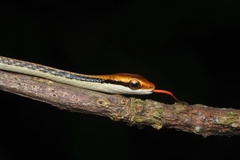
Common Bronze-back

Common Bronze-back

Dendrelaphis pictus

Silhouette: Alex Slavenko · PhyloPic

LCLeast ConcernNTVUENCR
Daily sighting probability ~40% · Likely
at Kinabatangan Wildlife Sanctuary

In 3 days ~80% in a week >90%

67 Verified sightings at Kinabatangan Wildlife Sanctuary From 2019 to 2026
146 In all 5 parks
June Best month
☀️ Diurnal When it's spotted

About the Common Bronze-back

Dendrelaphis pictus, commonly known as either the common bronzeback, painted bronzeback, or Indonesian bronzeback, is a species of colubrid snake found in Southeast Asia. Dendrelaphis pictus belongs to the genus Dendrelaphis, which contains 48 other described species.

Dendrelaphis is one of five genera belonging to the vine snake subfamily Ahaetuliinae, of which Dendrelaphis is most closely related to Chrysopelea, as shown in the cladogram below: It is found throughout Southeast Asian forests in Malaysia, Indonesia, Brunei, China, Cambodia, Laos, Vietnam, Thailand, and Singapore. Populations from India, Bangladesh, and Myanmar are now considered to belong to the separate species Dendrelaphis proarchos.

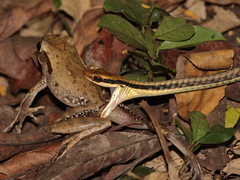
The snake's colouration is olive or brown above with a yellow lateral stripe, bordered below by a dark line between the outer scales and the ventrals. A black stripe on each side of the head passes through the eye, widens or breaks up into spots, separated by bluish-green bands on the nape. The upper lip is yellow, and the lower surface yellowish or greenish. Length of head and body approximately 74 cm (29 in) and the tail... Wikipedia →

Sounds

Recording0:34

Indonesia · 2024

© M Nur Yahya · iNaturalist · CC BY-NC 4.0

Global Distribution

Parks Where Found

# Park Country Daily sighting probability
1 Kinabatangan Wildlife Sanctuary 🇲🇾 Malaysia
~40%
2 Bako National Park 🇲🇾 Malaysia
~40%
3 Gunung Leuser National Park 🇮🇩 Indonesia
~40%
4 Kaeng Krachan National Park 🇹🇭 Thailand
~10%
5 Cat Tien National Park 🇻🇳 Vietnam
~10%

Cities Where Found

# City Country Daily sighting probability
1 Bandar Lampung 🇮🇩 Indonesia
~50%
2 Jakarta 🇮🇩 Indonesia
~40%
3 Denpasar 🇮🇩 Indonesia
~40%
4 Yogyakarta 🇮🇩 Indonesia
~40%
5 Kuching 🇲🇾 Malaysia
~30%
6 Semarang 🇮🇩 Indonesia
~30%
7 Kuala Lumpur 🇲🇾 Malaysia
~20%
8 Singapore 🇸🇬 Singapore
~20%
9 Ho Chi Minh City 🇻🇳 Vietnam
~10%
10 Bangkok 🇹🇭 Thailand
<5%

Before you go

What are the chances of seeing a Common Bronze-back in Kinabatangan Wildlife Sanctuary?

Likely

About 40% of wildlife watchers report a Common Bronze-back sighting in Kinabatangan Wildlife Sanctuary on a given day, based on 67 verified sightings from GBIF citizen-science data from 2019 to 2026. It is the 4th most-seen of the 25 reptiles we can rate there. Over three days the chance rises to about 80%, and over a week to over 90%, if each day is a fresh chance.

When is the best time to see a Common Bronze-back in Kinabatangan Wildlife Sanctuary?

January, June and November

In those months about 50% of wildlife watchers report a Common Bronze-back in Kinabatangan Wildlife Sanctuary on a given day, against under 5% in December, the lowest month.

What time of day is best to see a Common Bronze-back?

Between 2 and 5 pm

Across all the parks we cover, that three-hour window holds the most Common Bronze-back sightings with a recorded time, and about 8 in 10 of them come between 6 am and 6 pm: it is a daytime animal.

Is Kinabatangan Wildlife Sanctuary the best place to see a Common Bronze-back?

Yes

Of the 5 parks where we can rate Common Bronze-back sightings, Kinabatangan Wildlife Sanctuary has the highest daily chance: about 40%. Next come Bako National Park (Malaysia, about 40%) and Gunung Leuser National Park (Indonesia, about 40%).

Where does the Common Bronze-back sighting chance come from?

GBIF citizen-science records

It is estimated from how often the Common Bronze-back is recorded against all the reptiles logged in Kinabatangan Wildlife Sanctuary (67 verified sightings from 2019 to 2026), calibrated against known sighting rates. Figures are rounded to the nearest 10% because citizen-science data supports honest approximations, not decimals, and months with records from fewer than five people show "—". How it works.

← Back to Kinabatangan Wildlife Sanctuary