Sabah Slender Skink

Sabah Slender Skink

Sphenomorphus sabanus

Silhouette: Gopal Murali · PhyloPic

LCLeast ConcernNTVUENCR
Daily sighting probability ~10% · With luck
at Kinabatangan Wildlife Sanctuary

In 3 days ~40% in a week ~60%

9 Verified sightings at Kinabatangan Wildlife Sanctuary From 2019 to 2026
47 In all 4 parks
May Best month
🌅 Crepuscular When it's spotted

About the Sabah Slender Skink

Sphenomorphus sabanus is a species of skink in the family Scincidae. It is known commonly as the Sabah slender skink. The holotype of this species was deposited at the Field Museum (Specimen No. 63671). It is an adult male collected in Sapagaya Forest Reserve in North Borneo on July 18, 1950 by Robert F. Inger. Paratypes were also deposited at the Field Museum. They include 32 specimens all collected from scattered localities in eastern North Borneo.

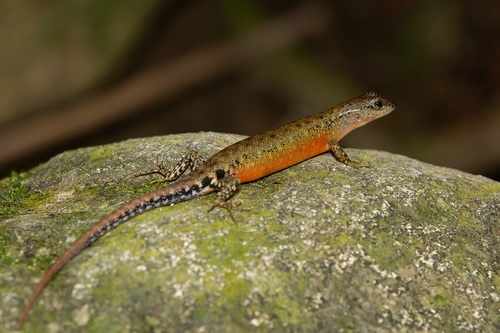
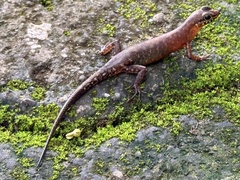
The Sabah slender skink is a slender, smooth-scaled, dark grey skink that lacks a black spot on the neck and a black lateral stripe. The ventral surface of these lizards is cream-colored. Males of the species have an orange flush on the flanks. Once preserved in alcohol, the color will range from brown to greyish brown.

The Sabah slender skink is a terrestrial lizard. The Encyclopedia of Life Wikipedia →

Global Distribution

Parks Where Found

# Park Country Daily sighting probability
1 Danum Valley Conservation Area 🇲🇾 Malaysia
~20%
2 Sepilok 🇲🇾 Malaysia
~20%
3 Kinabalu Park 🇲🇾 Malaysia
~20%
4 Kinabatangan Wildlife Sanctuary 🇲🇾 Malaysia
~10%

Before you go

What are the chances of seeing a Sabah Slender Skink in Kinabatangan Wildlife Sanctuary?

With luck

About 10% of wildlife watchers report a Sabah Slender Skink sighting in Kinabatangan Wildlife Sanctuary on a given day, based on 9 verified sightings from GBIF citizen-science data from 2019 to 2026. It is the 18th most-seen of the 25 reptiles we can rate there. Over three days the chance rises to about 40%, and over a week to about 60%, if each day is a fresh chance.

When is the best time to see a Sabah Slender Skink in Kinabatangan Wildlife Sanctuary?

May–June and October

In those months about 20% of wildlife watchers report a Sabah Slender Skink in Kinabatangan Wildlife Sanctuary on a given day, against under 5% in April, August–September and November–February, the lowest months.

What time of day is best to see a Sabah Slender Skink?

Between midnight and 3 am

Across all the parks we cover, that three-hour window holds the most Sabah Slender Skink sightings with a recorded time, and about half of them come between 6 pm and 6 am: it is most active around dawn and dusk.

Is Kinabatangan Wildlife Sanctuary the best place to see a Sabah Slender Skink?

4th of 4

Of the 4 parks where we can rate Sabah Slender Skink sightings, Kinabatangan Wildlife Sanctuary ranks 4th at about 10%. The best odds are in Danum Valley Conservation Area (Malaysia, about 20%), Sepilok (Malaysia, about 20%) and Kinabalu Park (Malaysia, about 20%).

Which relatives of the Sabah Slender Skink live in Kinabatangan Wildlife Sanctuary?

Same family: Scincidae

The closest relatives of the Sabah Slender Skink that you can see in Kinabatangan Wildlife Sanctuary (family Scincidae, Skinks) are Rough Mabuya (about 30%) and Borneo Skink (about 30%), with each one's daily chance of a sighting.

Where does the Sabah Slender Skink sighting chance come from?

GBIF citizen-science records

It is estimated from how often the Sabah Slender Skink is recorded against all the reptiles logged in Kinabatangan Wildlife Sanctuary (9 verified sightings from 2019 to 2026), calibrated against known sighting rates. Figures are rounded to the nearest 10% because citizen-science data supports honest approximations, not decimals, and months with records from fewer than five people show "—". How it works.

← Back to Kinabatangan Wildlife Sanctuary