Storm's Stork

Storm's Stork

Ciconia stormi

Silhouette: L. Shyamal · PhyloPic

LCNTVUENEndangeredCR
Daily sighting probability ~60% · Likely
at Kinabatangan Wildlife Sanctuary

In 3 days ~90% in a week >90%

1,672 Verified sightings at Kinabatangan Wildlife Sanctuary From 2019 to 2026
1,743 In all 3 parks
March Best month
🌅 Crepuscular When it's spotted

About the Storm's Stork

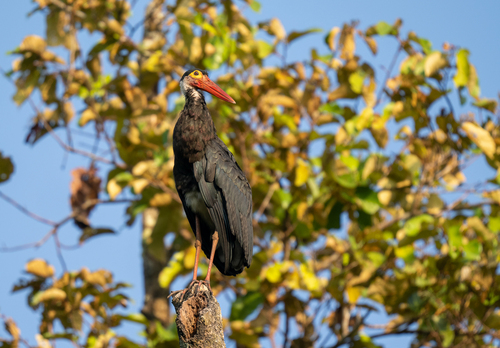
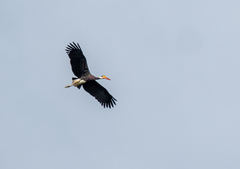
Storm's stork (Ciconia stormi) is a medium-sized stork species that occurs primarily in lowland tropical forests of Malaysia, Indonesia and southern Thailand. It is considered to be the rarest of all storks, and is estimated to number at most 1,750 wild individuals across its geographic range. The population has long been in decline and the primary cause is widely considered to be deforestation of its native habitat.

This stork was first described by Blasius in 1896, and named after the German sea captain Hugo Storm, a collector of zoological specimens in the East Indies. In Thailand, it is known as "nok kra su um", which refers to the birds' fishing procedure by stalking along the bank of a stream in dense forest.

This species is very similar and closely related to the woolly-necked stork whose range partially overlaps with that of Storm's stork. Although Storm's stork has long been considered a separate species, it has also been previously treated as a subspecies of the woolly-necked stork in the more recent past. However, Storm's stork is characterised by a yellowish-orange facial skin patch around the eye that is absent in the woolly-necked stork... Wikipedia →

Global Distribution

Parks Where Found

# Park Country Daily sighting probability
1 Kinabatangan Wildlife Sanctuary 🇲🇾 Malaysia
~60%
2 Tanjung Puting National Park 🇮🇩 Indonesia
~40%
3 Way Kambas National Park 🇮🇩 Indonesia
~10%

Zoos & Centres Where Found

# Zoo / Centre Country
1 Walsrode World Bird Park 🇩🇪 Germany In captivity
2 San Diego Zoo Safari Park 🇺🇸 United States In captivity
3 Bronx Zoo 🇺🇸 United States In captivity
4 National Zoo of Malaysia 🇲🇾 Malaysia In captivity
5 Fort Worth Zoo 🇺🇸 United States In captivity

Before you go

What are the chances of seeing a Storm's Stork in Kinabatangan Wildlife Sanctuary?

Likely

About 60% of wildlife watchers report a Storm's Stork sighting in Kinabatangan Wildlife Sanctuary on a given day, based on 1,672 verified sightings from GBIF citizen-science data from 2019 to 2026. It is the 13th most-seen of the 231 birds we can rate there. Over three days the chance rises to about 90%, and over a week to over 90%, if each day is a fresh chance.

When is the best time to see a Storm's Stork in Kinabatangan Wildlife Sanctuary?

March

In that month about 80% of wildlife watchers report a Storm's Stork in Kinabatangan Wildlife Sanctuary on a given day, against about 50% in January, May–June and November, the lowest months.

What time of day is best to see a Storm's Stork?

Between midnight and 3 am

Across all the parks we cover, that three-hour window holds the most Storm's Stork sightings with a recorded time, and about 7 in 10 of them come between 6 pm and 6 am: it is most active around dawn and dusk.

Is Kinabatangan Wildlife Sanctuary the best place to see a Storm's Stork?

Yes

Of the 3 parks where we can rate Storm's Stork sightings, Kinabatangan Wildlife Sanctuary has the highest daily chance: about 60%. Next come Tanjung Puting National Park (Indonesia, about 40%) and Way Kambas National Park (Indonesia, about 10%).

Where does the Storm's Stork sighting chance come from?

GBIF citizen-science records

It is estimated from how often the Storm's Stork is recorded against all the birds logged in Kinabatangan Wildlife Sanctuary (1,672 verified sightings from 2019 to 2026), calibrated against known sighting rates. Figures are rounded to the nearest 10% because citizen-science data supports honest approximations, not decimals, and months with records from fewer than five people show "—". How it works.

← Back to Kinabatangan Wildlife Sanctuary