Cape Centipede-Eater

Cape Centipede-Eater

Aparallactus capensis

Silhouette: SeismicShrimp · PhyloPic

LCLeast ConcernNTVUENCR
Daily sighting probability ~10% · With luck
at Kruger National Park

In 3 days ~20% in a week ~30%

16 Verified sightings at Kruger National Park From 2019 to 2026
16 In 1 park
November Best month
☀️ Diurnal When it's spotted

About the Cape Centipede-Eater

Aparallactus capensis, or the Cape centipede-eater, is a species of mildly venomous rear-fanged snake in the Atractaspididae family. It is found in South Africa, Eswatini, Zambia, Botswana, Zimbabwe, Mozambique, and the Democratic Republic of the Congo.

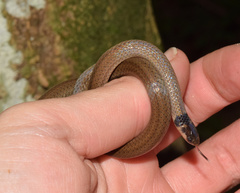
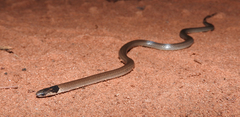
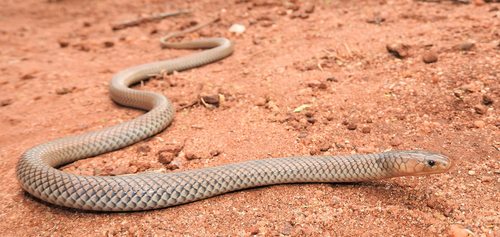
Yellow or pale reddish-brown dorsally, with or without a blackish vertebral line. Yellowish white ventrally. Neck and top of head black, with or without a yellowish crossbar behind the parietals. Sides of head yellowish, with the shields bordering the eye black.

Adults may attain a total length of 33.5 cm (13+1⁄4 in), with a tail 7 cm (2+3⁄4 in) long. A portion of rostral visible from above 1⁄3 as long as its distance from the frontal. Frontal 1+1⁄2 to 1+2⁄3 as long as broad, much longer than its distance from the end of the snout, a little shorter than the parietals. Nasal entire, in contact with the preocular. One postocular. Seven upper labials, third and fourth entering the eye, fifth in contact with the parietal. Mental in contact with the anterior chin shields, which are as long as or a little longer than the posterior. Anterior chin shields in contact with three lower labials.

Dorsal scales... Wikipedia →

Global Distribution

Parks Where Found

# Park Country Daily sighting probability
1 Kruger National Park 🇿🇦 South Africa
~10%

More parks will be added in future updates.

Cities Where Found

# City Country Daily sighting probability
1 Pretoria 🇿🇦 South Africa
~20%
2 Durban 🇿🇦 South Africa
~10%

Before you go

What are the chances of seeing a Cape Centipede-Eater in Kruger National Park?

With luck

About 10% of wildlife watchers report a Cape Centipede-Eater sighting in Kruger National Park on a given day, based on 16 verified sightings from GBIF citizen-science data from 2019 to 2026. It is the 42nd most-seen of the 62 reptiles we can rate there. Over three days the chance rises to about 20%, and over a week to about 30%, if each day is a fresh chance.

When is the best time to see a Cape Centipede-Eater in Kruger National Park?

May–June and November–February

In those months about 10% of wildlife watchers report a Cape Centipede-Eater in Kruger National Park on a given day, against under 5% in March–April and July–October, the lowest months. Those are among Kruger National Park's wettest months, with about 60 mm of rain a month against almost none in August.

What time of day is best to see a Cape Centipede-Eater?

Between 8 and 11 am

Across all the parks we cover, that three-hour window holds the most Cape Centipede-Eater sightings with a recorded time, and about 9 in 10 of them come between 6 am and 6 pm: it is a daytime animal.

Where else can you see a Cape Centipede-Eater?

Only Kruger National Park, in our data

Kruger National Park is the only park on Wallace's Line with enough records to rate Cape Centipede-Eater sightings: about 10% of wildlife watchers there report one on a given day.

Where does the Cape Centipede-Eater sighting chance come from?

GBIF citizen-science records

It is estimated from how often the Cape Centipede-Eater is recorded against all the reptiles logged in Kruger National Park (16 verified sightings from 2019 to 2026), calibrated against known sighting rates. Figures are rounded to the nearest 10% because citizen-science data supports honest approximations, not decimals, and months with records from fewer than five people show "—". How it works.

← Back to Kruger National Park