Mole Viper

Mole Viper

Atractaspis bibronii

Silhouette: Ignazio Avella · PhyloPic

LCLeast ConcernNTVUENCR
Daily sighting probability ~10% · With luck
at Kruger National Park

In 3 days ~10% in a week ~30%

13 Verified sightings at Kruger National Park From 2019 to 2026
13 In 1 park
November Best month
🌅 Crepuscular When it's spotted

About the Mole Viper

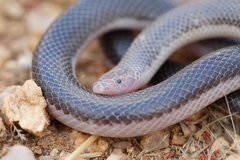
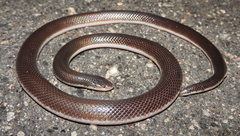
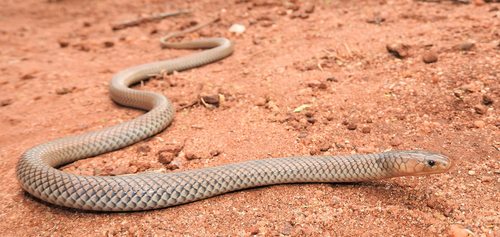
Atractaspis bibronii is a species of venomous snake in the family Atractaspididae. The species is endemic to southern Africa. There are no subspecies that are recognised as being valid. Its common names are the Southern stiletto snake, Bibron's stiletto snake, Side-stabbing snake; previously it was known as Bibron's burrowing asp, Bibron's mole viper, and the mole adder.

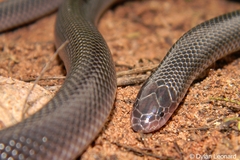
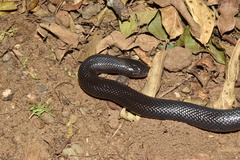
The specific epithet, bibronii, is in honour of French herpetologist Gabriel Bibron. Adults of A. bibronii average 30–40 cm (12–16 in) in total length (including tail), with a maximum total length of 55 cm (21+3⁄4 in). The dorsum is a uniform grey or dark brown to black colour. The belly is a uniform white, or pale yellow in colour, with a series of dark blotches. In specimens with a lighter belly colouration, the belly colouration may also include two or three scale rows on the flanks.

The snout is prominent and subcuneiform. The portion of the rostral visible from above is as long as or a little shorter than its distance from the frontal. The dorsals are in 21 or 23 rows at midbody. The ventrals number 221-260. The anal is entire. The subcaudals number 20-23, of which all or the greater... Wikipedia →

Global Distribution

Parks Where Found

# Park Country Daily sighting probability
1 Kruger National Park 🇿🇦 South Africa
~10%

More parks will be added in future updates.

Zoos & Centres Where Found

# Zoo / Centre Country
1 Tbilisi Zoo 🇬🇪 Georgia In captivity

Before you go

What are the chances of seeing a Mole Viper in Kruger National Park?

With luck

About 10% of wildlife watchers report a Mole Viper sighting in Kruger National Park on a given day, based on 13 verified sightings from GBIF citizen-science data from 2019 to 2026. It is the 46th most-seen of the 62 reptiles we can rate there. Over three days the chance rises to about 10%, and over a week to about 30%, if each day is a fresh chance.

When is the best time to see a Mole Viper in Kruger National Park?

April–May and November–February

In those months about 10% of wildlife watchers report a Mole Viper in Kruger National Park on a given day, against under 5% in March and June–October, the lowest months. Those are among Kruger National Park's wettest months, with about 65 mm of rain a month against almost none in August.

What time of day is best to see a Mole Viper?

Between 6 and 9 pm

Across all the parks we cover, that three-hour window holds the most Mole Viper sightings with a recorded time, and about 7 in 10 of them come between 6 pm and 6 am: it is most active around dawn and dusk.

Where else can you see a Mole Viper?

Only Kruger National Park, in our data

Kruger National Park is the only park on Wallace's Line with enough records to rate Mole Viper sightings: about 10% of wildlife watchers there report one on a given day.

Where does the Mole Viper sighting chance come from?

GBIF citizen-science records

It is estimated from how often the Mole Viper is recorded against all the reptiles logged in Kruger National Park (13 verified sightings from 2019 to 2026), calibrated against known sighting rates. Figures are rounded to the nearest 10% because citizen-science data supports honest approximations, not decimals, and months with records from fewer than five people show "—". How it works.

← Back to Kruger National Park