Common Tiger Snake

Common Tiger Snake

Telescopus semiannulatus

Silhouette: Alex Slavenko · PhyloPic

LCLeast ConcernNTVUENCR
Daily sighting probability ~10% · With luck
at Kruger National Park

In 3 days ~20% in a week ~40%

25 Verified sightings at Kruger National Park From 2019 to 2026
25 In 1 park
January Best month
🌅 Crepuscular When it's spotted

About the Common Tiger Snake

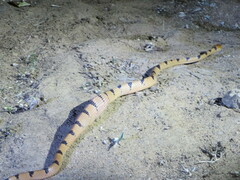
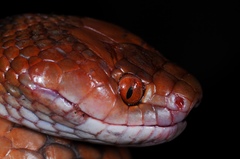
Telescopus semiannulatus, commonly known as the common tiger snake, tiger cat snake, western tiger snake, or eastern tiger snake is a species of rear-fanged colubrid snake. It is widespread in central, eastern, and southern Africa.

Range by UN subregion: Central Africa: Republic of the Congo, Democratic Republic of the Congo, Angola Eastern Africa: Kenya, Tanzania, Rwanda, Burundi, Malawi, Zambia, Zimbabwe, Mozambique Southern Africa: Namibia, Botswana, Eswatini, South Africa

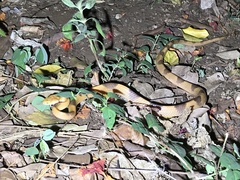
Adults average 60–90 cm (2.0–3.0 ft) in total length, with 17–21 rows of dorsal scales. The tiger snake is one of the more colorful species of snake in the family Colubridae. The upper side is pale orange to salmon pink in color with 24–48 black or dark-brown cross bars or blotches along the back and tail; the underside is pale yellow to orangish pink along the throat, paler along the rest of the body. It has a distinct head and large orange eyes with vertical pupils, and a narrow body with long tail.

There are two subspecies: Telescopus semiannulatus polystictus Mertens, 1954 Telescopus semiannulatus semiannulatus Smith, 1849 Wikipedia →

Global Distribution

Parks Where Found

# Park Country Daily sighting probability
1 Kruger National Park 🇿🇦 South Africa
~10%

More parks will be added in future updates.

Before you go

What are the chances of seeing a Common Tiger Snake in Kruger National Park?

With luck

About 10% of wildlife watchers report a Common Tiger Snake sighting in Kruger National Park on a given day, based on 25 verified sightings from GBIF citizen-science data from 2019 to 2026. It is the 34th most-seen of the 62 reptiles we can rate there. Over three days the chance rises to about 20%, and over a week to about 40%, if each day is a fresh chance.

When is the best time to see a Common Tiger Snake in Kruger National Park?

January–February, April–June and August–October

In those months about 10% of wildlife watchers report a Common Tiger Snake in Kruger National Park on a given day, against under 5% in March, July and November–December, the lowest months.

What time of day is best to see a Common Tiger Snake?

Between 6 and 9 pm

Across all the parks we cover, that three-hour window holds the most Common Tiger Snake sightings with a recorded time, and about half of them come between 6 pm and 6 am: it is most active around dawn and dusk.

Where else can you see a Common Tiger Snake?

Only Kruger National Park, in our data

Kruger National Park is the only park on Wallace's Line with enough records to rate Common Tiger Snake sightings: about 10% of wildlife watchers there report one on a given day.

Which relatives of the Common Tiger Snake live in Kruger National Park?

Same family: Colubridae

The closest relatives of the Common Tiger Snake that you can see in Kruger National Park (family Colubridae, Colubrid Snakes) are Boomslang (about 10%), Spotted Bush Snake (about 10%) and Egg-eating Snake (about 10%), with each one's daily chance of a sighting.

Where does the Common Tiger Snake sighting chance come from?

GBIF citizen-science records

It is estimated from how often the Common Tiger Snake is recorded against all the reptiles logged in Kruger National Park (25 verified sightings from 2019 to 2026), calibrated against known sighting rates. Figures are rounded to the nearest 10% because citizen-science data supports honest approximations, not decimals, and months with records from fewer than five people show "—". How it works.

← Back to Kruger National Park