
Twig Snake

Twig Snake

Thelotornis capensis

Silhouette: Alex Slavenko · PhyloPic

LCLeast ConcernNTVUENCR
Daily sighting probability <5% · Rare
at Kruger National Park

In 3 days ~10% in a week ~30%

13 Verified sightings at Kruger National Park From 2019 to 2026
56 In all 2 parks
November Best month
☀️ Diurnal When it's spotted

About the Twig Snake

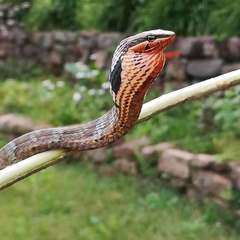
The savanna vine snake (Thelotornis capensis), also known commonly, as the southern vine snake, is a species of highly venomous snake in the subfamily Colubrinae of the family Colubridae. There are two recognized subspecies.

Thelotornis capensis is found in southern Africa. The preferred natural habitats of Thelotornis capensis are forest, savanna, and shrubland. Thelotornis capensis is diurnal and semi-arboreal. Thelotornis capensis is slender and has a long tail. The longest museum specimen is a male with a snout-to-vent length (SVL) of 106 cm (42 in), a tail 62 cm (24 in) long, and a combined total length of 168 cm (66 in).

Thelotornis capensis is venomous. Venom is delivered by large grooved teeth at the rear of the upper jaw. German herpetologist Robert Mertens died as the result of being bitten by this species. Thelotornis capensis is oviparous. Clutch size is 4–13 eggs. The eggs are elongated and rather small, each measuring on average 36 mm (1.4 in) long and 16 mm (0.63 in) wide.

Two subspecies of Thelotornis capensis are recognized as being valid, including... Wikipedia →

Global Distribution

Parks Where Found

# Park Country Daily sighting probability
1 iSimangaliso Wetland Park 🇿🇦 South Africa
~20%
2 Kruger National Park 🇿🇦 South Africa
<5%

Before you go

What are the chances of seeing a Twig Snake in Kruger National Park?

Rare

Under 5% of wildlife watchers report a Twig Snake sighting in Kruger National Park on a given day, based on 13 verified sightings from GBIF citizen-science data from 2019 to 2026. It is the 48th most-seen of the 62 reptiles we can rate there. Over three days the chance rises to about 10%, and over a week to about 30%, if each day is a fresh chance.

When is the best time to see a Twig Snake in Kruger National Park?

February, May, September and November

In those months about 10% of wildlife watchers report a Twig Snake in Kruger National Park on a given day, against under 5% in March–April, June–August, October and December–January, the lowest months.

What time of day is best to see a Twig Snake?

Between 2 and 5 pm

Across all the parks we cover, that three-hour window holds the most Twig Snake sightings with a recorded time, and about 9 in 10 of them come between 6 am and 6 pm: it is a daytime animal.

Is Kruger National Park the best place to see a Twig Snake?

2nd of 2

Of the 2 parks where we can rate Twig Snake sightings, Kruger National Park ranks 2nd at under 5%. The best odds are in iSimangaliso Wetland Park (South Africa, about 20%).

Which relatives of the Twig Snake live in Kruger National Park?

Same family: Colubridae

The closest relatives of the Twig Snake that you can see in Kruger National Park (family Colubridae, Colubrid Snakes) are Boomslang (about 10%), Spotted Bush Snake (about 10%) and Egg-eating Snake (about 10%), with each one's daily chance of a sighting.

Where does the Twig Snake sighting chance come from?

GBIF citizen-science records

It is estimated from how often the Twig Snake is recorded against all the reptiles logged in Kruger National Park (13 verified sightings from 2019 to 2026), calibrated against known sighting rates. Figures are rounded to the nearest 10% because citizen-science data supports honest approximations, not decimals, and months with records from fewer than five people show "—". How it works.

← Back to Kruger National Park