
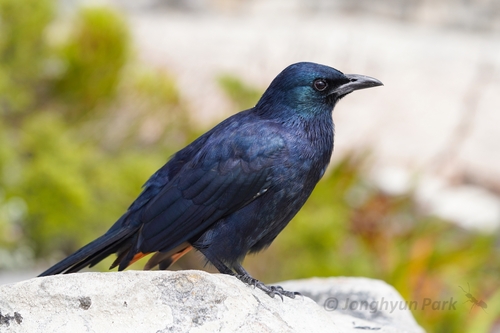
Hildebrandt's Starling

Hildebrandt's Starling

Lamprotornis hildebrandti

Silhouette: Rafael Maia · PhyloPic

LCLeast ConcernNTVUENCR
Daily sighting probability ~10% · With luck
at Lake Manyara National Park

In 3 days ~40% in a week ~60%

61 Verified sightings at Lake Manyara National Park From 2019 to 2026
4,694 In all 13 parks
December Best month
☀️ Diurnal When it's spotted

About the Hildebrandt's Starling

Hildebrandt's starling (Lamprotornis hildebrandti) is a species of starling in the family Sturnidae. It forms a superspecies with and has previously been included in the same species as Shelley's starling, a migratory species ranging from Ethiopia and Somalia to Kenya. Both of these species have also been combined into a superspecies with the chestnut-bellied starling of West Africa. It was originally placed in the now defunct genus Notauges. The species is named after Johann Maria Hildebrandt, a German collector who was the first European to obtain specimens.

Hildebrandt's starling is found in Kenya and Tanzania, where it occupies open country between 500 and 2,200 m (1,600 and 7,200 ft). Its habitat is open woodland and open thornbrush country. The species is often recorded as being uncommon, but it varies from being fairly common to fairly uncommon. It is not considered threatened by the IUCN, and is listed as least concern. Its habitat is not threatened and it occurs in a number of protected areas.

Hildebrandt's starling is 18 cm (7.1 in) in length and weighs 50 to 69 g (1.8–2.4 oz). The adult has bright iridescent plumage on its... Wikipedia →

Sounds

Song0:39

Kenya

© isaac kilusu · XC694802 · CC BY-NC-SA 4.0

Call0:28

Tanzania · 2019

© Peter Boesman · XC510194 · CC BY-NC-ND 4.0

Call0:10

Tanzania · 2017

© Frank Lambert · XC429544 · CC BY-NC-ND 4.0

Global Distribution

Parks Where Found

# Park Country Daily sighting probability
1 Serengeti National Park 🇹🇿 Tanzania
~50%
2 Mkomazi National Park 🇹🇿 Tanzania
~30%
3 Ngorongoro Conservation Area 🇹🇿 Tanzania
~30%
4 Tsavo West National Park 🇰🇪 Kenya
~30%
5 Tarangire National Park 🇹🇿 Tanzania
~20%
6 Masai Mara National Reserve 🇰🇪 Kenya
~20%
7 Nairobi National Park 🇰🇪 Kenya
~20%
8 Amboseli National Park 🇰🇪 Kenya
~10%
9 Lake Manyara National Park 🇹🇿 Tanzania
~10%
10 Tsavo East National Park 🇰🇪 Kenya
~10%
11 Samburu National Reserve 🇰🇪 Kenya
<5%
12 Arusha National Park 🇹🇿 Tanzania
<5%
13 Lake Nakuru National Park 🇰🇪 Kenya
<5%

Zoos & Centres Where Found

# Zoo / Centre Country
1 Birds of Eden 🇿🇦 South Africa In captivity

Before you go

What are the chances of seeing a Hildebrandt's Starling in Lake Manyara National Park?

With luck

About 10% of wildlife watchers report a Hildebrandt's Starling sighting in Lake Manyara National Park on a given day, based on 61 verified sightings from GBIF citizen-science data from 2019 to 2026. It is the 90th most-seen of the 307 birds we can rate there. Over three days the chance rises to about 40%, and over a week to about 60%, if each day is a fresh chance.

When is the best time to see a Hildebrandt's Starling in Lake Manyara National Park?

April and December

In those months about 30% of wildlife watchers report a Hildebrandt's Starling in Lake Manyara National Park on a given day, against under 5% in September, the lowest month. Those are among Lake Manyara National Park's wettest months, with about 180 mm of rain a month against 15 mm in September.

What time of day is best to see a Hildebrandt's Starling?

Between 8 and 11 am

Across all the parks we cover, that three-hour window holds the most Hildebrandt's Starling sightings with a recorded time, and about 8 in 10 of them come between 6 am and 6 pm: it is a daytime animal.

Where does the Hildebrandt's Starling sighting chance come from?

GBIF citizen-science records

It is estimated from how often the Hildebrandt's Starling is recorded against all the birds logged in Lake Manyara National Park (61 verified sightings from 2019 to 2026), calibrated against known sighting rates. Figures are rounded to the nearest 10% because citizen-science data supports honest approximations, not decimals, and months with records from fewer than five people show "—". How it works.

← Back to Lake Manyara National Park