Greater Kestrel

Greater Kestrel

Falco rupicoloides

Silhouette: Shyamal · PhyloPic

LCLeast ConcernNTVUENCR
Daily sighting probability <5% · Rare
at Lake Nakuru National Park

In 3 days <5%

6 Verified sightings at Lake Nakuru National Park From 2019 to 2026
1,558 In all 11 parks
January Best month
☀️ Diurnal When it's spotted

About the Greater Kestrel

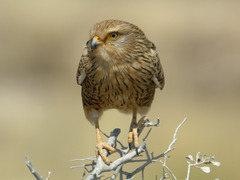
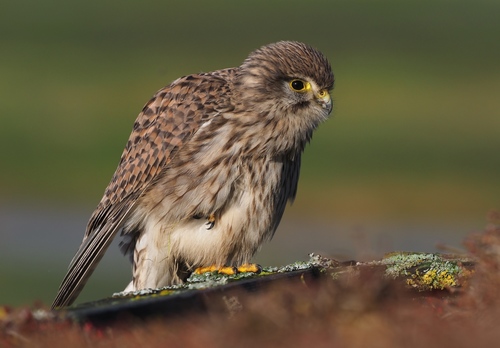
The greater kestrel (Falco rupicoloides) or white-eyed kestrel is a bird of prey belonging to the falcon family Falconidae. It is one of the largest kestrels and is found in open country in southern and eastern Africa. The plumage of the adult is mainly pale rufous, both above and below. The back, upperwing and flanks are barred with black. The breast has dark streaks and the head is streaked but has no malar stripe unlike the common and lesser kestrels. The rump and tail are grey with black bars; the tail has a white tip. In flight, the whitish underwing contrasts with the darker body. The iris of the eye is whitish, distinguishing the bird from any similar species. The bill is mainly blue-grey and the feet and cere are yellow. Juvenile birds have rufous instead of grey on the tail, streaked flanks and a dark eye.

The bird is 29–37 cm (11–15 in) long with a wingspan of 68–84 cm (27–33 in) The southern subspecies F. r. rupicoloides weighs about 181–334gr (.400–.736 lb). The form F. r. arthuri is smaller, weighing about 165–252gr (.364–.556 lb). The northern subspecies F. r. fieldi is also small and is paler than the others.

The species is usually silent but has a... Wikipedia →

Sounds

Call0:22

Tanzania · 2019

© Peter Boesman · XC510170 · CC BY-NC-ND 4.0

Global Distribution

Parks Where Found

# Park Country Daily sighting probability
1 Etosha National Park 🇳🇦 Namibia
~30%
2 Namib-Naukluft National Park 🇳🇦 Namibia
~20%
3 Serengeti National Park 🇹🇿 Tanzania
~10%
4 Kgalagadi Transfrontier Park 🇿🇦 South Africa
~10%
5 Amboseli National Park 🇰🇪 Kenya
<5%
6 Ngorongoro Conservation Area 🇹🇿 Tanzania
<5%
7 Kidepo Valley National Park 🇺🇬 Uganda
<5%
8 Chobe National Park 🇧🇼 Botswana
<5%
9 Lake Nakuru National Park 🇰🇪 Kenya
<5%
10 Tarangire National Park 🇹🇿 Tanzania
<5%
11 Kruger National Park 🇿🇦 South Africa
<5%

Zoos & Centres Where Found

# Zoo / Centre Country
1 World of Birds Wildlife Sanctuary and Monkey Park 🇿🇦 South Africa In captivity

Before you go

What are the chances of seeing a Greater Kestrel in Lake Nakuru National Park?

Rare

Under 5% of wildlife watchers report a Greater Kestrel sighting in Lake Nakuru National Park on a given day, based on 6 verified sightings from GBIF citizen-science data from 2019 to 2026. It is the 339th most-seen of the 369 birds we can rate there. Over three days the chance rises to under 5%, if each day is a fresh chance.

When is the best time to see a Greater Kestrel in Lake Nakuru National Park?

January

In that month about 10% of wildlife watchers report a Greater Kestrel in Lake Nakuru National Park on a given day, against under 5% in February to December, the lowest months.

What time of day is best to see a Greater Kestrel?

Between 10 am and 1 pm

Across all the parks we cover, that three-hour window holds the most Greater Kestrel sightings with a recorded time, and about 9 in 10 of them come between 6 am and 6 pm: it is a daytime animal.

Where does the Greater Kestrel sighting chance come from?

GBIF citizen-science records

It is estimated from how often the Greater Kestrel is recorded against all the birds logged in Lake Nakuru National Park (6 verified sightings from 2019 to 2026), calibrated against known sighting rates. Figures are rounded to the nearest 10% because citizen-science data supports honest approximations, not decimals, and months with records from fewer than five people show "—". How it works.

← Back to Lake Nakuru National Park