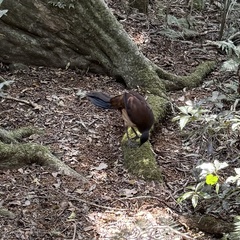
Albert's Lyrebird

Albert's Lyrebird

Menura alberti

Silhouette: PhyloPic

LCLeast ConcernNTVUENCR Endemic
Daily sighting probability ~40% · Likely
at Lamington National Park

In 3 days ~80% in a week >90%

1,627 Verified sightings at Lamington National Park From 2019 to 2026
2,199 In all 2 parks
July Best month
☀️ Diurnal When it's spotted

About the Albert's Lyrebird

Albert's lyrebird (Menura alberti), sometimes known as the northern lyrebird, is a timid, pheasant-sized songbird which is endemic to subtropical rainforests of Australia, in a small area on the state border between New South Wales and Queensland. The rarer of the two species of lyrebirds, Albert's lyrebird is named after Prince Albert, the prince consort of Queen Victoria, queen of the United Kingdom. It lacks the elegant lyre-shaped tail feathers of the superb lyrebird and is found in a much more restricted range.

The total population of Albert's lyrebirds was estimated at only 3,500 breeding birds in 2000, with one of the smallest distributional ranges of any bird on the continent. Due to its remote habitat, Menura alberti had not been discovered when famous English ornithologist John Gould first published his Birds of Australia in 1848, although he named it (after Prince Albert) and added it in a supplement in 1850. Under taxonomic convention, he would normally have been assigned the credit for describing the species and assigning its scientific name. However, the credit as scientific describer instead went to French naturalist Charles Lucien Bonaparte, nephew of Napoleon... Wikipedia →

Sounds

Song1:04

Australia · 2020

© Mike FitzGerald · XC585919 · CC BY-NC-SA 4.0

Call0:26

Australia · 2019

© Geoffrey Monchaux · XC510779 · CC BY-NC-SA 4.0

Alarm call0:31

Australia · 2017

© Greg McLachlan · XC351475 · CC BY-NC-ND 4.0

Global Distribution

Parks Where Found

# Park Country Daily sighting probability
1 Lamington National Park 🇦🇺 Australia
~40%
2 Springbrook National Park 🇦🇺 Australia
~10%

Before you go

What are the chances of seeing an Albert's Lyrebird in Lamington National Park?

Likely

About 40% of wildlife watchers report an Albert's Lyrebird sighting in Lamington National Park on a given day, based on 1,627 verified sightings from GBIF citizen-science data from 2019 to 2026. It is the 28th most-seen of the 171 birds we can rate there. Over three days the chance rises to about 80%, and over a week to over 90%, if each day is a fresh chance.

When is the best time to see an Albert's Lyrebird in Lamington National Park?

June and July

In those months about 50% of wildlife watchers report an Albert's Lyrebird in Lamington National Park on a given day, against about 30% in January and April, the lowest months. Those are among Lamington National Park's driest months, with about 45 mm of rain a month against 160 mm in February.

What time of day is best to see an Albert's Lyrebird?

Between 5 and 8 am

Across all the parks we cover, that three-hour window holds the most Albert's Lyrebird sightings with a recorded time, and about 7 in 10 of them come between 6 am and 6 pm: it is a daytime animal.

Is Lamington National Park the best place to see an Albert's Lyrebird?

Yes

Of the 2 parks where we can rate Albert's Lyrebird sightings, Lamington National Park has the highest daily chance: about 40%. Next come Springbrook National Park (Australia, about 10%).

Which relatives of the Albert's Lyrebird live in Lamington National Park?

Same order: Passeriformes

The closest relatives of the Albert's Lyrebird that you can see in Lamington National Park (order Passeriformes, Perching Birds) are Lewin's Honeyeater (about 90%), Eastern Whipbird (about 90%) and Eastern Yellow Robin (about 80%), with each one's daily chance of a sighting.

Where does the Albert's Lyrebird sighting chance come from?

GBIF citizen-science records

It is estimated from how often the Albert's Lyrebird is recorded against all the birds logged in Lamington National Park (1,627 verified sightings from 2019 to 2026), calibrated against known sighting rates. Figures are rounded to the nearest 10% because citizen-science data supports honest approximations, not decimals, and months with records from fewer than five people show "—". How it works.

← Back to Lamington National Park