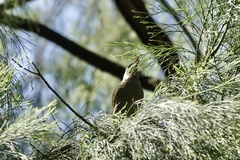

Lewin's Honeyeater

Lewin's Honeyeater

Meliphaga lewinii

Silhouette: Rachael Joakim · PhyloPic

LCLeast ConcernNTVUENCR Endemic
Daily sighting probability ~90% · Very likely
at Lamington National Park

In 3 days >90%

4,618 Verified sightings at Lamington National Park From 2019 to 2026
8,863 In all 7 parks
February Best month
☀️ Diurnal When it's spotted

About the Lewin's Honeyeater

Lewin's honeyeater (Meliphaga lewinii) is a bird that inhabits the ranges along the east coast of Australia. It has a semicircular ear-patch, pale yellow in colour. Another name is Yellow-eared Honeyeater. The Lewin's honeyeater is small to medium in size, around 19–22 cm (7.5–8.7 in) long with a weight of 27–49 g. The average wingspan is 8.4–10.6 cm (3.3 to 4.2 in), and the bill is 2.0–2.7 cm in length. It is dark greenish-grey in colour, with a creamy yellow gape (i.e., the fleshy corners of the mouth). It has large, yellowish, crescent-shaped ear-patches, which distinguish it from other honeyeaters, apart from two similar, but smaller, species in tropical Queensland. In flight, the pale yellow edges of the flight feathers can be seen. The bill is black and the eye is blue-grey. Both sexes are similar in appearance. Young Lewin's honeyeaters are similar to the adults, but have brown eyes. The strong 'machine gun-like' rattling notes of Lewin's honeyeater are heard over long distances, and reveal its presence in an area.

Body size, voice, and the shape and size of the ear-patch help in identifying the similar Graceful and Yellow-spotted Honeyeaters in tropical Queensland... Wikipedia →

Sounds

Song0:19

Australia · 2024

© Romuald Mikusek · XC1172495 · CC BY-NC-SA 4.0

Call0:15

Australia · 2024

© Tom Cooney · XC1103112 · CC BY-NC-SA 4.0

Alarm call0:45

Australia · 2023

© Sreekar · XC836021 · CC BY-NC-SA 4.0

Global Distribution

Parks Where Found

# Park Country Daily sighting probability
1 Lamington National Park 🇦🇺 Australia
~90%
2 Springbrook National Park 🇦🇺 Australia
~80%
3 Royal National Park 🇦🇺 Australia
~60%
4 Noosa National Park 🇦🇺 Australia
~50%
5 Booderee National Park 🇦🇺 Australia
~40%
6 Blue Mountains National Park 🇦🇺 Australia
~30%
7 Daintree National Park 🇦🇺 Australia
<5%

Cities Where Found

# City Country Daily sighting probability
1 Brisbane 🇦🇺 Australia
~40%
2 Sydney 🇦🇺 Australia
~10%
3 Melbourne 🇦🇺 Australia
<5%

Before you go

What are the chances of seeing a Lewin's Honeyeater in Lamington National Park?

Very likely

About 90% of wildlife watchers report a Lewin's Honeyeater sighting in Lamington National Park on a given day, based on 4,618 verified sightings from GBIF citizen-science data from 2019 to 2026. It is the most-seen of the 171 birds we can rate there. Over three days the chance rises to over 90%, if each day is a fresh chance.

When is the best time to see a Lewin's Honeyeater in Lamington National Park?

February–March, May–June and August–December

In those months about 90% of wildlife watchers report a Lewin's Honeyeater in Lamington National Park on a given day, against about 80% in January, April and July, the lowest months.

What time of day is best to see a Lewin's Honeyeater?

Between 7 and 10 am

Across all the parks we cover, that three-hour window holds the most Lewin's Honeyeater sightings with a recorded time, and nearly all of them come between 6 am and 6 pm: it is a daytime animal.

Is Lamington National Park the best place to see a Lewin's Honeyeater?

Yes

Of the 7 parks where we can rate Lewin's Honeyeater sightings, Lamington National Park has the highest daily chance: about 90%. Next come Springbrook National Park (Australia, about 80%) and Royal National Park (Australia, about 60%). All parks ranked.

Which relatives of the Lewin's Honeyeater live in Lamington National Park?

Same family: Meliphagidae

The closest relatives of the Lewin's Honeyeater that you can see in Lamington National Park (family Meliphagidae, Honeyeaters) are Eastern Spinebill (about 40%), Yellow-faced Honeyeater (about 20%) and Noisy Miner (about 10%), with each one's daily chance of a sighting.

Where does the Lewin's Honeyeater sighting chance come from?

GBIF citizen-science records

It is estimated from how often the Lewin's Honeyeater is recorded against all the birds logged in Lamington National Park (4,618 verified sightings from 2019 to 2026), calibrated against known sighting rates. Figures are rounded to the nearest 10% because citizen-science data supports honest approximations, not decimals, and months with records from fewer than five people show "—". How it works.

← Back to Lamington National Park