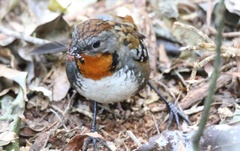
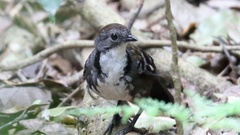

Australian Logrunner

Australian Logrunner

Orthonyx temminckii

Silhouette: Sheatherius · PhyloPic

LCLeast ConcernNTVUENCR Endemic
Daily sighting probability ~70% · Very likely
at Lamington National Park

In 3 days >90%

3,296 Verified sightings at Lamington National Park From 2019 to 2026
3,475 In all 3 parks
July Best month
☀️ Diurnal When it's spotted

About the Australian Logrunner

The Australian logrunner (Orthonyx temminckii) is a species of bird that is endemic to eastern Australia where it uses unique foraging techniques and adaptations to search for its food on the floors of temperate, subtropical, or tropical moist lowland forests in south-eastern Australia. Until 2002, it was widely considered to be conspecific with the New Guinea logrunner, but studies showed the two differ significantly, both genetically and vocally.

It is known by a number of common names including spine-tailed logrunner, spine-tail, logrunner, scrub quail and chowcilla. The Australian logrunner is a Passeriform in the family Orthonychidae. It is one of only three species within the Orthonyx genus; the other two are the chowcilla (Orthonyx spaldingii) from northern Queensland and the New Guinean logrunner (Orthonyx novaeguineae) from Papua New Guinea.

Logrunners as a group are characterised by their distinctive tail feathers where the rachis (or central shafts) of the tail feathers protrude and are stiffened. The broad tail of the bird is less than four inches (10 cm) in length and the strong protruding rachis at the ends of the tail feathers are almost... Wikipedia →

Sounds

Song1:00

Australia · 2025

© Marc Anderson · XC1088961 · CC BY-NC-ND 4.0

Call0:16

Australia · 2025

© Peter Boesman · XC1066795 · CC BY-NC-ND 4.0

Alarm call0:35

Australia · 2025

© Colin Reid · XC1058310 · CC BY-NC-SA 4.0

Global Distribution

Parks Where Found

# Park Country Daily sighting probability
1 Lamington National Park 🇦🇺 Australia
~70%
2 Springbrook National Park 🇦🇺 Australia
~30%
3 Royal National Park 🇦🇺 Australia
<5%

Before you go

What are the chances of seeing an Australian Logrunner in Lamington National Park?

Very likely

About 70% of wildlife watchers report an Australian Logrunner sighting in Lamington National Park on a given day, based on 3,296 verified sightings from GBIF citizen-science data from 2019 to 2026. It is the 11th most-seen of the 171 birds we can rate there. Over three days the chance rises to over 90%, if each day is a fresh chance.

When is the best time to see an Australian Logrunner in Lamington National Park?

June–August and October

In those months about 80% of wildlife watchers report an Australian Logrunner in Lamington National Park on a given day, against about 60% in March, the lowest month.

What time of day is best to see an Australian Logrunner?

Between 10 am and 1 pm

Across all the parks we cover, that three-hour window holds the most Australian Logrunner sightings with a recorded time, and about 9 in 10 of them come between 6 am and 6 pm: it is a daytime animal.

Is Lamington National Park the best place to see an Australian Logrunner?

Yes

Of the 3 parks where we can rate Australian Logrunner sightings, Lamington National Park has the highest daily chance: about 70%. Next come Springbrook National Park (Australia, about 30%) and Royal National Park (Australia, under 5%).

Which relatives of the Australian Logrunner live in Lamington National Park?

Same order: Passeriformes

The closest relatives of the Australian Logrunner that you can see in Lamington National Park (order Passeriformes, Perching Birds) are Lewin's Honeyeater (about 90%), Eastern Whipbird (about 90%) and Eastern Yellow Robin (about 80%), with each one's daily chance of a sighting.

Where does the Australian Logrunner sighting chance come from?

GBIF citizen-science records

It is estimated from how often the Australian Logrunner is recorded against all the birds logged in Lamington National Park (3,296 verified sightings from 2019 to 2026), calibrated against known sighting rates. Figures are rounded to the nearest 10% because citizen-science data supports honest approximations, not decimals, and months with records from fewer than five people show "—". How it works.

← Back to Lamington National Park