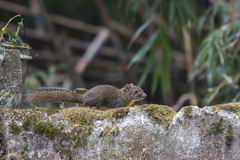
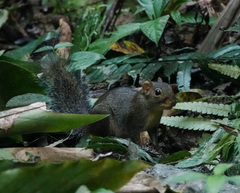

Orange-bellied Himalayan Squirrel

Orange-bellied Himalayan Squirrel

Dremomys lokriah

Silhouette: Joseph Smit · PhyloPic

LCLeast ConcernNTVUENCR
Daily sighting probability ~20% · Possible
at Langtang National Park

In 3 days ~60% in a week ~90%

9 Verified sightings at Langtang National Park From 2019 to 2026
9 In 1 park
December Best month
🌅 Crepuscular When it's spotted

About the Orange-bellied Himalayan Squirrel

The orange-bellied Himalayan squirrel (Dremomys lokriah) is a species of rodent in the family Sciuridae. It is found in Bangladesh, China, India, Myanmar, Nepal and Bhutan. The species was first described as Sciurus lokriah by Hodgson in the year 1836. He collected the specimens from the South Tibet region of Mount Everest. In 1916, Thomas and Wroughton described a species from the Manipur, India and Chin Hills as D. macmillani. Later that year, Wroughton also described a subspecies of D. lokriah as D. l. bhotia from the specimens collected from sedochen of Sikkim Himalaya, and Manipur.

Although subspecies of D. lokriah has gone though several revisions, presently, there are total eight known valid subspecies of the Orange-bellied Himalayan Squirrel exists throughout... Wikipedia →

Sounds

Call0:17

China · 2024

© Dave GUO · XC964738 · CC BY-NC-SA 4.0

Alarm call0:25

India · 2017

© Jelle Scharringa · XC1025100 · CC BY-NC-SA 4.0

Global Distribution

Parks Where Found

# Park Country Daily sighting probability
1 Langtang National Park 🇳🇵 Nepal
~20%

More parks will be added in future updates.

Before you go

What are the chances of seeing an Orange-bellied Himalayan Squirrel in Langtang National Park?

Possible

About 20% of wildlife watchers report an Orange-bellied Himalayan Squirrel sighting in Langtang National Park on a given day, based on 9 verified sightings from GBIF citizen-science data from 2019 to 2026. It is the 7th most-seen of the 8 mammals we can rate there. Over three days the chance rises to about 60%, and over a week to about 90%, if each day is a fresh chance.

When is the best time to see an Orange-bellied Himalayan Squirrel in Langtang National Park?

May and December

In those months about 40% of wildlife watchers report an Orange-bellied Himalayan Squirrel in Langtang National Park on a given day, against under 5% in March, the lowest month. Those are among Langtang National Park's driest months, with about 70 mm of rain a month against 390 mm in July. July to September have too few records to rate.

What time of day is best to see an Orange-bellied Himalayan Squirrel?

Between 2 and 5 am

Across all the parks we cover, that three-hour window holds the most Orange-bellied Himalayan Squirrel sightings with a recorded time, and about half of them come between 6 am and 6 pm: it is most active around dawn and dusk.

Where else can you see an Orange-bellied Himalayan Squirrel?

Only Langtang National Park, in our data

Langtang National Park is the only park on Wallace's Line with enough records to rate Orange-bellied Himalayan Squirrel sightings: about 20% of wildlife watchers there report one on a given day.

Where does the Orange-bellied Himalayan Squirrel sighting chance come from?

GBIF citizen-science records

It is estimated from how often the Orange-bellied Himalayan Squirrel is recorded against all the mammals logged in Langtang National Park (9 verified sightings from 2019 to 2026), calibrated against known sighting rates. Figures are rounded to the nearest 10% because citizen-science data supports honest approximations, not decimals, and months with records from fewer than five people show "—". How it works.

← Back to Langtang National Park