About the Himalayan Tahr
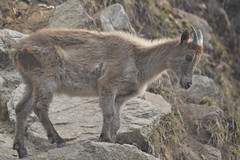
The Himalayan tahr (Hemitragus jemlahicus) is a large even-toed ungulate native to the Himalayas in southern Tibet, northern India, western Bhutan and Nepal. It is listed as Near Threatened on the IUCN Red List, as the population is declining due to hunting and habitat loss.
The Himalayan tahr has been introduced to Argentina, New Zealand, South Africa and the United States. Tahr belong to the subfamily Caprinae in the order Artiodactyla. Their closest relatives in the subfamily Caprinae are sheep and goats.
A subspecies, the Eastern Himalayan tahr or shapi, was described in 1944. This classification is not considered valid anymore, and no subspecies are currently recognized. A recent phylogenetic analysis indicates that the genus Hemitragus is monospecific, and that the Himalayan tahr is a wild goat.
The word "tahr," first used in English writings in 1835, is derived from the animal's local name in the Western Himalayas, which has otherwise been rendered as "tehr," "tare" and "tahir". Through confusion with thār, a Nepali word for the Himalayan serow, it has also been spelled "thar."
The genus name Hemitragus is derived from the Greek words... Wikipedia →