White-cheeked Bulbul

White-cheeked Bulbul

Pycnonotus leucogenys

Silhouette: Andy Wilson · PhyloPic

LCLeast ConcernNTVUENCR
Daily sighting probability ~30% · Possible
at Langtang National Park

In 3 days ~60% in a week ~90%

150 Verified sightings at Langtang National Park From 2019 to 2026
2,150 In all 5 parks
November Best month
☀️ Diurnal When it's spotted

About the White-cheeked Bulbul

The Himalayan bulbul (Pycnonotus leucogenys), or white-cheeked bulbul, is a species of songbird in the bulbul family found in Central and South Asia. The Himalayan bulbul is considered to belong to a superspecies along with the white-eared bulbul, white-spectacled bulbul, African red-eyed bulbul, Cape bulbul, and common bulbul. The alternate name, white-cheeked bulbul, is also used by the white-eared bulbul.

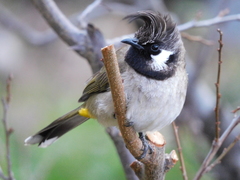
The Himalayan bulbul is about 18 cm in length, with a wingspan of 25.5–28 cm and an average weight of 30 g. Its head, throat, and crest are black and white. The back, side, and lengthy tail are brown, the underside is pale yellow. Sexes have similar plumage. The song is a beautiful 4-part whistle, which resembles an accelerated oriole whistle.

The species occurs in the northern regions of the Indian subcontinent and some adjoining areas. It is found predominantly in Kashmir and near the Himalayas. The Himalayan bulbul frequents forests and shrubland and also comes into gardens and parks.

The Himalayan bulbul feeds on insects and other small invertebrates, as well as berries... Wikipedia →

Sounds

Call1:09

India · 2025

© Peter Boesman · XC1030850 · CC BY-NC-ND 4.0

Song0:58

Nepal · 2023

© Greg Irving · XC843983 · CC BY-NC-SA 4.0

Song0:32

Nepal · 2023

© Bram Piot · XC835420 · CC BY-NC-SA 4.0

Global Distribution

Parks Where Found

# Park Country Daily sighting probability
1 Jim Corbett National Park 🇮🇳 India
~60%
2 Langtang National Park 🇳🇵 Nepal
~30%
3 Royal Bardia National Park 🇳🇵 Nepal
<5%
4 Chitwan National Park 🇳🇵 Nepal
<5%
5 Royal Manas National Park 🇧🇹 Bhutan
<5%

Cities Where Found

# City Country Daily sighting probability
1 Dehradun 🇮🇳 India
~70%
2 Srinagar 🇮🇳 India
~60%
3 Jammu 🇮🇳 India
~50%
4 Islamabad 🇵🇰 Pakistan
~40%
5 Kathmandu 🇳🇵 Nepal
~10%
6 Chandigarh 🇮🇳 India
~10%

Before you go

What are the chances of seeing a White-cheeked Bulbul in Langtang National Park?

Possible

About 30% of wildlife watchers report a White-cheeked Bulbul sighting in Langtang National Park on a given day, based on 150 verified sightings from GBIF citizen-science data from 2019 to 2026. It is the 28th most-seen of the 225 birds we can rate there. Over three days the chance rises to about 60%, and over a week to about 90%, if each day is a fresh chance.

When is the best time to see a White-cheeked Bulbul in Langtang National Park?

November to January

In those months about 40% of wildlife watchers report a White-cheeked Bulbul in Langtang National Park on a given day, against about 20% in February, April–May and September–October, the lowest months. Those are among Langtang National Park's driest months, with about 30 mm of rain a month against 390 mm in July.

What time of day is best to see a White-cheeked Bulbul?

Between 6 and 9 am

Across all the parks we cover, that three-hour window holds the most White-cheeked Bulbul sightings with a recorded time, and about 9 in 10 of them come between 6 am and 6 pm: it is a daytime animal.

Is Langtang National Park the best place to see a White-cheeked Bulbul?

2nd of 5

Of the 5 parks where we can rate White-cheeked Bulbul sightings, Langtang National Park ranks 2nd at about 30%. The best odds are in Jim Corbett National Park (India, about 60%).

Where does the White-cheeked Bulbul sighting chance come from?

GBIF citizen-science records

It is estimated from how often the White-cheeked Bulbul is recorded against all the birds logged in Langtang National Park (150 verified sightings from 2019 to 2026), calibrated against known sighting rates. Figures are rounded to the nearest 10% because citizen-science data supports honest approximations, not decimals, and months with records from fewer than five people show "—". How it works.

← Back to Langtang National Park