


Completed

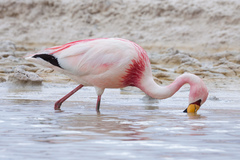

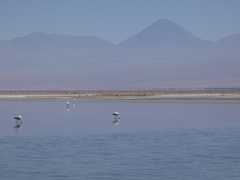

James's Flamingo
Phoenicoparrus jamesi
Silhouette: Lee Harding (photo), John E. McCormack, Michael G. Harvey, Brant C. Faircloth, Nicholas G. Crawford, Travis C. Glenn, Robb T. Brumfield & T. Michael Keesey · PhyloPic
- KingdomAnimalia (Animals)
- PhylumChordata (Chordates)
- ClassAves (Birds)
- OrderPhoenicopteriformes (Flamingos)
- FamilyPhoenicopteridae (Flamingos)
- GenusPhoenicoparrus (Andean flamingos)
- SpeciesPhoenicoparrus jamesi (James's Flamingo)
In 3 days ~60% in a week ~90%
225 Verified sightings at Lauca National Park From 2019 to 2026
225 In 1 park
July Best month
☀️ Diurnal When it's spotted
About the James's Flamingo
James's flamingo (Phoenicoparrus jamesi), also known as the puna flamingo, is a species of flamingo that lives at high altitudes in the Andean plateaus of Peru, Chile, Bolivia, and northwest Argentina. It is named for Harry Berkeley James, a British naturalist who studied the bird. James's flamingo is closely related to the Andean flamingo, and the two species are the only members of the genus Phoenicoparrus. The Chilean flamingo, Andean flamingo, and James's flamingo are all sympatric, and all live in colonies (including shared nesting areas). James's flamingo had been thought to be extinct until a population was discovered in a remote area in 1956.
The James's flamingo is smaller than the Andean flamingo, and is about the same size as the Old World species, the lesser flamingo. A specimen of the bird was first collected by Charles Rahmer, who was on a collecting expedition sponsored by Harry Berkeley James, (1846–1892, a manager of a Chilean saltpetre mine born in Walsall, England) after whom the bird was named. It typically measures about 90–92 cm (2.95–3.02 ft) long and weighs about 2 kg (4.4 lb). James's flamingos have a very long neck made up of 19 long cervical... Wikipedia →
Recent sightings of James's Flamingo in Lauca National Park
LIVEiNaturalistGlobal Distribution
Parks Where Found
| # | Park | Country | Daily sighting probability |
|---|---|---|---|
| 1 | Lauca National Park | 🇨🇱 Chile |
More parks will be added in future updates.
Zoos & Centres Where Found
| # | Zoo / Centre | Country | |
|---|---|---|---|
| 1 | Bioparque Municipal Vesty Pakos | 🇧🇴 Bolivia |
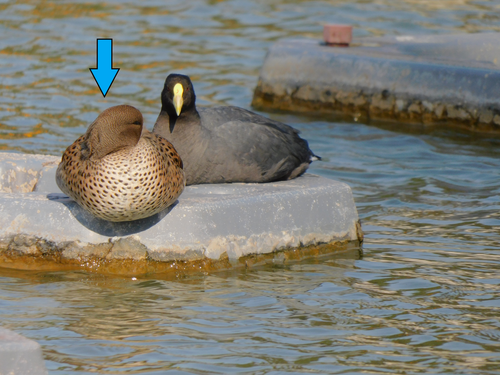
Closest Relatives at Lauca National Park




Before you go
What are the chances of seeing a James's Flamingo in Lauca National Park?
Possible
About 30% of wildlife watchers report a James's Flamingo sighting in Lauca National Park on a given day, based on 225 verified sightings from GBIF citizen-science data from 2019 to 2026. It is the 49th most-seen of the 112 birds we can rate there. Over three days the chance rises to about 60%, and over a week to about 90%, if each day is a fresh chance.
When is the best time to see a James's Flamingo in Lauca National Park?
January, July and November
In those months about 40% of wildlife watchers report a James's Flamingo in Lauca National Park on a given day, against about 10% in February, April and September, the lowest months.
What time of day is best to see a James's Flamingo?
Between 11 am and 2 pm
Across all the parks we cover, that three-hour window holds the most James's Flamingo sightings with a recorded time, and about 9 in 10 of them come between 6 am and 6 pm: it is a daytime animal.
Where else can you see a James's Flamingo?
Only Lauca National Park, in our data
Lauca National Park is the only park on Wallace's Line with enough records to rate James's Flamingo sightings: about 30% of wildlife watchers there report one on a given day.
Where does the James's Flamingo sighting chance come from?
GBIF citizen-science records
It is estimated from how often the James's Flamingo is recorded against all the birds logged in Lauca National Park (225 verified sightings from 2019 to 2026), calibrated against known sighting rates. Figures are rounded to the nearest 10% because citizen-science data supports honest approximations, not decimals, and months with records from fewer than five people show "—". How it works.
