Dingy Bushbrown

Dingy Bushbrown

Mycalesis perseus

Daily sighting probability ~40% · Likely
at Litchfield National Park

In 3 days ~70% in a week >90%

37 Verified sightings at Litchfield National Park From 2019 to 2026
70 In all 2 parks
June Best month
☀️ Diurnal When it's spotted

About the Dingy Bushbrown

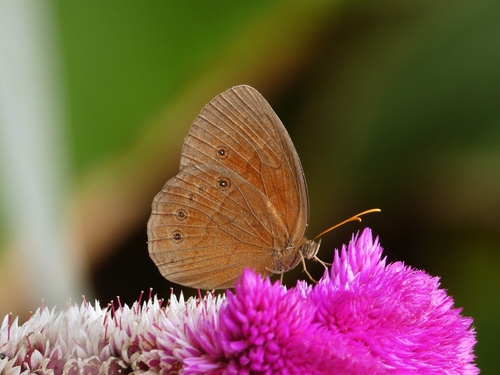
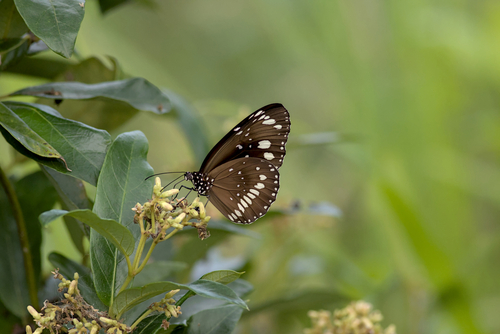
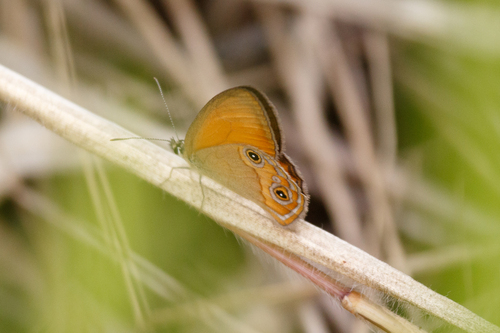
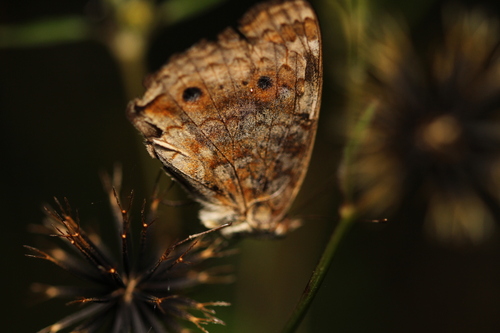
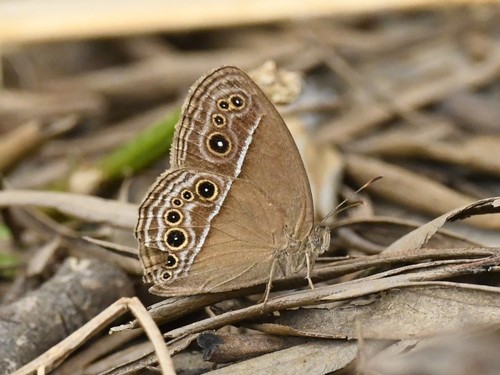
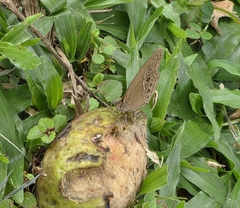
Mycalesis perseus, the dingy bushbrown or common bushbrown, is a species of satyrine butterfly found in south Asia and southeast Asia. Mycalesis perseus exhibits seasonal dimorphism with distinct wet-season and dry-season forms.

Wet-season form. Male and female. Upperside dark to somewhat pale vandyke-brown. Fore wing with a white-centred, fulvous-ringed, black ocellus in interspace 2, and rarely a very small but similar ocellus in interspace 5. Hind wing uniform, occasionally two or three postmedian obscure ocelli present. Fore and hind wings with subterminal and terminal pale lines. Underside: the groundcolour, subterminal and terminal lines on the wings as on upper-side, but crossed by a common purplish - white narrow discal fascia. Fore wing with from two to four, hind wing normally with seven ocelli, similar to, but more clearly defined than, the ocelli on the upperside; on both wings the line of ocelli bordered inwardly and outwardly by sinuous purplish-white lines. On the hind wing only the three posterior ocelli in a straight line, the rest strongly curved outwards. In the female the median or posterior ocellus on the upperside of the fore wing is always larger... Wikipedia →
Global Distribution

Parks Where Found

# Park Country Daily sighting probability
1 Litchfield National Park 🇦🇺 Australia
~40%
2 Daintree National Park 🇦🇺 Australia
~20%

Cities Where Found

# City Country Daily sighting probability
1 Salem 🇮🇳 India
~20%
2 Yogyakarta 🇮🇩 Indonesia
~10%
3 Mysuru 🇮🇳 India
~10%
4 Singapore 🇸🇬 Singapore
~10%
5 Bengaluru 🇮🇳 India
~10%
6 Jakarta 🇮🇩 Indonesia
~10%
7 Chennai 🇮🇳 India
~10%
8 Kuala Lumpur 🇲🇾 Malaysia
<5%

Before you go

What are the chances of seeing a Dingy Bushbrown in Litchfield National Park?

Likely

About 40% of wildlife watchers report a Dingy Bushbrown sighting in Litchfield National Park on a given day, based on 37 verified sightings from GBIF citizen-science data from 2019 to 2026. It is the 10th most-seen of the 43 insects we can rate there. Over three days the chance rises to about 70%, and over a week to over 90%, if each day is a fresh chance.

When is the best time to see a Dingy Bushbrown in Litchfield National Park?

June

In that month about 50% of wildlife watchers report a Dingy Bushbrown in Litchfield National Park on a given day, against under 5% in September and December, the lowest months. That is one of Litchfield National Park's driest months, with about 5 mm of rain against 400 mm in January.

What time of day is best to see a Dingy Bushbrown?

Between 8 and 11 am

Across all the parks we cover, that three-hour window holds the most Dingy Bushbrown sightings with a recorded time, and about 9 in 10 of them come between 6 am and 6 pm: it is a daytime animal.

Is Litchfield National Park the best place to see a Dingy Bushbrown?

Yes

Of the 2 parks where we can rate Dingy Bushbrown sightings, Litchfield National Park has the highest daily chance: about 40%. Next come Daintree National Park (Australia, about 20%).

Where does the Dingy Bushbrown sighting chance come from?

GBIF citizen-science records

It is estimated from how often the Dingy Bushbrown is recorded against all the insects logged in Litchfield National Park (37 verified sightings from 2019 to 2026), calibrated against known sighting rates. Figures are rounded to the nearest 10% because citizen-science data supports honest approximations, not decimals, and months with records from fewer than five people show "—". How it works.

← Back to Litchfield National Park