Rough-scaled Death Adder

Rough-scaled Death Adder

Acanthophis rugosus

Silhouette: SeismicShrimp · PhyloPic

LCLeast ConcernNTVUENCR
Daily sighting probability ~40% · Likely
at Litchfield National Park

In 3 days ~80% in a week >90%

27 Verified sightings at Litchfield National Park From 2019 to 2026
45 In all 2 parks
November Best month
🌙 Nocturnal When it's spotted

About the Rough-scaled Death Adder

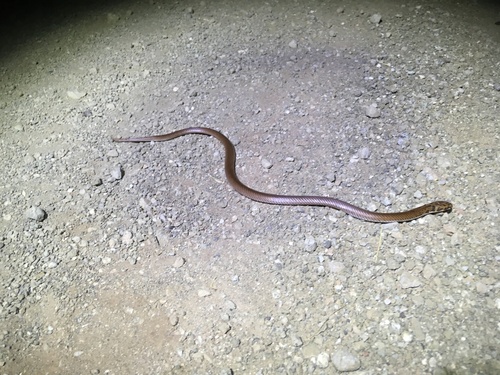
The rough-scaled death adder (Acanthophis rugosus) is a species of venomous snake in the family Elapidae. They are native to northern Australia, particularly Arnhem Land. Rough-scaled death adders are native to deserts. Death adders are generalists that feed upon small mammals, birds, lizards, and frogs. It is likely that allometric (size-related) shifts occur, with smaller specimens feeding more upon lizards and frogs and larger specimens including more mammals in their diets. Regional and interspecific differences in diet may also occur, although these are poorly documented. Like other species in the Elapidae family, they are ground hunters, and can wait for days and days in grass for food.

Body slender to stout, unicolour or with a patterning of crossbands, with smooth or keeled scales in 19-23 rows at midbody, head angular with elevated supraocular scales, 6-7 supralabials with temporolabial scale present, eyes small with vertically elliptical pupils, tail slender, extremely distinct from the body, terminating in a flattened spinous tip which may be black or yellow and contrasts with the dorsal body colouration. Wikipedia →

Global Distribution

Parks Where Found

# Park Country Daily sighting probability
1 Litchfield National Park 🇦🇺 Australia
~40%
2 Kakadu National Park 🇦🇺 Australia
~20%

Zoos & Centres Where Found

# Zoo / Centre Country
1 Territory Wildlife Park 🇦🇺 Australia In captivity
2 Omaha’s Henry Doorly Zoo and Aquarium 🇺🇸 United States In captivity
3 Terra Natura Benidorm 🇪🇸 Spain In captivity

Before you go

What are the chances of seeing a Rough-scaled Death Adder in Litchfield National Park?

Likely

About 40% of wildlife watchers report a Rough-scaled Death Adder sighting in Litchfield National Park on a given day, based on 27 verified sightings from GBIF citizen-science data from 2019 to 2026. It is the 6th most-seen of the 24 reptiles we can rate there. Over three days the chance rises to about 80%, and over a week to over 90%, if each day is a fresh chance.

When is the best time to see a Rough-scaled Death Adder in Litchfield National Park?

March and November

In those months about 70% of wildlife watchers report a Rough-scaled Death Adder in Litchfield National Park on a given day, against under 5% in July, the lowest month.

What time of day is best to see a Rough-scaled Death Adder?

Between 7 and 10 pm

Across all the parks we cover, that three-hour window holds the most Rough-scaled Death Adder sightings with a recorded time, and about 8 in 10 of them come between 6 pm and 6 am: it is mostly seen at night.

Is Litchfield National Park the best place to see a Rough-scaled Death Adder?

Yes

Of the 2 parks where we can rate Rough-scaled Death Adder sightings, Litchfield National Park has the highest daily chance: about 40%. Next come Kakadu National Park (Australia, about 20%).

Which relatives of the Rough-scaled Death Adder live in Litchfield National Park?

Same family: Elapidae

The closest relatives of the Rough-scaled Death Adder that you can see in Litchfield National Park (family Elapidae, Elapid Snakes) are Weigel's Black Snake (about 30%), Orange-naped Snake (about 20%) and Northern Small-eyed Snake (about 20%), with each one's daily chance of a sighting.

Where does the Rough-scaled Death Adder sighting chance come from?

GBIF citizen-science records

It is estimated from how often the Rough-scaled Death Adder is recorded against all the reptiles logged in Litchfield National Park (27 verified sightings from 2019 to 2026), calibrated against known sighting rates. Figures are rounded to the nearest 10% because citizen-science data supports honest approximations, not decimals, and months with records from fewer than five people show "—". How it works.

← Back to Litchfield National Park