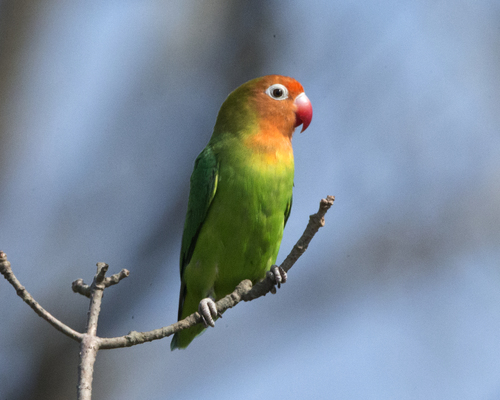
Brown-headed Parrot

Brown-headed Parrot

Poicephalus cryptoxanthus

Silhouette: Sheatherius · PhyloPic

LCLeast ConcernNTVUENCR
Daily sighting probability ~10% · With luck
at Liwonde National Park

In 3 days ~30% in a week ~60%

37 Verified sightings at Liwonde National Park From 2019 to 2026
3,044 In all 5 parks
June Best month
☀️ Diurnal When it's spotted

About the Brown-headed Parrot

The brown-headed parrot (Poicephalus cryptoxanthus) is a south-eastern African parrot. The general plumage colour is green, indeed Sinclair et al., (1993) describe the species as "the greenest parrot of the sub-region". The under wing coverts are bright yellow, although the extent of this is variable. It is from this yellow that the specific name derives, kryptos being Greek for hidden or concealed and xanthos meaning yellow.

The rump is very bright, almost metallic green. As is the margins of the feathers on the underparts, with this coloration becoming more pronounced towards the vent and thighs. The neck is grey-brown merging to brown on the head but merging to greenish on the mantle. On some individuals, some random yellow feathers are visible on the head, neck and wings. Why these occur is unknown but it has been proposed that these may result from over-vigorous preening by parents.

The tail is edged olive-brown and tipped green. The bill is dark, almost black above, merging to whitish below. The immature is always described as "duller than the adult and... Wikipedia →

Sounds

Call0:35

South Africa · 2025

© Bobby Wilcox · XC1038406 · CC BY-NC-SA 4.0

Flight call0:29

South Africa · 2023

© Marc Anderson · XC877090 · CC BY-NC-ND 4.0

Begging call0:50

South Africa · 1991

© Rick Nuttall · XC779267 · CC BY-NC-SA 4.0

Global Distribution

Parks Where Found

# Park Country Daily sighting probability
1 Gonarezhou National Park 🇿🇼 Zimbabwe
~50%
2 Kruger National Park 🇿🇦 South Africa
~30%
3 Mikumi National Park 🇹🇿 Tanzania
~20%
4 Liwonde National Park 🇲🇼 Malawi
~10%
5 Gorongosa National Park 🇲🇿 Mozambique
~10%

Zoos & Centres Where Found

# Zoo / Centre Country
1 Chapultepec Zoo 🇲🇽 Mexico In captivity
2 Bird Paradise 🇸🇬 Singapore In captivity
3 Rainforest Wild Asia 🇸🇬 Singapore In captivity
4 Loro Parque 🇪🇸 Spain In captivity

Before you go

What are the chances of seeing a Brown-headed Parrot in Liwonde National Park?

With luck

About 10% of wildlife watchers report a Brown-headed Parrot sighting in Liwonde National Park on a given day, based on 37 verified sightings from GBIF citizen-science data from 2019 to 2026. It is the 134th most-seen of the 267 birds we can rate there. Over three days the chance rises to about 30%, and over a week to about 60%, if each day is a fresh chance.

When is the best time to see a Brown-headed Parrot in Liwonde National Park?

April to June

In those months about 20% of wildlife watchers report a Brown-headed Parrot in Liwonde National Park on a given day, against under 5% in August, the lowest month. Those are among Liwonde National Park's driest months, with about 20 mm of rain a month against 300 mm in January.

What time of day is best to see a Brown-headed Parrot?

Between 7 and 10 am

Across all the parks we cover, that three-hour window holds the most Brown-headed Parrot sightings with a recorded time, and about 9 in 10 of them come between 6 am and 6 pm: it is a daytime animal.

Is Liwonde National Park the best place to see a Brown-headed Parrot?

4th of 5

Of the 5 parks where we can rate Brown-headed Parrot sightings, Liwonde National Park ranks 4th at about 10%. The best odds are in Gonarezhou National Park (Zimbabwe, about 50%), Kruger National Park (South Africa, about 30%) and Mikumi National Park (Tanzania, about 20%).

Where does the Brown-headed Parrot sighting chance come from?

GBIF citizen-science records

It is estimated from how often the Brown-headed Parrot is recorded against all the birds logged in Liwonde National Park (37 verified sightings from 2019 to 2026), calibrated against known sighting rates. Figures are rounded to the nearest 10% because citizen-science data supports honest approximations, not decimals, and months with records from fewer than five people show "—". How it works.

← Back to Liwonde National Park