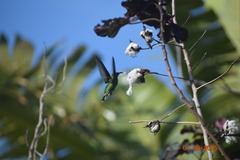
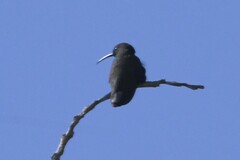
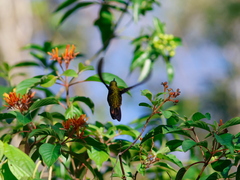
Antillean Mango

Antillean Mango

Anthracothorax dominicus

Silhouette: Ferran Sayol · PhyloPic

LCLeast ConcernNTVUENCR
Daily sighting probability ~80% · Very likely
at Los Haitises National Park

In 3 days >90%

483 Verified sightings at Los Haitises National Park From 2019 to 2026
588 In all 2 parks
July Best month
☀️ Diurnal When it's spotted

About the Antillean Mango

The Hispaniolan mango (Anthracothorax dominicus) is a species of hummingbird in the subfamily Polytminae. It is endemic to the Caribbean island of Hispaniola (in both the Dominican Republic and Haiti). The Hispaniolan mango was formally described by the Swedish naturalist Carl Linnaeus in 1766 in the twelfth edition of his Systema Naturae under the binomial name Trochilus dominicus. Linnaeus based his description on the "colibry de S. Domingue" that was described and illustrated by the French zoologist Mathurin Jacques Brisson in 1760. The type locality is in the Dominican Republic on the island of Hispaniola (and not the island of Dominica). The Antillean mango is now placed in the genus Anthracothorax that was introduced by the German zoologist Friedrich Boie in 1831.

From about 1945, some taxonomic systems treated what are now the Hispaniolan mango and the Puerto Rican mango (Anthracothorax aurulentus) as subspecies of the "Antillean mango" under the same binomial, A. dominicus, as the current species. BirdLife International's Handbook of the Birds of the World (HBW) treated the two as separate species as early as 2003 and called A. dominicus the "Hispaniolan... Wikipedia →

Sounds

Call0:09

Dominican Republic · 2014

© Oscar Humberto Marin-Gomez · XC214514 · CC BY-NC-SA 4.0

Call0:10

Puerto Rico · 2010

© Daniel Lane · XC46677 · CC BY-NC-SA 3.0

Global Distribution

Parks Where Found

# Park Country Daily sighting probability
1 Los Haitises National Park 🇩🇴 Dominican Republic
~80%
2 Jaragua National Park 🇩🇴 Dominican Republic
~40%

Cities Where Found

# City Country Daily sighting probability
1 Santo Domingo 🇩🇴 Dominican Republic
~60%

Before you go

What are the chances of seeing an Antillean Mango in Los Haitises National Park?

Very likely

About 80% of wildlife watchers report an Antillean Mango sighting in Los Haitises National Park on a given day, based on 483 verified sightings from GBIF citizen-science data from 2019 to 2026. It is the 7th most-seen of the 106 birds we can rate there. Over three days the chance rises to over 90%, if each day is a fresh chance.

When is the best time to see an Antillean Mango in Los Haitises National Park?

January–March and July

In those months about 90% of wildlife watchers report an Antillean Mango in Los Haitises National Park on a given day, against about 50% in August, the lowest month.

What time of day is best to see an Antillean Mango?

Between 7 and 10 am

Across all the parks we cover, that three-hour window holds the most Antillean Mango sightings with a recorded time, and about 9 in 10 of them come between 6 am and 6 pm: it is a daytime animal.

Is Los Haitises National Park the best place to see an Antillean Mango?

Yes

Of the 2 parks where we can rate Antillean Mango sightings, Los Haitises National Park has the highest daily chance: about 80%. Next come Jaragua National Park (Dominican Republic, about 40%).

Which relatives of the Antillean Mango live in Los Haitises National Park?

Same family: Trochilidae

The closest relatives of the Antillean Mango that you can see in Los Haitises National Park (family Trochilidae, Hummingbirds) are Vervain Hummingbird (about 30%) and Hispaniolan Emerald (about 10%), with each one's daily chance of a sighting.

Where does the Antillean Mango sighting chance come from?

GBIF citizen-science records

It is estimated from how often the Antillean Mango is recorded against all the birds logged in Los Haitises National Park (483 verified sightings from 2019 to 2026), calibrated against known sighting rates. Figures are rounded to the nearest 10% because citizen-science data supports honest approximations, not decimals, and months with records from fewer than five people show "—". How it works.

← Back to Los Haitises National Park