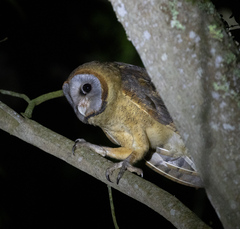
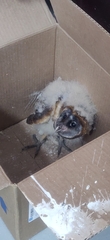
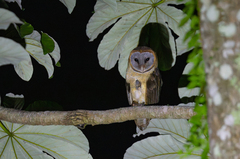
Ashy-faced Owl

Ashy-faced Owl

Tyto glaucops

Silhouette: Sharon Wegner-Larsen · PhyloPic

LCLeast ConcernNTVUENCR Endemic
Daily sighting probability ~20% · Possible
at Los Haitises National Park

In 3 days ~40% in a week ~70%

111 Verified sightings at Los Haitises National Park From 2019 to 2026
111 In 1 park
April Best month
🌙 Nocturnal When it's spotted

About the Ashy-faced Owl

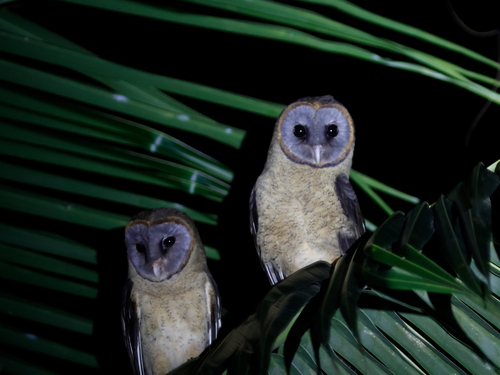
The ashy-faced owl (Tyto glaucops) is a species of bird in the barn-owl family Tytonidae. It is found on the Caribbean island of Hispaniola, on Dominica, and on several other islands of the Lesser Antilles. The ashy-faced owl was formally described in 1852 by the German naturalist Johann Jakob Kaup and given the binomial name Strix glaucops. The specific epithet is from Ancient Greek glaukos meaning "blue-grey" or "glaucous". Kaup specified the type locality as Jamaica. This was an error and has been corrected to Hispaniola. The ashy-faced owl is now placed in the genus Tyto that was introduced in 1828 by Gustaf Johan Billberg.

The taxonomy of the ashy-faced owl is unsettled. At one time it was considered conspecific with the barn owl sensu lato (Tyto alba). After the separation the International Ornithological Committee (IOC) long treated it as monotypic and endemic to Hispaniola, but in July 2023 moved two subspecies from the American barn owl (Tyto furcata) into it. The North American Classification Committee of the American Ornithological Society (AOS/NACC) and the Clements taxonomy retain it as monotypic. In 2022 the AOS/NACC rejected a proposal to... Wikipedia →

Sounds

Call0:21

Dominican Republic · 2016

© Andrew Spencer · XC303752 · CC BY-NC-ND 4.0

Recording0:10

Dominican Republic · 2026

© Jonathan M · iNaturalist · CC BY-NC 4.0

Recording0:26

Dominican Republic · 2023

© Christopher Rustay · iNaturalist · CC BY-NC 4.0

Global Distribution

Parks Where Found

# Park Country Daily sighting probability
1 Los Haitises National Park 🇩🇴 Dominican Republic
~20%

More parks will be added in future updates.

Zoos & Centres Where Found

# Zoo / Centre Country
1 Parque y Zoológico Nacional Arquitecto Manuel Valverde Podestá 🇩🇴 Dominican Republic In captivity
2 Bird Park Steinen 🇩🇪 Germany In captivity
3 Small Breeds Farm Park 🇬🇧 United Kingdom In captivity
4 Suffolk Owl Sanctuary 🇬🇧 United Kingdom In captivity
5 Art Aquarium Museum 🇯🇵 Japan In captivity

Before you go

What are the chances of seeing an Ashy-faced Owl in Los Haitises National Park?

Possible

About 20% of wildlife watchers report an Ashy-faced Owl sighting in Los Haitises National Park on a given day, based on 111 verified sightings from GBIF citizen-science data from 2019 to 2026. It is the 51st most-seen of the 106 birds we can rate there. Over three days the chance rises to about 40%, and over a week to about 70%, if each day is a fresh chance.

When is the best time to see an Ashy-faced Owl in Los Haitises National Park?

April

In that month about 30% of wildlife watchers report an Ashy-faced Owl in Los Haitises National Park on a given day, against about 10% in May to November, the lowest months.

What time of day is best to see an Ashy-faced Owl?

Between 7 and 10 pm

Across all the parks we cover, that three-hour window holds the most Ashy-faced Owl sightings with a recorded time, and about 7 in 10 of them come between 6 pm and 6 am: it is mostly seen at night.

Where else can you see an Ashy-faced Owl?

Only Los Haitises National Park, in our data

Los Haitises National Park is the only park on Wallace's Line with enough records to rate Ashy-faced Owl sightings: about 20% of wildlife watchers there report one on a given day.

Where does the Ashy-faced Owl sighting chance come from?

GBIF citizen-science records

It is estimated from how often the Ashy-faced Owl is recorded against all the birds logged in Los Haitises National Park (111 verified sightings from 2019 to 2026), calibrated against known sighting rates. Figures are rounded to the nearest 10% because citizen-science data supports honest approximations, not decimals, and months with records from fewer than five people show "—". How it works.
← Back to Los Haitises National Park