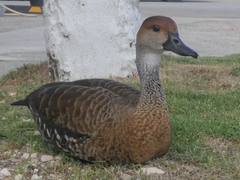
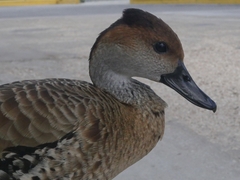
West Indian Whistling-Duck

West Indian Whistling-Duck

Dendrocygna arborea

Silhouette: Sheatherius · PhyloPic

LCNTNear ThreatenedVUENCR
Daily sighting probability ~20% · Possible
at Los Haitises National Park

In 3 days ~50% in a week ~80%

136 Verified sightings at Los Haitises National Park From 2019 to 2026
185 In all 2 parks
July Best month
☀️ Diurnal When it's spotted

About the West Indian Whistling-Duck

The West Indian whistling duck (Dendrocygna arborea) is a whistling duck that breeds in the Caribbean. Alternative names are black-billed whistling duck and Cuban whistling duck. The West Indian whistling duck was formally described in 1758 by the Swedish naturalist Carl Linnaeus in the tenth edition of his Systema Naturae under the binomial name Anas arborea. Linnaeus based his account on the descriptions by earlier authors. In 1725 the Irish physician, naturalist and collector Hans Sloane had described and illustrated the "Whistling-Duck" in the second volume of his A Voyage to the Islands Madera, Barbados, Nieves, S. Christophers and Jamaica. Sloane noted that it was common on the island of Jamaica. The English naturalist George Edwards had included a description and a hand-coloured illustration of the "Black-bill'd whistling Duck" in the fourth volume of his A Natural History of Uncommon Birds that was published in 1751. Edwards had been able to examine a specimen at the home of Admiral Sir Charles Wager at Stanley House in Chelsea, west London.

The West Indian whistling duck is now one of eight species placed in the genus Dendrocygna that was introduced in 1837... Wikipedia →

Sounds

Call0:48

United Kingdom · 2014

© Todd Mark · XC174874 · CC BY-NC-SA 4.0

Call0:07

Dominican Republic · 2012

© Ian Davies · XC97204 · CC BY-NC-ND 2.5

Call1:01

Puerto Rico · 2010

© Daniel Lane · XC46665 · CC BY-NC-SA 3.0

Global Distribution

Parks Where Found

# Park Country Daily sighting probability
1 Los Haitises National Park 🇩🇴 Dominican Republic
~20%
2 Ciénaga de Zapata 🇨🇺 Cuba
<5%

Cities Where Found

# City Country Daily sighting probability
1 Santo Domingo 🇩🇴 Dominican Republic
~40%

Zoos & Centres Where Found

# Zoo / Centre Country
1 Parc des oiseaux 🇫🇷 France In captivity
2 Zoo Miami 🇺🇸 United States In captivity
3 Dallas Zoo 🇺🇸 United States In captivity
4 Gatorland 🇺🇸 United States In captivity
5 Little Rock Zoo 🇺🇸 United States In captivity
6 Parco Zoo Punta Verde 🇮🇹 Italy In captivity
7 Jardín Zoológico El Bosque 🇨🇺 Cuba In captivity
8 Randers Tropical Zoo 🇩🇰 Denmark In captivity
9 Bermuda Aquarium, Museum and Zoo 🇧🇲 Bermuda In captivity
10 Wild Discovery Zoo 🇬🇧 United Kingdom In captivity

Before you go

What are the chances of seeing a West Indian Whistling-Duck in Los Haitises National Park?

Possible

About 20% of wildlife watchers report a West Indian Whistling-Duck sighting in Los Haitises National Park on a given day, based on 136 verified sightings from GBIF citizen-science data from 2019 to 2026. It is the 43rd most-seen of the 106 birds we can rate there. Over three days the chance rises to about 50%, and over a week to about 80%, if each day is a fresh chance.

When is the best time to see a West Indian Whistling-Duck in Los Haitises National Park?

July

In that month about 40% of wildlife watchers report a West Indian Whistling-Duck in Los Haitises National Park on a given day, against about 10% in January and March, the lowest months.

What time of day is best to see a West Indian Whistling-Duck?

Between 2 and 5 pm

Across all the parks we cover, that three-hour window holds the most West Indian Whistling-Duck sightings with a recorded time, and about 9 in 10 of them come between 6 am and 6 pm: it is a daytime animal.

Is Los Haitises National Park the best place to see a West Indian Whistling-Duck?

Yes

Of the 2 parks where we can rate West Indian Whistling-Duck sightings, Los Haitises National Park has the highest daily chance: about 20%. Next come Ciénaga de Zapata (Cuba, under 5%).

Where does the West Indian Whistling-Duck sighting chance come from?

GBIF citizen-science records

It is estimated from how often the West Indian Whistling-Duck is recorded against all the birds logged in Los Haitises National Park (136 verified sightings from 2019 to 2026), calibrated against known sighting rates. Figures are rounded to the nearest 10% because citizen-science data supports honest approximations, not decimals, and months with records from fewer than five people show "—". How it works.

← Back to Los Haitises National Park