
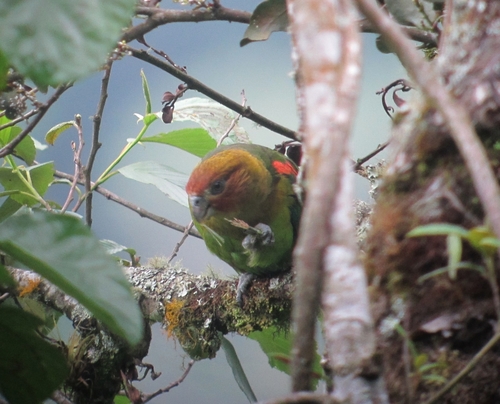
Golden-plumed Parakeet

Golden-plumed Parakeet

Leptosittaca branickii

Silhouette: Sheatherius · PhyloPic

LCLeast ConcernNTVUENCR
Daily sighting probability ~10% · With luck
at Los Nevados National Natural Park

In 3 days ~30% in a week ~60%

661 Verified sightings at Los Nevados National Natural Park From 2019 to 2026
1,166 In all 2 parks
May Best month
☀️ Diurnal When it's spotted

About the Golden-plumed Parakeet

The golden-plumed parakeet (Leptosittaca branickii) is a Neotropical parrot species within the family Psittacidae, belonging to the monotypic genus Leptosittaca. This somewhat Aratinga-like species is found in humid temperate highland forests, especially with Podocarpus, on the east Andean slope in Colombia, Ecuador, and Peru. It is generally local and uncommon. It is threatened by habitat loss. Clearing of high-altitude forests for agricultural reasons have greatly impacted the loss of habitat for this parakeet species. Further reduction of such habitats will continue to diminish the number of golden-plumed parakeets left in South America. It is the only known parakeet species that can detect ultraviolet radiation.

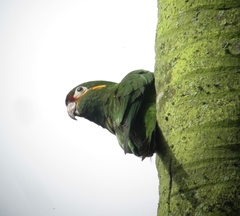
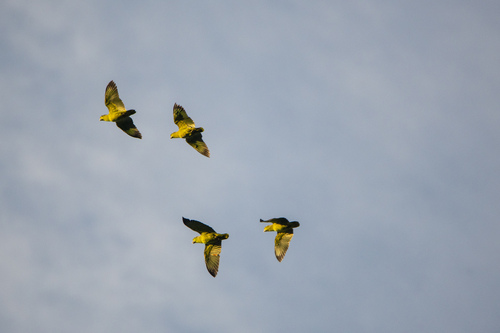
The golden-plumed parakeet is a large and long tailed montane parakeet that resides in the Andean cloud forests of Colombia, Peru, and Ecuador. Adults are mostly bright green with orange-yellow lores and small golden yellow crests behind the eyes. Their bellies are a faded yellowish color with reddish orange feathers scattered about. Golden-plumed parakeets have yellowish flight feathers on their underside as well as strongly reddish color feathers on the... Wikipedia →

Sounds

Flight call0:15

Colombia · 2025

© Alain Verneau · XC1073526 · CC BY-NC-SA 4.0

Call1:14

Colombia · 2022

© Frank Lambert · XC1044455 · CC BY-NC-ND 4.0

Recording0:25

Colombia · 2023

© Andrés Mauricio López · XC780167 · CC BY-NC-SA 4.0

Global Distribution

Parks Where Found

# Park Country Daily sighting probability
1 Podocarpus National Park 🇪🇨 Ecuador
~30%
2 Los Nevados National Natural Park 🇨🇴 Colombia
~10%

Before you go

What are the chances of seeing a Golden-plumed Parakeet in Los Nevados National Natural Park?

With luck

About 10% of wildlife watchers report a Golden-plumed Parakeet sighting in Los Nevados National Natural Park on a given day, based on 661 verified sightings from GBIF citizen-science data from 2019 to 2026. It is the 78th most-seen of the 424 birds we can rate there. Over three days the chance rises to about 30%, and over a week to about 60%, if each day is a fresh chance.

When is the best time to see a Golden-plumed Parakeet in Los Nevados National Natural Park?

March and May

In those months about 20% of wildlife watchers report a Golden-plumed Parakeet in Los Nevados National Natural Park on a given day, against about 10% in April and June–February, the lowest months.

What time of day is best to see a Golden-plumed Parakeet?

Between 9 am and noon

Across all the parks we cover, that three-hour window holds the most Golden-plumed Parakeet sightings with a recorded time, and about 8 in 10 of them come between 6 am and 6 pm: it is a daytime animal.

Is Los Nevados National Natural Park the best place to see a Golden-plumed Parakeet?

2nd of 2

Of the 2 parks where we can rate Golden-plumed Parakeet sightings, Los Nevados National Natural Park ranks 2nd at about 10%. The best odds are in Podocarpus National Park (Ecuador, about 30%).

Which relatives of the Golden-plumed Parakeet live in Los Nevados National Natural Park?

Same family: Psittacidae

The closest relatives of the Golden-plumed Parakeet that you can see in Los Nevados National Natural Park (family Psittacidae, New World and African Parrots) are Rufous-fronted Parakeet (about 10%) and Bronze-winged Parrot (about 10%), with each one's daily chance of a sighting.

Where does the Golden-plumed Parakeet sighting chance come from?

GBIF citizen-science records

It is estimated from how often the Golden-plumed Parakeet is recorded against all the birds logged in Los Nevados National Natural Park (661 verified sightings from 2019 to 2026), calibrated against known sighting rates. Figures are rounded to the nearest 10% because citizen-science data supports honest approximations, not decimals, and months with records from fewer than five people show "—". How it works.

← Back to Los Nevados National Natural Park