
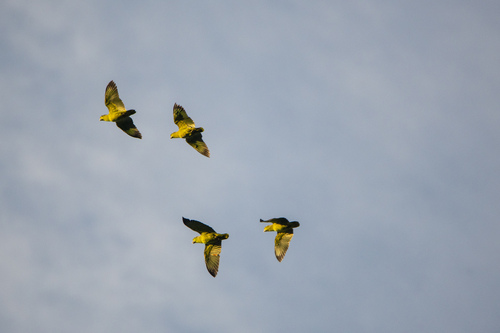
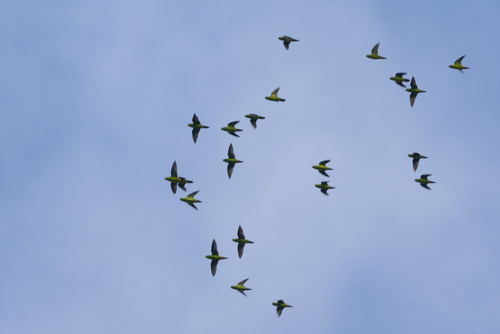
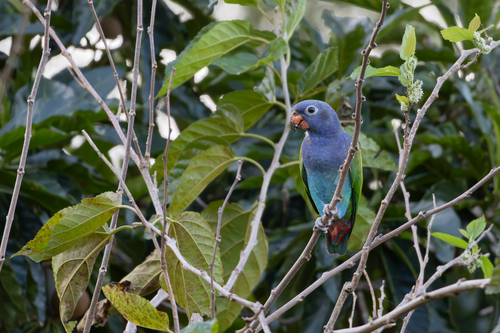
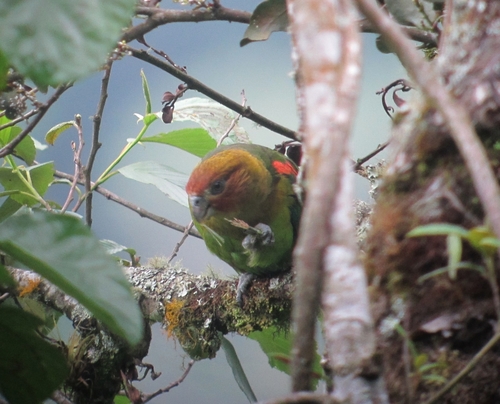
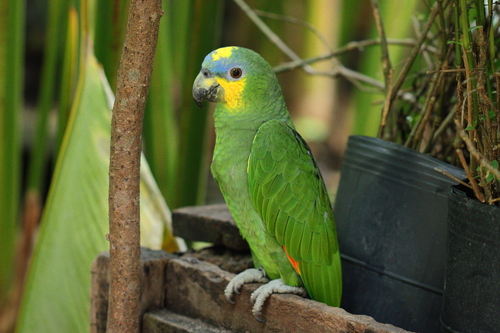
Yellow-eared Parrot

Yellow-eared Parrot

Ognorhynchus icterotis

Silhouette: Sheatherius · PhyloPic

LCNTVUVulnerableENCR Endemic
Daily sighting probability <5% · Rare
at Los Nevados National Natural Park

In 3 days ~10%

118 Verified sightings at Los Nevados National Natural Park From 2019 to 2026
124 In all 2 parks
September Best month
☀️ Diurnal When it's spotted

About the Yellow-eared Parrot

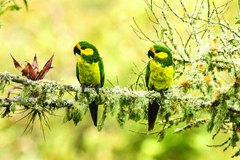
The yellow-eared parrot (Ognorhynchus icterotis) is a vulnerable parrot found in the Andes of Colombia. It was thought to be extinct up until April 1999, when a group of researchers that were sponsored by ABC and Fundación Loro Parque, discovered a total of 81 individuals in the Colombian Andes. It is currently enlisted as vulnerable on the International Union for Conservation of Nature (IUCN) Red List. Its current population trend is increasing, in part due to conservation measures implemented to protect the existing populations of the species. It is closely associated with the wax palm (Ceroxylon sp.).

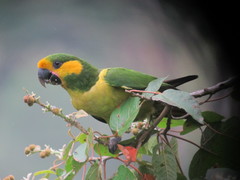
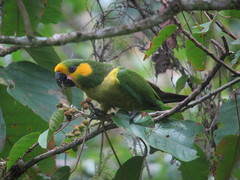
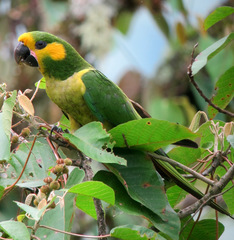
The yellow-eared parrot is a relatively large, long-tailed parrot, with an average length of 42 cm (17 in) and a weight of about 285 g (10.1 oz). It is overall green, with the underparts being paler, more lime green than the upperparts. The heavy beak and a ring of bare skin around the eyes are black. The origin of the common epithet "yellow-eared" derives from the yellow patch of feathers that extends from the forehead down to its cheeks and ear-coverts. Its calls sound similar to those of geese.

The yellow-eared parrot nests and lives... Wikipedia →

Sounds

Call0:43

Colombia · 2024

© Scott Olmstead · XC907183 · CC BY-NC-SA 4.0

Uncertain0:30

Colombia · 2021

© David Monroy Rengifo · XC689249 · CC BY-NC-SA 4.0

Flight call0:37

Colombia · 2020

© Jerome Fischer · XC582923 · CC BY-NC-SA 4.0

Global Distribution

Parks Where Found

# Park Country Daily sighting probability
1 Los Nevados National Natural Park 🇨🇴 Colombia
<5%
2 Chingaza National Natural Park 🇨🇴 Colombia
<5%

Before you go

What are the chances of seeing a Yellow-eared Parrot in Los Nevados National Natural Park?

Rare

Under 5% of wildlife watchers report a Yellow-eared Parrot sighting in Los Nevados National Natural Park on a given day, based on 118 verified sightings from GBIF citizen-science data from 2019 to 2026. It is the 232nd most-seen of the 424 birds we can rate there. Over three days the chance rises to about 10%, if each day is a fresh chance.

When is the best time to see a Yellow-eared Parrot in Los Nevados National Natural Park?

September

In that month about 10% of wildlife watchers report a Yellow-eared Parrot in Los Nevados National Natural Park on a given day, against under 5% in October to August, the lowest months.

What time of day is best to see a Yellow-eared Parrot?

Between 6 and 9 am

Across all the parks we cover, that three-hour window holds the most Yellow-eared Parrot sightings with a recorded time, and about 8 in 10 of them come between 6 am and 6 pm: it is a daytime animal.

Is Los Nevados National Natural Park the best place to see a Yellow-eared Parrot?

Yes

Of the 2 parks where we can rate Yellow-eared Parrot sightings, Los Nevados National Natural Park has the highest daily chance: under 5%. Next come Chingaza National Natural Park (Colombia, under 5%).

Which relatives of the Yellow-eared Parrot live in Los Nevados National Natural Park?

Same family: Psittacidae

The closest relatives of the Yellow-eared Parrot that you can see in Los Nevados National Natural Park (family Psittacidae, New World and African Parrots) are Golden-plumed Parakeet (about 10%), Rufous-fronted Parakeet (about 10%) and Bronze-winged Parrot (about 10%), with each one's daily chance of a sighting.

Where does the Yellow-eared Parrot sighting chance come from?

GBIF citizen-science records

It is estimated from how often the Yellow-eared Parrot is recorded against all the birds logged in Los Nevados National Natural Park (118 verified sightings from 2019 to 2026), calibrated against known sighting rates. Figures are rounded to the nearest 10% because citizen-science data supports honest approximations, not decimals, and months with records from fewer than five people show "—". How it works.

← Back to Los Nevados National Natural Park