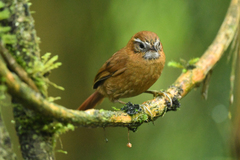
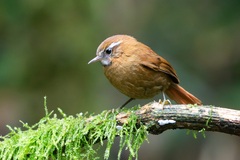
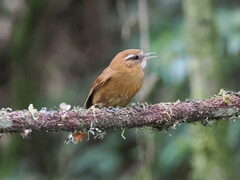

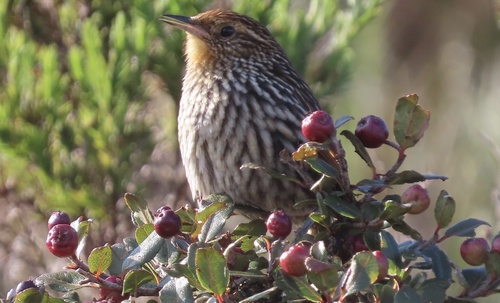
White-browed Spinetail

White-browed Spinetail

Hellmayrea gularis

Silhouette: Sheatherius · PhyloPic

LCLeast ConcernNTVUENCR
Daily sighting probability <5% · Rare
at Los Nevados National Natural Park

In 3 days ~10% in a week ~30%

218 Verified sightings at Los Nevados National Natural Park From 2019 to 2026
368 In all 4 parks
December Best month
☀️ Diurnal When it's spotted

About the White-browed Spinetail

The white-browed spinetail (Hellmayrea gularis) is a species of bird in the Furnariinae subfamily of the ovenbird family Furnariidae. It is found in Colombia, Ecuador, Peru, and Venezuela. Several twentieth century authors placed the white-browed spinetail in genus Synallaxis. Data published in the early twenty-first century confirm its placement in Hellmayrea, and showed that it is not closely related to Synallaxis but instead to genus Asthenes.

The white-browed spinetail is the only member of its genus and has these four subspecies: It has a short tail compared to other spinetails. The sexes have the same plumage. Adults of the nominate subspecies H. g. gularis have whitish supercilia that almost meet on the forehead on an otherwise dark rufescent brown face. Their forehead, crown, and nape are rufescent brown with faint paler streaks. Their upperparts and... Wikipedia →

Sounds

Song0:07

Ecuador · 2025

© Manuel Sánchez-Nivicela · XC1136668 · CC BY-NC-ND 4.0

Call0:36

Colombia · 2022

© Frank Lambert · XC772178 · CC BY-NC-ND 4.0

Song0:18

Colombia · 2021

© Peter Boesman · XC693579 · CC BY-NC-ND 4.0

Global Distribution

Parks Where Found

# Park Country Daily sighting probability
1 Chingaza National Natural Park 🇨🇴 Colombia
~10%
2 Los Nevados National Natural Park 🇨🇴 Colombia
<5%
3 Podocarpus National Park 🇪🇨 Ecuador
<5%
4 Farallones de Cali National Natural Park 🇨🇴 Colombia
<5%

Before you go

What are the chances of seeing a White-browed Spinetail in Los Nevados National Natural Park?

Rare

Under 5% of wildlife watchers report a White-browed Spinetail sighting in Los Nevados National Natural Park on a given day, based on 218 verified sightings from GBIF citizen-science data from 2019 to 2026. It is the 180th most-seen of the 424 birds we can rate there. Over three days the chance rises to about 10%, and over a week to about 30%, if each day is a fresh chance.

When is the best time to see a White-browed Spinetail in Los Nevados National Natural Park?

February, April–June, August and December

In those months about 10% of wildlife watchers report a White-browed Spinetail in Los Nevados National Natural Park on a given day, against under 5% in January, March, July and September–November, the lowest months.

What time of day is best to see a White-browed Spinetail?

Between 8 and 11 am

Across all the parks we cover, that three-hour window holds the most White-browed Spinetail sightings with a recorded time, and about 8 in 10 of them come between 6 am and 6 pm: it is a daytime animal.

Is Los Nevados National Natural Park the best place to see a White-browed Spinetail?

2nd of 4

Of the 4 parks where we can rate White-browed Spinetail sightings, Los Nevados National Natural Park ranks 2nd at under 5%. The best odds are in Chingaza National Natural Park (Colombia, about 10%).

Which relatives of the White-browed Spinetail live in Los Nevados National Natural Park?

Same family: Furnariidae

The closest relatives of the White-browed Spinetail that you can see in Los Nevados National Natural Park (family Furnariidae, Ovenbirds and Woodcreepers) are Stout-billed Cinclodes (about 30%), Andean Tit-Spinetail (about 20%) and Azara's Spinetail (about 20%), with each one's daily chance of a sighting.

Where does the White-browed Spinetail sighting chance come from?

GBIF citizen-science records

It is estimated from how often the White-browed Spinetail is recorded against all the birds logged in Los Nevados National Natural Park (218 verified sightings from 2019 to 2026), calibrated against known sighting rates. Figures are rounded to the nearest 10% because citizen-science data supports honest approximations, not decimals, and months with records from fewer than five people show "—". How it works.

← Back to Los Nevados National Natural Park