
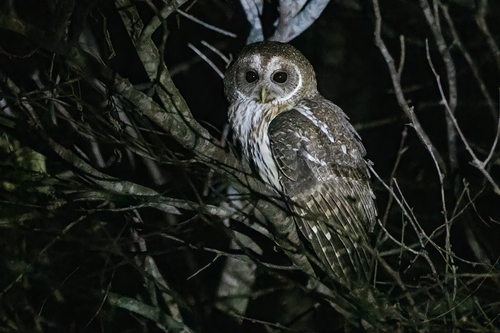
Unspotted Saw-whet Owl

Unspotted Saw-whet Owl

Aegolius ridgwayi

Silhouette: Ferran Sayol · PhyloPic

LCLeast ConcernNTVUENCR
Daily sighting probability <5% · Rare
at Los Quetzales National Park

In 3 days <5% in a week ~10%

121 Verified sightings at Los Quetzales National Park From 2019 to 2026
348 In all 5 parks
December Best month
🌙 Nocturnal When it's spotted

About the Unspotted Saw-whet Owl

The unspotted saw-whet owl (Aegolius ridgwayi) is a small "typical owl" in subfamily Surniinae. It is native to mountainous areas of Central America. The unspotted saw-whet owl's taxonomy is unsettled. The International Ornithological Committee (IOC) treats it as monotypic. The unspotted saw-whet owl and the northern saw-whet owl (A. acadicus) form a superspecies and some authors have proposed that they are a single species.

The unspotted saw-whet owl is 18 to 21.5 cm (7.1 to 8.5 in) long and weighs about 80 to 90 g (2.8 to 3.2 oz). Its upperparts, throat, and upper breast are plain sepia brown and the lower breast and belly plain cinnamon buff. The tail is a darker brown and the wings generally a grayer brown. Its facial disk is brown with a narrow white border; the lores, chin, and "eyebrows" are whitish. It has yellow eyes. The two putative... Wikipedia →

Sounds

Song0:08

Guatemala · 2024

© Brendan Sloan · XC918477 · CC BY-NC-ND 4.0

Begging call1:25

Guatemala · 2022

© Jesse Fagan · XC741770 · CC BY-NC-SA 4.0

Call0:45

Costa Rica · 2019

© Hans Matheve · XC518520 · CC BY-NC-ND 4.0

Global Distribution

Parks Where Found

# Park Country Daily sighting probability
1 Irazú Volcano National Park 🇨🇷 Costa Rica
<5%
2 Los Quetzales National Park 🇨🇷 Costa Rica
<5%
3 Tapantí-Macizo de la Muerte National Park 🇨🇷 Costa Rica
<5%
4 Volcán Barú National Park 🇵🇦 Panama
<5%
5 La Amistad International Park (Panama) 🇵🇦 Panama
<5%

Before you go

What are the chances of seeing an Unspotted Saw-whet Owl in Los Quetzales National Park?

Rare

Under 5% of wildlife watchers report an Unspotted Saw-whet Owl sighting in Los Quetzales National Park on a given day, based on 121 verified sightings from GBIF citizen-science data from 2019 to 2026. It is the 134th most-seen of the 252 birds we can rate there. Over three days the chance rises to under 5%, and over a week to about 10%, if each day is a fresh chance.

When is the best time to see an Unspotted Saw-whet Owl in Los Quetzales National Park?

Any time of year

In every month with enough records, under 5% of wildlife watchers report an Unspotted Saw-whet Owl in Los Quetzales National Park on a given day, so our monthly data shows no clear season.

What time of day is best to see an Unspotted Saw-whet Owl?

Between 7 and 10 pm

Across all the parks we cover, that three-hour window holds the most Unspotted Saw-whet Owl sightings with a recorded time, and about 9 in 10 of them come between 6 pm and 6 am: it is mostly seen at night.

Is Los Quetzales National Park the best place to see an Unspotted Saw-whet Owl?

Among the best

Of the 5 parks where we can rate Unspotted Saw-whet Owl sightings, Los Quetzales National Park ranks 2nd at under 5%, level with the leaders once rounded. The best odds are in Irazú Volcano National Park (Costa Rica, under 5%).

Which relatives of the Unspotted Saw-whet Owl live in Los Quetzales National Park?

Same family: Strigidae

The closest relatives of the Unspotted Saw-whet Owl that you can see in Los Quetzales National Park (family Strigidae, Typical Owls) are Costa Rican Pygmy-Owl (about 10%) and Bare-shanked Screech-Owl (about 10%), with each one's daily chance of a sighting.

Where does the Unspotted Saw-whet Owl sighting chance come from?

GBIF citizen-science records

It is estimated from how often the Unspotted Saw-whet Owl is recorded against all the birds logged in Los Quetzales National Park (121 verified sightings from 2019 to 2026), calibrated against known sighting rates. Figures are rounded to the nearest 10% because citizen-science data supports honest approximations, not decimals, and months with records from fewer than five people show "—". How it works.

← Back to Los Quetzales National Park