
Fasciated Wren

Fasciated Wren

Campylorhynchus fasciatus

Silhouette: Andy Wilson · PhyloPic

LCLeast ConcernNTVUENCR
Daily sighting probability ~20% · Possible
at Machalilla National Park

In 3 days ~60% in a week ~90%

219 Verified sightings at Machalilla National Park From 2019 to 2026
239 In all 2 parks
December Best month
☀️ Diurnal When it's spotted

About the Fasciated Wren

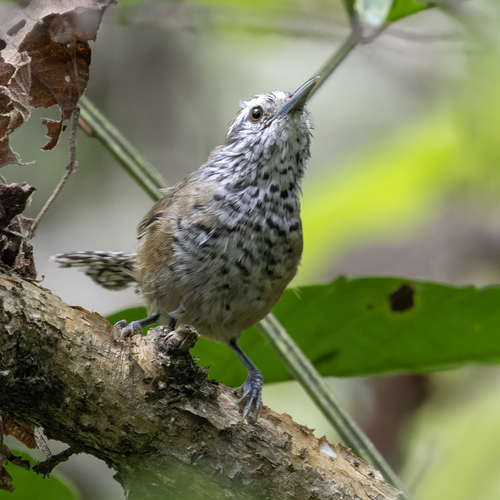
The fasciated wren (Campylorhynchus fasciatus) is a species of bird in the family Troglodytidae. It is found in Ecuador and Peru. The fasciated wren has two subspecies, the nominate Campylorhynchus fasciatus fasciatus and C. f. pallescens.

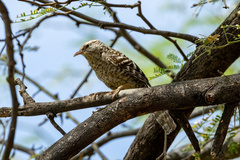
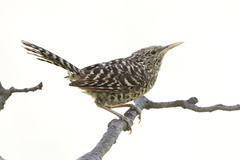
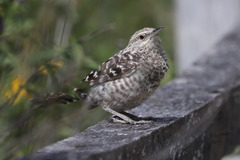
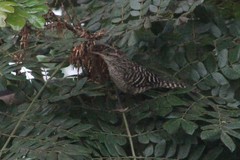
The fasciated wren is approximately 19 cm (7.5 in) long; one female weighed 24.9 g (0.88 oz). Both sexes of the nominate have a gray crown, grayish supercilium, and dark gray shoulders, back, and rump. The shoulders have whitish speckles and the rump whitish bars. The tail is barred off-white and blackish brown. The chin is off-white with darker streaks. The whitish chest and belly have heavy dark gray spots and the flanks are barred with dark gray. C. f. pallescens is paler with less distinct markings on the underside. The juvenile also has less well defined markings on its underside.

The nominate fasciated wren is found in coastal Peru from the Department of Piura south to the Department of Lima and also inland Peru from the departments of Cajamarca and Amazonas south to the Department of Huánuco. C. f. pallescens is found from southwestern and southern Ecuador into... Wikipedia →

Sounds

Alarm call0:08

Ecuador · 2021

© Manuel Sánchez-Nivicela · XC1162224 · CC BY-NC-ND 4.0

Song0:13

Ecuador · 2014

© Leonardo Ordóñez-Delgado · XC597750 · CC BY-NC-ND 4.0

Call0:20

Ecuador · 2014

© Vanessa Luzuriaga · XC355946 · CC BY-NC-SA 4.0

Global Distribution

Parks Where Found

# Park Country Daily sighting probability
1 Machalilla National Park 🇪🇨 Ecuador
~20%
2 Podocarpus National Park 🇪🇨 Ecuador
<5%

Cities Where Found

# City Country Daily sighting probability
1 Guayaquil 🇪🇨 Ecuador
~40%

Before you go

What are the chances of seeing a Fasciated Wren in Machalilla National Park?

Possible

About 20% of wildlife watchers report a Fasciated Wren sighting in Machalilla National Park on a given day, based on 219 verified sightings from GBIF citizen-science data from 2019 to 2026. It is the 39th most-seen of the 248 birds we can rate there. Over three days the chance rises to about 60%, and over a week to about 90%, if each day is a fresh chance.

When is the best time to see a Fasciated Wren in Machalilla National Park?

April and December

In those months about 40% of wildlife watchers report a Fasciated Wren in Machalilla National Park on a given day, against about 10% in May and November, the lowest months.

What time of day is best to see a Fasciated Wren?

Between 7 and 10 am

Across all the parks we cover, that three-hour window holds the most Fasciated Wren sightings with a recorded time, and about 9 in 10 of them come between 6 am and 6 pm: it is a daytime animal.

Is Machalilla National Park the best place to see a Fasciated Wren?

Yes

Of the 2 parks where we can rate Fasciated Wren sightings, Machalilla National Park has the highest daily chance: about 20%. Next come Podocarpus National Park (Ecuador, under 5%).

Which relatives of the Fasciated Wren live in Machalilla National Park?

Same family: Troglodytidae

The closest relatives of the Fasciated Wren that you can see in Machalilla National Park (family Troglodytidae, Wrens) are Southern House Wren (about 60%), Superciliated Wren (about 20%) and Speckle-breasted Wren (about 20%), with each one's daily chance of a sighting.

Where does the Fasciated Wren sighting chance come from?

GBIF citizen-science records

It is estimated from how often the Fasciated Wren is recorded against all the birds logged in Machalilla National Park (219 verified sightings from 2019 to 2026), calibrated against known sighting rates. Figures are rounded to the nearest 10% because citizen-science data supports honest approximations, not decimals, and months with records from fewer than five people show "—". How it works.

← Back to Machalilla National Park