Pacific Parrotlet

Pacific Parrotlet

Forpus coelestis

Silhouette: Sheatherius · PhyloPic

LCLeast ConcernNTVUENCR
Daily sighting probability ~30% · Possible
at Machalilla National Park

In 3 days ~60% in a week ~90%

272 Verified sightings at Machalilla National Park From 2019 to 2026
272 In 1 park
April Best month
☀️ Diurnal When it's spotted

About the Pacific Parrotlet

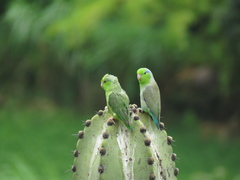
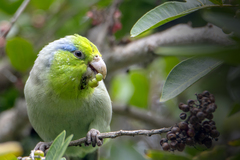
The Pacific parrotlet (Forpus coelestis), also known as Lesson's parrotlet, or the celestial parrotlet, is a species of small parrot in the family Psittacidae. The Pacific parrotlet (Forpus coelestis) is a small green parrot originating in South America. A typical specimen is 11–14 centimetres (4.3–5.5 in) long and typically weighs 30 grams or more. Wild Pacific parrotlets are green with a dusty grey cast over the body, a bright green mask and a pinkish beak. Legs and feet are pinkish-grey. Pacific parrotlets are sexually dimorphic: males possess shades of blue on their wings. Blue can vary in intensity from a bright cobalt blue to a pale, almost lavender shade of blue on American birds; the blue is almost non-existent on marbled birds, only being visible on the underside of the wing right on the joint. Male parrotlets also have blue streaks behind the eyes which is often referred to as "eyeshadow;" as well as blue rumps. Female parrotlets have no blue on the wings whatsoever but can have blue eye streaks as well as a blue rump.

Parrotlets are often referred to as pocket parrots because of their size; but they are known for their larger-than-life personalities... Wikipedia →

Sounds

Call0:21

Ecuador · 2018

© Hans Matheve · XC512761 · CC BY-NC-ND 4.0

Flight call0:23

Ecuador · 1998

© John V. Moore · XC257661 · CC BY-NC-SA 4.0

Call0:15

Peru · 2015

© Ross Gallardy · XC296988 · CC BY-NC-SA 4.0

Global Distribution

Parks Where Found

# Park Country Daily sighting probability
1 Machalilla National Park 🇪🇨 Ecuador
~30%

More parks will be added in future updates.

Cities Where Found

# City Country Daily sighting probability
1 Guayaquil 🇪🇨 Ecuador
~40%
2 Lima 🇵🇪 Peru
~20%

Zoos & Centres Where Found

# Zoo / Centre Country
1 Zoo Miami 🇺🇸 United States In captivity
2 Bronx Zoo 🇺🇸 United States In captivity
3 Kadoorie Farm and Botanic Garden 🇭🇰 Hong Kong SAR China In captivity
4 Songkhla Zoo 🇹🇭 Thailand In captivity
5 Curitiba Zoo 🇧🇷 Brazil In captivity
6 Potter Park Zoo 🇺🇸 United States In captivity
7 Cambridge Butterfly Conservatory 🇨🇦 Canada In captivity
8 Zoo El Pantanal 🇪🇨 Ecuador In captivity
9 El Jardí dels Ocells 🇪🇸 Spain In captivity
10 Castellar Zoo 🇪🇸 Spain In captivity
11 National Aviary 🇺🇸 United States In captivity
12 Snake Farm of Queen Saovabha Memorial Institute 🇹🇭 Thailand In captivity
13 Bristol Aquarium 🇬🇧 United Kingdom In captivity
14 Aquarium of Niagara 🇺🇸 United States In captivity
15 Bangkok Aquarium 🇹🇭 Thailand In captivity
16 Huachipa Zoo Park 🇵🇪 Peru In captivity
17 Wildlife Rescue Association of BC 🇨🇦 Canada In captivity

Before you go

What are the chances of seeing a Pacific Parrotlet in Machalilla National Park?

Possible

About 30% of wildlife watchers report a Pacific Parrotlet sighting in Machalilla National Park on a given day, based on 272 verified sightings from GBIF citizen-science data from 2019 to 2026. It is the 34th most-seen of the 248 birds we can rate there. Over three days the chance rises to about 60%, and over a week to about 90%, if each day is a fresh chance.

When is the best time to see a Pacific Parrotlet in Machalilla National Park?

April

In that month about 40% of wildlife watchers report a Pacific Parrotlet in Machalilla National Park on a given day, against about 10% in August and November, the lowest months. That is one of Machalilla National Park's wettest months, with about 60 mm of rain against 5 mm in September.

What time of day is best to see a Pacific Parrotlet?

Between 9 am and noon

Across all the parks we cover, that three-hour window holds the most Pacific Parrotlet sightings with a recorded time, and nearly all of them come between 6 am and 6 pm: it is a daytime animal.

Where else can you see a Pacific Parrotlet?

Only Machalilla National Park, in our data

Machalilla National Park is the only park on Wallace's Line with enough records to rate Pacific Parrotlet sightings: about 30% of wildlife watchers there report one on a given day.

Which relatives of the Pacific Parrotlet live in Machalilla National Park?

Same family: Psittacidae

The closest relatives of the Pacific Parrotlet that you can see in Machalilla National Park (family Psittacidae, New World and African Parrots) are Red-masked Parakeet (about 10%) and Bronze-winged Parrot (about 10%), with each one's daily chance of a sighting.

Where does the Pacific Parrotlet sighting chance come from?

GBIF citizen-science records

It is estimated from how often the Pacific Parrotlet is recorded against all the birds logged in Machalilla National Park (272 verified sightings from 2019 to 2026), calibrated against known sighting rates. Figures are rounded to the nearest 10% because citizen-science data supports honest approximations, not decimals, and months with records from fewer than five people show "—". How it works.

← Back to Machalilla National Park