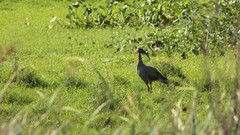
Plumbeous Ibis

Plumbeous Ibis

Theristicus caerulescens

Silhouette: Robert Cooke · PhyloPic

LCLeast ConcernNTVUENCR
Daily sighting probability ~20% · Possible
at Madidi National Park

In 3 days ~40% in a week ~70%

36 Verified sightings at Madidi National Park From 2019 to 2026
783 In all 4 parks
August Best month
☀️ Diurnal When it's spotted

About the Plumbeous Ibis

The plumbeous ibis (Theristicus caerulescens), also formerly called the blue ibis, is a large distinctive ibis species endemic to parts of central South America. The plumbeous ibis has historically undergone frequent reclassification and been placed in various genera such as Molydophanes, Geronticus, Theresticus and Harpiprion. It has also been referred to as Ibis caerulescens and Theresticus (Harpiprion) caerulescens. Nevertheless, this ibis has traditionally been assigned to the monotypic genus Harpiprion, carrying the binomial name Harpiprion caerulescens; on the basis that this species was previously believed to have no close relatives. However, phylogenetic analyses based on both nuclear and mitochondrial DNA markers have suggested that the plumbeous ibis is closely related to other ibis species in the genus Theresticus such as the buff-necked ibis; given the markedly low genetic distances between the plumbeous ibis and other Theresticus species. Hence, the current placement of the plumbeous ibis in the genus Theresticus appears justified.

This large ibis measures 71–77 cm in length, with a wing length of 397-450mm...

Wikipedia →

Sounds

Song0:58

Brazil · 2007

© Dante Buzzetti · XC720702 · CC BY-NC-SA 4.0

Call0:06

Bolivia · 2021

© Richard E. Webster · XC705025 · CC BY-NC-SA 4.0

Dawn song0:06

Brazil · 2015

© András Schmidt · XC699649 · CC BY-NC-SA 4.0

Global Distribution

Parks Where Found

# Park Country Daily sighting probability
1 Parque Estadual Encontro das Águas 🇧🇷 Brazil
~30%
2 El Impenetrable National Park 🇦🇷 Argentina
~20%
3 Madidi National Park 🇧🇴 Bolivia
~20%
4 Iberá National Park 🇦🇷 Argentina
~10%

Cities Where Found

# City Country Daily sighting probability
1 Santa Cruz de la Sierra 🇧🇴 Bolivia
<5%

Before you go

What are the chances of seeing a Plumbeous Ibis in Madidi National Park?

Possible

About 20% of wildlife watchers report a Plumbeous Ibis sighting in Madidi National Park on a given day, based on 36 verified sightings from GBIF citizen-science data from 2019 to 2026. It is the 59th most-seen of the 239 birds we can rate there. Over three days the chance rises to about 40%, and over a week to about 70%, if each day is a fresh chance.

When is the best time to see a Plumbeous Ibis in Madidi National Park?

August

In that month about 40% of wildlife watchers report a Plumbeous Ibis in Madidi National Park on a given day, against about 10% in January–February and May, the lowest months. That is one of Madidi National Park's driest months, with about 50 mm of rain against 290 mm in February. March and December have too few records to rate.

What time of day is best to see a Plumbeous Ibis?

Between 9 am and noon

Across all the parks we cover, that three-hour window holds the most Plumbeous Ibis sightings with a recorded time, and about 8 in 10 of them come between 6 am and 6 pm: it is a daytime animal.

Where does the Plumbeous Ibis sighting chance come from?

GBIF citizen-science records

It is estimated from how often the Plumbeous Ibis is recorded against all the birds logged in Madidi National Park (36 verified sightings from 2019 to 2026), calibrated against known sighting rates. Figures are rounded to the nearest 10% because citizen-science data supports honest approximations, not decimals, and months with records from fewer than five people show "—". How it works.

← Back to Madidi National Park