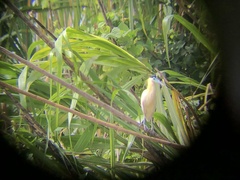
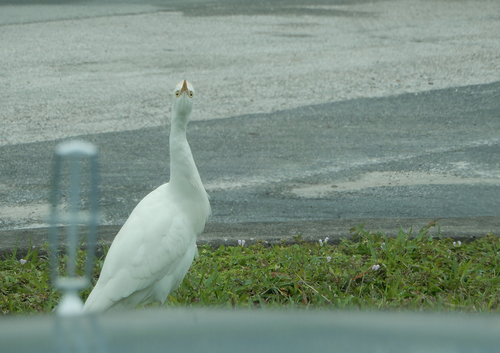
The capped heron (Pilherodius pileatus) is a water bird endemic to the neotropics, inhabiting rainforest from the center of Panama to the south of Brazil. It is the only species of the genus Pilherodius, and one of the least known of the heron family, Ardeidae. It is superficially similar to the group of the night herons, but is active during daytime or at twilight.
The capped heron was described by the French polymath Georges-Louis Leclerc, Comte de Buffon in 1780 in his Histoire Naturelle des Oiseaux from a specimen collected in Cayenne, French Guiana. The bird was also illustrated in a hand-coloured plate engraved by François-Nicolas Martinet in the Planches Enluminées D'Histoire Naturelle which was produced under the supervision of Edme-Louis Daubenton to accompany Buffon's text. Neither the plate caption nor Buffon's description included a scientific name but in 1783 the Dutch naturalist Pieter Boddaert coined the binomial name Ardea pileata in his catalogue of the Planches Enluminées. The capped heron is now the only species placed in the genus Pilherodius that was erected by the German naturalist Ludwig Reichenbach in 1853. The genus name combines the Ancient...