Bare-eyed Thrush

Bare-eyed Thrush

Turdus nudigenis

Silhouette: Sharon Wegner-Larsen · PhyloPic

LCLeast ConcernNTVUENCR
Daily sighting probability ~40% · Likely
at Main Ridge Forest Reserve

In 3 days ~80% in a week >90%

394 Verified sightings at Main Ridge Forest Reserve From 2019 to 2026
695 In all 5 parks
March Best month
☀️ Diurnal When it's spotted

About the Bare-eyed Thrush

The spectacled thrush, bare-eyed thrush, or yellow-eyed thrush (Turdus nudigenis), is a resident breeding bird in the Lesser Antilles and in South America from Colombia and Venezuela south and east to northern Brazil. In Trinidad and Tobago, this thrush is also known as big-eye grieve.

The similar but allopatric Ecuadorian thrush was formerly considered a subspecies of the bare-eyed thrush and named T. n. maculirostris; it is now normally considered as a separate species T. maculirostris. It has a narrower eyering and is only found in forest and woodland in western Ecuador and northwestern Peru.

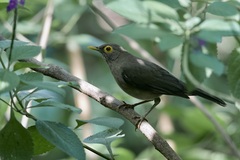
The spectacled thrush is 23–24 cm (9.1–9.4 in) long and weighs 60 g (2.1 oz). It is plain olive-brown above and paler brown below. The throat is brown-streaked off-white, and the lower belly is whitish. It has a prominent yellow eye ring which gives rise to its English and scientific names.

There are two poorly defined subspecies, differing mainly in the darkness of the plumage. Sexes are similar, but young birds are flecked above and spotted below, and have a thinner eye ring. The song is a musical warble, slower and lower pitched than that of the cocoa thrush (T. fumigatus... Wikipedia →

Sounds

Call0:24

St Lucia · 2026

© Paul Driver · XC1074457 · CC BY-NC-SA 4.0

Song0:16

France · 2022

© Denis Dujardin · XC1056097 · CC BY-NC-SA 4.0

?0:50

Colombia · 2000

© Bernabe Lopez-Lanus · XC54700 · CC BY-NC-SA 3.0

Global Distribution

Parks Where Found

# Park Country Daily sighting probability
1 Main Ridge Forest Reserve 🇹🇹 Trinidad and Tobago
~40%
2 Henri Pittier National Park 🇻🇪 Venezuela
~30%
3 Caroni Swamp 🇹🇹 Trinidad and Tobago
~10%
4 Sierra de la Macarena National Park 🇨🇴 Colombia
<5%
5 Chingaza National Natural Park 🇨🇴 Colombia
<5%

Cities Where Found

# City Country Daily sighting probability
1 Valencia 🇻🇪 Venezuela
~60%
2 Caracas 🇻🇪 Venezuela
~40%

Before you go

What are the chances of seeing a Bare-eyed Thrush in Main Ridge Forest Reserve?

Likely

About 40% of wildlife watchers report a Bare-eyed Thrush sighting in Main Ridge Forest Reserve on a given day, based on 394 verified sightings from GBIF citizen-science data from 2019 to 2026. It is the 24th most-seen of the 103 birds we can rate there. Over three days the chance rises to about 80%, and over a week to over 90%, if each day is a fresh chance.

When is the best time to see a Bare-eyed Thrush in Main Ridge Forest Reserve?

March

In that month about 60% of wildlife watchers report a Bare-eyed Thrush in Main Ridge Forest Reserve on a given day, against about 20% in June, August and October, the lowest months. That is one of Main Ridge Forest Reserve's driest months, with about 65 mm of rain against 230 mm in October.

What time of day is best to see a Bare-eyed Thrush?

Between 3 and 6 pm

Across all the parks we cover, that three-hour window holds the most Bare-eyed Thrush sightings with a recorded time, and about 9 in 10 of them come between 6 am and 6 pm: it is a daytime animal.

Is Main Ridge Forest Reserve the best place to see a Bare-eyed Thrush?

Yes

Of the 5 parks where we can rate Bare-eyed Thrush sightings, Main Ridge Forest Reserve has the highest daily chance: about 40%. Next come Henri Pittier National Park (Venezuela, about 30%) and Caroni Swamp (Trinidad and Tobago, about 10%).

Which relatives of the Bare-eyed Thrush live in Main Ridge Forest Reserve?

Same genus: Turdus

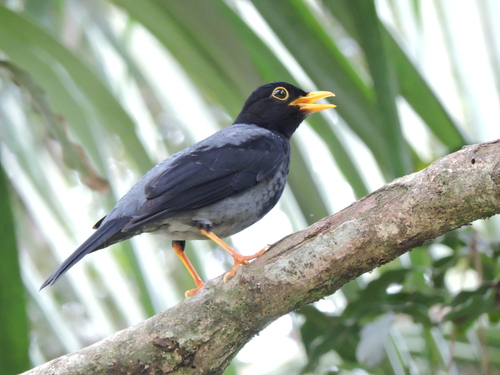
The closest relatives of the Bare-eyed Thrush that you can see in Main Ridge Forest Reserve (genus Turdus, Typical Thrushes) are Yellow-legged Thrush (about 30%) and White-necked Thrush (about 30%), with each one's daily chance of a sighting.

Where does the Bare-eyed Thrush sighting chance come from?

GBIF citizen-science records

It is estimated from how often the Bare-eyed Thrush is recorded against all the birds logged in Main Ridge Forest Reserve (394 verified sightings from 2019 to 2026), calibrated against known sighting rates. Figures are rounded to the nearest 10% because citizen-science data supports honest approximations, not decimals, and months with records from fewer than five people show "—". How it works.

← Back to Main Ridge Forest Reserve