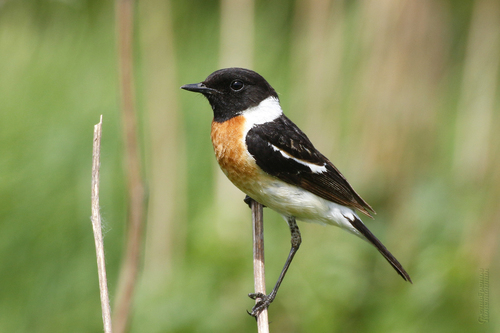
Black-breasted Parrotbill

Black-breasted Parrotbill

Paradoxornis flavirostris

Silhouette: Sheatherius · PhyloPic

LCNTVUVulnerableENCR
Daily sighting probability ~10% · With luck
at Manas National Park

In 3 days ~20% in a week ~50%

131 Verified sightings at Manas National Park From 2019 to 2026
131 In 1 park
May Best month
☀️ Diurnal When it's spotted

About the Black-breasted Parrotbill

The black-breasted parrotbill (Paradoxornis flavirostris) is a 19 cm (7.5 in) long, large, thick-billed parrotbill with black patches on the head-sides and throat. Formerly placed in the family Sylviidae, the parrotbills are now considered a distinct family, the Paradoxornithidae, following Cai et al. (2019).

The bird is more or less brown all over, with an extensive black area on upper breast and uniform rufous-buff remainder of underparts. The similar spot-breasted parrotbill, a close relative, has arrow-shaped spotting on breast and pale buff underparts. The voice is a gruff howh, jeehw or jahw, the song a rhythmic series, aw jahw jahw jahw and uhwi uhwi uhwi uhwi. Alternatively, a higher-pitched wi chi'chi'chi'chi'chi, wi yi'yi'yi'yi'yi; wi'uwi-uwi-uwi wi chu-chu-chu is given.

Paradoxornis flavirostris is now very probably endemic to north-eastern India, where it is known from only five widely scattered localities in the plains of the Brahmaputra valley and adjacent foothills: Manas National Park and its surrounds, Kaziranga National Park (where it is rather scarce), Loktak Lake and adjacent marshes in Manipur, the species' stronghold... Wikipedia →

Sounds

Call1:13

India · 2025

© Elangbam Premjit Singh · XC958123 · CC BY-NC-SA 4.0

Song0:28

India · 2024

© Lars Lachmann · XC880786 · CC BY-NC-SA 4.0

Call?0:58

India · 2006

© Mathias Ritschard · XC21858 · CC BY-NC-ND 2.5

Global Distribution

Parks Where Found

# Park Country Daily sighting probability
1 Manas National Park 🇮🇳 India
~10%

More parks will be added in future updates.

Before you go

What are the chances of seeing a Black-breasted Parrotbill in Manas National Park?

With luck

About 10% of wildlife watchers report a Black-breasted Parrotbill sighting in Manas National Park on a given day, based on 131 verified sightings from GBIF citizen-science data from 2019 to 2026. It is the 163rd most-seen of the 377 birds we can rate there. Over three days the chance rises to about 20%, and over a week to about 50%, if each day is a fresh chance.

When is the best time to see a Black-breasted Parrotbill in Manas National Park?

May

In that month about 20% of wildlife watchers report a Black-breasted Parrotbill in Manas National Park on a given day, against under 5% in July–October and December, the lowest months. That is one of Manas National Park's wettest months, with about 500 mm of rain against 10 mm in December.

What time of day is best to see a Black-breasted Parrotbill?

Between 6 and 9 am

Across all the parks we cover, that three-hour window holds the most Black-breasted Parrotbill sightings with a recorded time, and about 9 in 10 of them come between 6 am and 6 pm: it is a daytime animal.

Where else can you see a Black-breasted Parrotbill?

Only Manas National Park, in our data

Manas National Park is the only park on Wallace's Line with enough records to rate Black-breasted Parrotbill sightings: about 10% of wildlife watchers there report one on a given day.

Which relatives of the Black-breasted Parrotbill live in Manas National Park?

Same family: Sylviidae

The closest relatives of the Black-breasted Parrotbill that you can see in Manas National Park (family Sylviidae, Sylviid Warblers and Allies) are Yellow-eyed Babbler (about 10%) and Jerdon's Babbler (about 10%), with each one's daily chance of a sighting.

Where does the Black-breasted Parrotbill sighting chance come from?

GBIF citizen-science records

It is estimated from how often the Black-breasted Parrotbill is recorded against all the birds logged in Manas National Park (131 verified sightings from 2019 to 2026), calibrated against known sighting rates. Figures are rounded to the nearest 10% because citizen-science data supports honest approximations, not decimals, and months with records from fewer than five people show "—". How it works.

← Back to Manas National Park