

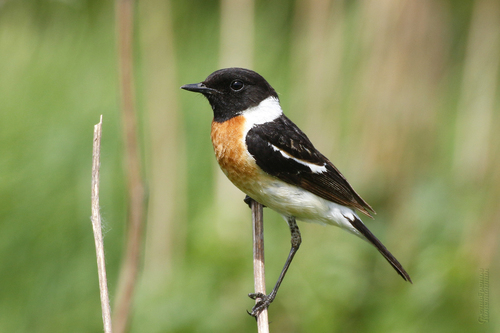
Jerdon's Babbler

Jerdon's Babbler

Chrysomma altirostre

Silhouette: Sheatherius · PhyloPic

LCNTVUVulnerableENCR
Daily sighting probability ~10% · With luck
at Manas National Park

In 3 days ~10% in a week ~30%

69 Verified sightings at Manas National Park From 2019 to 2026
69 In 1 park
April Best month
☀️ Diurnal When it's spotted

About the Jerdon's Babbler

Jerdon's babbler (Chrysomma altirostre) is a passerine bird native to wetlands and grasslands of the Indian sub-continent. It is listed as Vulnerable on the IUCN Red List since 1994. It is a member of the genus Chrysomma of the family Paradoxornithidae.

The common name commemorates the surgeon-naturalist Thomas C. Jerdon. Measuring 16–17 cm in length, it is quite intermediate in habitus between certain typical warblers (Sylvia) and the parrotbills (Paradoxornis). Like these, it is a drab bird with a long tail used to balance when creeping through the vegetation; its bill is thicker than in Sylvia but not as heavy as in Paradoxornis. Buffy chestnut brown above and a slightly lighter yellowish-brown on the belly, its lores are pale greyish, as are the throat and breast. The tail and a wing patch are redder than the rest of the upperside. The legs and feet are dark, the bill is greyish-horn colored above and pale below; the eyes' irides are yellowish-brown and a thin nude ring of greenish-yellow skin surrounds the eye. The sexes are alike; young birds have a more orange hue to the upperside plumage, and the lower bill is pink. Differences between subspecies are slight... Wikipedia →

Sounds

Song0:17

India · 2022

© Sandeep Chakraborty · XC764760 · CC BY-NC-SA 4.0

Call0:10

Myanmar · 2016

© Thet Zaw Naing · XC683645 · CC BY-NC-SA 4.0

Call0:21

India · 2019

© Dibyendu Ash · XC549711 · CC BY-NC-SA 4.0

Global Distribution

Parks Where Found

# Park Country Daily sighting probability
1 Manas National Park 🇮🇳 India
~10%

More parks will be added in future updates.

Before you go

What are the chances of seeing a Jerdon's Babbler in Manas National Park?

With luck

About 10% of wildlife watchers report a Jerdon's Babbler sighting in Manas National Park on a given day, based on 69 verified sightings from GBIF citizen-science data from 2019 to 2026. It is the 208th most-seen of the 377 birds we can rate there. Over three days the chance rises to about 10%, and over a week to about 30%, if each day is a fresh chance.

When is the best time to see a Jerdon's Babbler in Manas National Park?

January, April–June, September and November

In those months about 10% of wildlife watchers report a Jerdon's Babbler in Manas National Park on a given day, against under 5% in February–March, July–August, October and December, the lowest months.

What time of day is best to see a Jerdon's Babbler?

Between 6 and 9 am

Across all the parks we cover, that three-hour window holds the most Jerdon's Babbler sightings with a recorded time, and about 8 in 10 of them come between 6 am and 6 pm: it is a daytime animal.

Where else can you see a Jerdon's Babbler?

Only Manas National Park, in our data

Manas National Park is the only park on Wallace's Line with enough records to rate Jerdon's Babbler sightings: about 10% of wildlife watchers there report one on a given day.

Where does the Jerdon's Babbler sighting chance come from?

GBIF citizen-science records

It is estimated from how often the Jerdon's Babbler is recorded against all the birds logged in Manas National Park (69 verified sightings from 2019 to 2026), calibrated against known sighting rates. Figures are rounded to the nearest 10% because citizen-science data supports honest approximations, not decimals, and months with records from fewer than five people show "—". How it works.

← Back to Manas National Park