Chestnut-tailed Starling

Chestnut-tailed Starling

Sturnia malabarica

Silhouette: Rafael Maia · PhyloPic

LCLeast ConcernNTVUENCR
Daily sighting probability ~40% · Likely
at Manas National Park

In 3 days ~80% in a week >90%

752 Verified sightings at Manas National Park From 2019 to 2026
6,097 In all 23 parks
February Best month
🌅 Crepuscular When it's spotted

About the Chestnut-tailed Starling

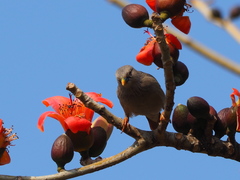
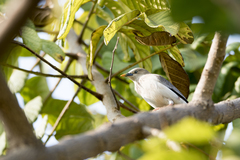
The chestnut-tailed starling (Sturnia malabarica), also called grey-headed starling and grey-headed myna is a member of the starling family. It is a resident or partially migratory species found in wooded habitats in India and Southeast Asia. The species name is after the distribution of a former subspecies in the Malabar region. While the chestnut-tailed starling is a winter visitor to peninsular India, the closely related resident breeding population with a white head is now treated as a full species, the Malabar starling (Sturnia blythii).

The chestnut-tailed starling was formally described in 1789 by the German naturalist Johann Friedrich Gmelin in his revised and expanded edition of Carl Linnaeus's Systema Naturae. He placed it with the thrushes in the genus Turdus and coined the binomial name Turdus malabaricus. Gmelin based his account on the "Le Martin Vieillard de la côte de Malabar" that had been described in 1782 by the French naturalist Pierre Sonnerat in his book Voyage aux Indes orientales et à la Chine.

The chestnut-tailed starling was formerly placed in the genus Sturnus. A molecular phylogenetic study published in 2008 found that the genus was polyphyletic... Wikipedia →

Sounds

Call0:18

Vietnam · 2026

© Tim Dinh / Annambirding · XC1186124 · CC BY-NC-SA 4.0

Flight call0:20

Laos · 2023

© Bram Piot · XC854748 · CC BY-NC-SA 4.0

Call0:11

Thailand · 2021

© Ding Li Yong · XC697224 · CC BY-NC-ND 4.0

Global Distribution

Parks Where Found

# Park Country Daily sighting probability
1 Kaziranga National Park 🇮🇳 India
~50%
2 Manas National Park 🇮🇳 India
~40%
3 Chitwan National Park 🇳🇵 Nepal
~40%
4 Royal Manas National Park 🇧🇹 Bhutan
~20%
5 Sundarbans National Park 🇮🇳 India
~20%
6 Nagarhole National Park 🇮🇳 India
~20%
7 Jim Corbett National Park 🇮🇳 India
~20%
8 Royal Bardia National Park 🇳🇵 Nepal
~20%
9 Kanha National Park 🇮🇳 India
~10%
10 Mudumalai National Park 🇮🇳 India
~10%
11 Namdapha National Park 🇮🇳 India
~10%
12 Gir National Park 🇮🇳 India
~10%
13 Doi Inthanon National Park 🇹🇭 Thailand
~10%
14 Bandipur National Park 🇮🇳 India
~10%
15 Bandhavgarh National Park 🇮🇳 India
~10%
16 Periyar National Park 🇮🇳 India
~10%
17 Satpura National Park 🇮🇳 India
<5%
18 Ranthambore National Park 🇮🇳 India
<5%
19 Kaeng Krachan National Park 🇹🇭 Thailand
<5%
20 Eravikulam National Park 🇮🇳 India
<5%
21 Keoladeo National Park 🇮🇳 India
<5%
22 Khao Yai National Park 🇹🇭 Thailand
<5%
23 Cat Tien National Park 🇻🇳 Vietnam
<5%

Cities Where Found

# City Country Daily sighting probability
1 Savar 🇧🇩 Bangladesh
~60%
2 Chattogram 🇧🇩 Bangladesh
~60%
3 Dhaka 🇧🇩 Bangladesh
~50%
4 Asansol 🇮🇳 India
~40%
5 Kaohsiung 🇹🇼 Taiwan
~30%
6 Jamshedpur 🇮🇳 India
~30%
7 Guwahati 🇮🇳 India
~20%
8 Berhampore 🇮🇳 India
~20%
9 Tamluk 🇮🇳 India
~20%
10 Bhubaneshwar 🇮🇳 India
~20%

Before you go

What are the chances of seeing a Chestnut-tailed Starling in Manas National Park?

Likely

About 40% of wildlife watchers report a Chestnut-tailed Starling sighting in Manas National Park on a given day, based on 752 verified sightings from GBIF citizen-science data from 2019 to 2026. It is the 15th most-seen of the 377 birds we can rate there. Over three days the chance rises to about 80%, and over a week to over 90%, if each day is a fresh chance.

When is the best time to see a Chestnut-tailed Starling in Manas National Park?

February

In that month about 70% of wildlife watchers report a Chestnut-tailed Starling in Manas National Park on a given day, against about 40% in March–May, August and October–January, the lowest months. That is one of Manas National Park's driest months, with about 40 mm of rain against 1070 mm in June.

What time of day is best to see a Chestnut-tailed Starling?

Between 9 am and noon

Across all the parks we cover, that three-hour window holds the most Chestnut-tailed Starling sightings with a recorded time, and about 7 in 10 of them come between 6 am and 6 pm: it is most active around dawn and dusk.

Is Manas National Park the best place to see a Chestnut-tailed Starling?

2nd of 23

Of the 23 parks where we can rate Chestnut-tailed Starling sightings, Manas National Park ranks 2nd at about 40%. The best odds are in Kaziranga National Park (India, about 50%). All parks ranked.

Which relatives of the Chestnut-tailed Starling live in Manas National Park?

Same family: Sturnidae

The closest relatives of the Chestnut-tailed Starling that you can see in Manas National Park (family Sturnidae, Starlings) are Jungle Myna (about 50%), Indian Pied Starling (about 40%) and Common Hill Myna (about 20%), with each one's daily chance of a sighting.

Where does the Chestnut-tailed Starling sighting chance come from?

GBIF citizen-science records

It is estimated from how often the Chestnut-tailed Starling is recorded against all the birds logged in Manas National Park (752 verified sightings from 2019 to 2026), calibrated against known sighting rates. Figures are rounded to the nearest 10% because citizen-science data supports honest approximations, not decimals, and months with records from fewer than five people show "—". How it works.

← Back to Manas National Park