Swamp Francolin

Swamp Francolin

Ortygornis gularis

Silhouette: Sheatherius · PhyloPic

LCNTNear ThreatenedVUENCR
Daily sighting probability ~10% · With luck
at Manas National Park

In 3 days ~40% in a week ~70%

214 Verified sightings at Manas National Park From 2019 to 2026
1,072 In all 2 parks
October Best month
🌅 Crepuscular When it's spotted

About the Swamp Francolin

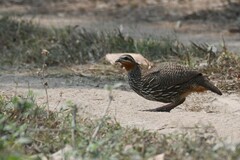
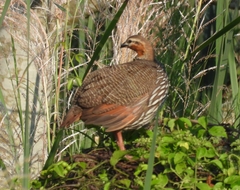
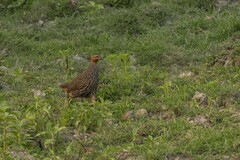
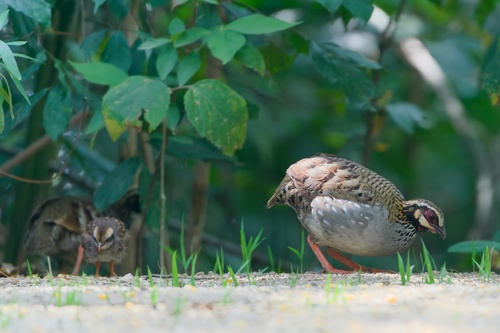
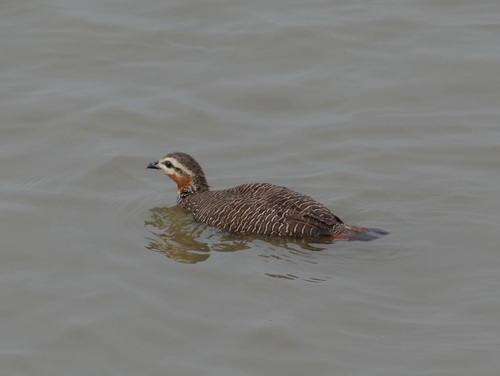
The swamp francolin (Ortygornis gularis), also called swamp partridge, is a francolin species native to the foothills of the Himalayas in northern India and Nepal. It is considered extinct in the Ganges-Brahmaputra delta in Bangladesh. It is listed as Near Threatened on the IUCN Red List.

It was formerly classified in the genus Francolinus, but phylogenetic analyses indicates that it groups with the crested francolin (O. sephaena) and grey francolin (O. pondicerianus). All three species were reclassified in the genus Ortygornis.

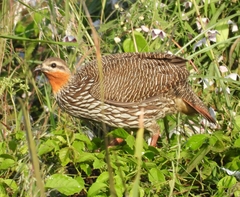
From Frank Finn's The Game Birds of India & Asia (1911): This species is easily distinguished from most of our partridges by its large size and comparatively long legs; as in the last species, the sexes are alike in plumage, but the cock is easily distinguishable by his spurs. The upper plumage is brown barred with buff, and the outer tail-feathers chestnut, as in the grey partridge; but the throat is bright rust-red, and the rest of the under-parts brown longitudinally streaked with white. The bill is blackish, the eyes dark, and the feet dull red. The cock of this species, which is a little larger than the hen, will measure... Wikipedia →
Sounds

Song0:11

India · 2024

© Lars Lachmann · XC882265 · CC BY-NC-SA 4.0

Uncertain0:08

India · 2020

© Sandip das · XC635402 · CC BY-NC-SA 4.0

Call0:15

India · 2018

© Dibyendu Ash · XC472456 · CC BY-NC-SA 4.0

Global Distribution

Parks Where Found

# Park Country Daily sighting probability
1 Kaziranga National Park 🇮🇳 India
~40%
2 Manas National Park 🇮🇳 India
~10%

Before you go

What are the chances of seeing a Swamp Francolin in Manas National Park?

With luck

About 10% of wildlife watchers report a Swamp Francolin sighting in Manas National Park on a given day, based on 214 verified sightings from GBIF citizen-science data from 2019 to 2026. It is the 112th most-seen of the 377 birds we can rate there. Over three days the chance rises to about 40%, and over a week to about 70%, if each day is a fresh chance.

When is the best time to see a Swamp Francolin in Manas National Park?

October and November

In those months about 30% of wildlife watchers report a Swamp Francolin in Manas National Park on a given day, against under 5% in January, the lowest month. Those are among Manas National Park's driest months, with about 75 mm of rain a month against 1070 mm in June.

What time of day is best to see a Swamp Francolin?

Between 10 am and 1 pm

Across all the parks we cover, that three-hour window holds the most Swamp Francolin sightings with a recorded time, and about 7 in 10 of them come between 6 am and 6 pm: it is most active around dawn and dusk.

Is Manas National Park the best place to see a Swamp Francolin?

2nd of 2

Of the 2 parks where we can rate Swamp Francolin sightings, Manas National Park ranks 2nd at about 10%. The best odds are in Kaziranga National Park (India, about 40%).

Which relatives of the Swamp Francolin live in Manas National Park?

Same family: Phasianidae

The closest relatives of the Swamp Francolin that you can see in Manas National Park (family Phasianidae, Pheasants, Grouse, and Allies) are Common Peafowl (about 60%), Red Junglefowl (about 50%) and Kalij Pheasant (about 20%), with each one's daily chance of a sighting.

Where does the Swamp Francolin sighting chance come from?

GBIF citizen-science records

It is estimated from how often the Swamp Francolin is recorded against all the birds logged in Manas National Park (214 verified sightings from 2019 to 2026), calibrated against known sighting rates. Figures are rounded to the nearest 10% because citizen-science data supports honest approximations, not decimals, and months with records from fewer than five people show "—". How it works.

← Back to Manas National Park