Madagascar Flufftail

Madagascar Flufftail

Sarothrura insularis

Silhouette: Andrew Smith (original) · PhyloPic

LCLeast ConcernNTVUENCR Endemic
Daily sighting probability ~40% · Likely
at Mantadia National Park

In 3 days ~70% in a week >90%

173 Verified sightings at Mantadia National Park From 2019 to 2026
414 In all 2 parks
May Best month
🌅 Crepuscular When it's spotted

About the Madagascar Flufftail

The Madagascar flufftail (Sarothrura insularis) is a species of bird in the family Sarothruridae. It is endemic to Madagascar. The subspecies is Monotypic. Madagascar flufftails are found in Madagascar however, they are limited in the wet areas in the north and lacking from Lake Sahaka in the northeast.

Its natural habitat is subtropical, tropical moist lowland forests, shrubland, grassland, and artificial areas. This is where they find their food which consists of insects and seeds. Madagascar Flufftails have a stable population of around 6,700-67,000. The species does not meet the criteria for vulnerability, therefore, it is marked as Least Concern.

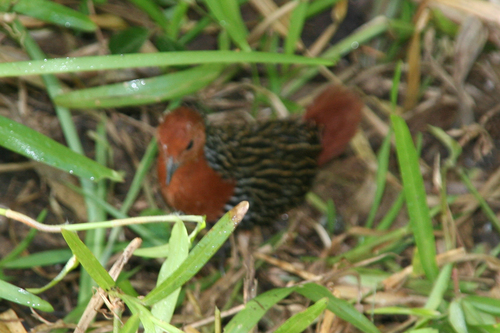
The Madagascar flufftail is small in size with a length of around 14cm and a weight of 30g. The head, neck, and breast of the adult male are chestnut rufous while the side of the head, the chin, and the throat are paler. Their back and stomach are black with stripes of white/yellow. The immature male is similar to the adult male except has a more dull color.

The females have a dull color. They have dark upper parts with chestnut streaks. The upper tail is barred cinnamon-buff and the longest upper tail is deep chestnut... Wikipedia →
Sounds

Call1:24

Madagascar · 2025

© Joost van Bruggen · XC1079466 · CC BY-NC-ND 4.0

Alarm call0:06

Madagascar · 2024

© Francesco Barberini · XC937122 · CC BY-NC-SA 4.0

Song0:15

Madagascar · 2012

© Peter Boesman · XC762967 · CC BY-NC-ND 4.0

Global Distribution

Parks Where Found

# Park Country Daily sighting probability
1 Mantadia National Park 🇲🇬 Madagascar
~40%
2 Ranomafana National Park 🇲🇬 Madagascar
~30%

Before you go

What are the chances of seeing a Madagascar Flufftail in Mantadia National Park?

Likely

About 40% of wildlife watchers report a Madagascar Flufftail sighting in Mantadia National Park on a given day, based on 173 verified sightings from GBIF citizen-science data from 2019 to 2026. It is the 35th most-seen of the 98 birds we can rate there. Over three days the chance rises to about 70%, and over a week to over 90%, if each day is a fresh chance.

When is the best time to see a Madagascar Flufftail in Mantadia National Park?

May and September

In those months about 50% of wildlife watchers report a Madagascar Flufftail in Mantadia National Park on a given day, against about 20% in June–July and December, the lowest months. Those are among Mantadia National Park's driest months, with about 70 mm of rain a month against 340 mm in January. January to April have too few records to rate.

What time of day is best to see a Madagascar Flufftail?

Between 4 and 7 pm

Across all the parks we cover, that three-hour window holds the most Madagascar Flufftail sightings with a recorded time, and about half of them come between 6 am and 6 pm: it is most active around dawn and dusk.

Is Mantadia National Park the best place to see a Madagascar Flufftail?

Yes

Of the 2 parks where we can rate Madagascar Flufftail sightings, Mantadia National Park has the highest daily chance: about 40%. Next come Ranomafana National Park (Madagascar, about 30%).

Which relatives of the Madagascar Flufftail live in Mantadia National Park?

Same family: Rallidae

The closest relatives of the Madagascar Flufftail that you can see in Mantadia National Park (family Rallidae, Rails, Gallinules, and Coots) are Madagascar Rail (about 40%), Common Moorhen (about 20%) and White-throated Rail (about 20%), with each one's daily chance of a sighting.

Where does the Madagascar Flufftail sighting chance come from?

GBIF citizen-science records

It is estimated from how often the Madagascar Flufftail is recorded against all the birds logged in Mantadia National Park (173 verified sightings from 2019 to 2026), calibrated against known sighting rates. Figures are rounded to the nearest 10% because citizen-science data supports honest approximations, not decimals, and months with records from fewer than five people show "—". How it works.

← Back to Mantadia National Park