
Madagascar Rail

Madagascar Rail

Rallus madagascariensis

Silhouette: Ferran Sayol · PhyloPic

LCNTVUVulnerableENCR Endemic
Daily sighting probability ~40% · Likely
at Mantadia National Park

In 3 days ~80% in a week >90%

182 Verified sightings at Mantadia National Park From 2019 to 2026
182 In 1 park
November Best month
☀️ Diurnal When it's spotted

About the Madagascar Rail

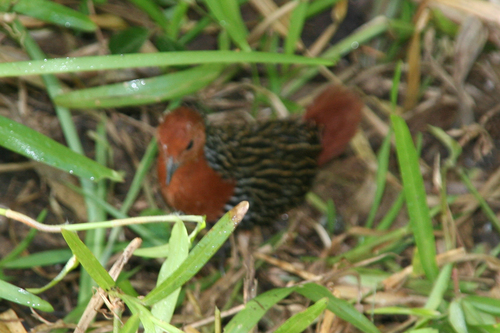
The Madagascar rail (Rallus madagascariensis) is a species of bird in the family Rallidae. It is endemic to Madagascar. This is a medium-sized rail measuring 25 cm (9.8 in). Its plumage is mostly plain brown with some streaks on the upperparts and upper breast. Its face and throat are greyish and its undertail is white. The bill is red and the legs are dark.

Its natural habitats are subtropical or tropical moist lowland forest, subtropical or tropical moist montane forest, and freshwater marshes. It is threatened by habitat loss. "Rallus madagascariensis". Avibase. "Madagascar rail media". Internet Bird Collection.

Interactive range map of Rallus madagascariensis at IUCN Red List Audio recordings of Madagascan rail on Xeno-canto. Wikipedia →

Sounds

Song0:07

Madagascar · 2012

© Hans Matheve · XC155189 · CC BY-NC-ND 3.0

Call0:33

Madagascar · 2020

© Ken Behrens · XC623652 · CC BY-NC-SA 4.0

Song0:05

Madagascar · 2001

© Brian Cox · XC57889 · CC BY-NC-ND 2.5

Global Distribution

Parks Where Found

# Park Country Daily sighting probability
1 Mantadia National Park 🇲🇬 Madagascar
~40%

More parks will be added in future updates.

Before you go

What are the chances of seeing a Madagascar Rail in Mantadia National Park?

Likely

About 40% of wildlife watchers report a Madagascar Rail sighting in Mantadia National Park on a given day, based on 182 verified sightings from GBIF citizen-science data from 2019 to 2026. It is the 25th most-seen of the 98 birds we can rate there. Over three days the chance rises to about 80%, and over a week to over 90%, if each day is a fresh chance.

When is the best time to see a Madagascar Rail in Mantadia National Park?

November

In that month about 50% of wildlife watchers report a Madagascar Rail in Mantadia National Park on a given day, against about 20% in May and June, the lowest months. January to April have too few records to rate.

What time of day is best to see a Madagascar Rail?

Between 2 and 5 pm

Across all the parks we cover, that three-hour window holds the most Madagascar Rail sightings with a recorded time, and about 8 in 10 of them come between 6 am and 6 pm: it is a daytime animal.

Where else can you see a Madagascar Rail?

Only Mantadia National Park, in our data

Mantadia National Park is the only park on Wallace's Line with enough records to rate Madagascar Rail sightings: about 40% of wildlife watchers there report one on a given day.

Which relatives of the Madagascar Rail live in Mantadia National Park?

Same family: Rallidae

The closest relatives of the Madagascar Rail that you can see in Mantadia National Park (family Rallidae, Rails, Gallinules, and Coots) are Madagascar Flufftail (about 40%), Common Moorhen (about 20%) and White-throated Rail (about 20%), with each one's daily chance of a sighting.

Where does the Madagascar Rail sighting chance come from?

GBIF citizen-science records

It is estimated from how often the Madagascar Rail is recorded against all the birds logged in Mantadia National Park (182 verified sightings from 2019 to 2026), calibrated against known sighting rates. Figures are rounded to the nearest 10% because citizen-science data supports honest approximations, not decimals, and months with records from fewer than five people show "—". How it works.

← Back to Mantadia National Park