
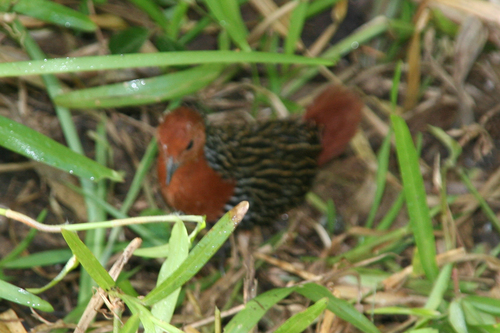
Madagascar Wood-Rail

Madagascar Wood-Rail

Mentocrex kioloides

Silhouette: Sheatherius · PhyloPic

LCLeast ConcernNTVUENCR Endemic
Daily sighting probability ~10% · With luck
at Mantadia National Park

In 3 days ~30% in a week ~50%

51 Verified sightings at Mantadia National Park From 2019 to 2026
235 In all 2 parks
December Best month
🌅 Crepuscular When it's spotted

About the Madagascar Wood-Rail

The Madagascar forest rail (Mentocrex kioloides), also known as the Madagascar wood rail or the kioloides rail, is a species of bird in the family Sarothruridae. It is endemic to forests, often in wet areas, in northern and eastern Madagascar. The secretive and shy personality of this reddish brown bird has contributed to a lack of study on this species; a reason why it is not that well known. Their smaller size and coloration make them great foragers on the forest floor. As of recent despite habitat loss the endangerment level of the Madagascar forest rail is 'of least concern.

This species was formerly placed in the genus Canirallus together with Tsingy forest rail and the grey-throated rail. A molecular genetic study published in 2019 found that the grey-throated rail is not closely related to the forest rails. The forest rails were therefore moved to the resurrected genus Mentocrex.

The Madagascar forest rail is a native species to Madagascar where it is seen throughout eastern humid forest, covering from near sea level to 2,000 m in elevation.The subspecies, M.k kiolodies, occupies the eastern rainforest while M.k berliozi is restricted to the Sambirano region of... Wikipedia →

Sounds

Call0:45

Madagascar · 2022

© Ken Behrens · XC750018 · CC BY-NC-SA 4.0

Song0:33

Madagascar · 2014

© Juha Honkala · XC395618 · CC BY-NC-SA 4.0

Song0:27

Madagascar · 2001

© Brian Cox · XC57892 · CC BY-NC-ND 2.5

Global Distribution

Parks Where Found

# Park Country Daily sighting probability
1 Ranomafana National Park 🇲🇬 Madagascar
~20%
2 Mantadia National Park 🇲🇬 Madagascar
~10%

Before you go

What are the chances of seeing a Madagascar Wood-Rail in Mantadia National Park?

With luck

About 10% of wildlife watchers report a Madagascar Wood-Rail sighting in Mantadia National Park on a given day, based on 51 verified sightings from GBIF citizen-science data from 2019 to 2026. It is the 65th most-seen of the 98 birds we can rate there. Over three days the chance rises to about 30%, and over a week to about 50%, if each day is a fresh chance.

When is the best time to see a Madagascar Wood-Rail in Mantadia National Park?

December

In that month about 20% of wildlife watchers report a Madagascar Wood-Rail in Mantadia National Park on a given day, against under 5% in June, the lowest month. January to April have too few records to rate.

What time of day is best to see a Madagascar Wood-Rail?

Between 5 and 8 am

Across all the parks we cover, that three-hour window holds the most Madagascar Wood-Rail sightings with a recorded time, and about 7 in 10 of them come between 6 am and 6 pm: it is most active around dawn and dusk.

Is Mantadia National Park the best place to see a Madagascar Wood-Rail?

2nd of 2

Of the 2 parks where we can rate Madagascar Wood-Rail sightings, Mantadia National Park ranks 2nd at about 10%. The best odds are in Ranomafana National Park (Madagascar, about 20%).

Which relatives of the Madagascar Wood-Rail live in Mantadia National Park?

Same order: Gruiformes

The closest relatives of the Madagascar Wood-Rail that you can see in Mantadia National Park (order Gruiformes, Cranes, Rails, and Allies) are Madagascar Rail (about 40%), Madagascar Flufftail (about 40%) and Common Moorhen (about 20%), with each one's daily chance of a sighting.

Where does the Madagascar Wood-Rail sighting chance come from?

GBIF citizen-science records

It is estimated from how often the Madagascar Wood-Rail is recorded against all the birds logged in Mantadia National Park (51 verified sightings from 2019 to 2026), calibrated against known sighting rates. Figures are rounded to the nearest 10% because citizen-science data supports honest approximations, not decimals, and months with records from fewer than five people show "—". How it works.

← Back to Mantadia National Park