



Completed

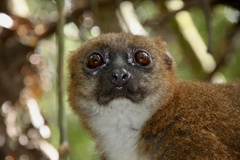


Red-bellied Lemur
Eulemur rubriventer
Silhouette: Yan Wong · PhyloPic
- KingdomAnimalia (Animals)
- PhylumChordata (Chordates)
- ClassMammalia (Mammals)
- OrderPrimates
- FamilyLemuridae (Typical Lemurs)
- GenusEulemur (Brown Lemurs)
- SpeciesEulemur rubriventer (Red-bellied Lemur)
In 3 days ~80% in a week >90%
36 Verified sightings at Mantadia National Park From 2019 to 2026
130 In all 2 parks
September Best month
☀️ Diurnal When it's spotted
About the Red-bellied Lemur
The red-bellied lemur (Eulemur rubriventer) is a medium-sized strepsirrhine primate with a luxuriant chestnut brown coat. This lemur is endemic to eastern Madagascan rainforests and is distinguished by patches of white skin below the eyes, giving rise to a "teardrop" effect, particularly conspicuous in the male.
The species, first identified in 1850, exhibits diurnal behaviour and marked sexual dimorphism. The red-bellied lemur has been studied extensively since the mid-1980s, primarily in Ranomafana National Park. This lemur species is designated as vulnerable according to the IUCN Red List, due to threats endangering habitats from slash-and-burn agriculture in Madagascar.
The various Malagasy names for the red-bellied lemur include tongo, tagona, halomena, kirioka, and soamiera. In the French scientific literature (Madagascar's second official language is French, due to prior colonisation by France), the species is called lémur à ventre rouge.
Being sexually dimorphic, the male of the species exhibits a medium-long, dense dorsal coat of intense chestnut brown. Ventrally, he is lighter and redder in hue, while his tail, muzzle and head are black. For... Wikipedia →
Recent sightings of Red-bellied Lemur in Mantadia National Park
LIVEiNaturalistGlobal Distribution
Parks Where Found
| # | Park | Country | Daily sighting probability |
|---|---|---|---|
| 1 | Ranomafana National Park | 🇲🇬 Madagascar | |
| 2 | Mantadia National Park | 🇲🇬 Madagascar |
Zoos & Centres Where Found
| # | Zoo / Centre | Country | |
|---|---|---|---|
| 1 | Paris Zoological Park | 🇫🇷 France | |
| 2 | Zoo Pilsen | 🇨🇿 Czechia | |
| 3 | Badoca Safari Park | 🇵🇹 Portugal | |
| 4 | Edinburgh Zoo | 🇬🇧 United Kingdom | |
| 5 | Parken Zoo | 🇸🇪 Sweden | |
| 6 | Botanical and Zoological Garden of Tsimbazaza | 🇲🇬 Madagascar | |
| 7 | Zoom di Cumiana | 🇮🇹 Italy | |
| 8 | Apenheul Primate Park | 🇳🇱 Netherlands | |
| 9 | Peak Wildlife Park | 🇬🇧 United Kingdom | |
| 10 | Valencia Bioparc | 🇪🇸 Spain | |
| 11 | LemuriaLand | 🇲🇬 Madagascar |
Closest Relatives at Mantadia National Park


Before you go
What are the chances of seeing a Red-bellied Lemur in Mantadia National Park?
Likely
About 40% of wildlife watchers report a Red-bellied Lemur sighting in Mantadia National Park on a given day, based on 36 verified sightings from GBIF citizen-science data from 2019 to 2026. It is the 8th most-seen of the 12 mammals we can rate there. Over three days the chance rises to about 80%, and over a week to over 90%, if each day is a fresh chance.
When is the best time to see a Red-bellied Lemur in Mantadia National Park?
March and September
In those months about 50% of wildlife watchers report a Red-bellied Lemur in Mantadia National Park on a given day, against under 5% in April, the lowest month.
What time of day is best to see a Red-bellied Lemur?
Between 7 and 10 am
Across all the parks we cover, that three-hour window holds the most Red-bellied Lemur sightings with a recorded time, and about 9 in 10 of them come between 6 am and 6 pm: it is a daytime animal.
Is Mantadia National Park the best place to see a Red-bellied Lemur?
2nd of 2
Of the 2 parks where we can rate Red-bellied Lemur sightings, Mantadia National Park ranks 2nd at about 40%. The best odds are in Ranomafana National Park (Madagascar, about 60%).
Where does the Red-bellied Lemur sighting chance come from?
GBIF citizen-science records
It is estimated from how often the Red-bellied Lemur is recorded against all the mammals logged in Mantadia National Park (36 verified sightings from 2019 to 2026), calibrated against known sighting rates. Figures are rounded to the nearest 10% because citizen-science data supports honest approximations, not decimals, and months with records from fewer than five people show "—". How it works.
