



Completed

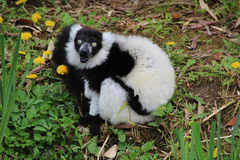

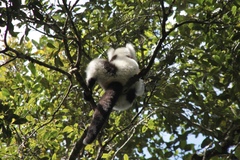


Black-and-white Ruffed Lemur
Varecia variegata
Silhouette: Elise · PhyloPic
- KingdomAnimalia (Animals)
- PhylumChordata (Chordates)
- ClassMammalia (Mammals)
- OrderPrimates
- FamilyLemuridae (Typical Lemurs)
- GenusVarecia (Ruffed Lemurs)
- SpeciesVarecia variegata (Black-and-white Ruffed Lemur)
In 3 days ~90% in a week >90%
105 Verified sightings at Mantadia National Park From 2019 to 2026
144 In all 2 parks
February Best month
☀️ Diurnal When it's spotted
About the Black-and-white Ruffed Lemur
The black-and-white ruffed lemur (Varecia variegata) is an endangered species of ruffed lemur, one of two which are endemic to the island of Madagascar. Despite having a larger range than the red ruffed lemur, it has a much smaller population that is spread out, living in lower population densities and reproductively isolated. It also has less coverage and protection in large national parks than the red ruffed lemur. Three subspecies of black-and-white ruffed lemur have been recognized since the red ruffed lemur was elevated to species status in 2001.
Together with the red ruffed lemur, they are the largest extant members of the family Lemuridae, ranging in length from 100 to 120 cm (39 to 47 in) and weighing between 3.1 and 4.1 kg (6.8 and 9.0 lb). They are arboreal, spending most of their time in the high canopy of the seasonal rainforests on the eastern side of the island. They are also diurnal, active exclusively in daylight hours. Quadrupedal locomotion is preferred in the trees and on the ground, and suspensory behavior is seen during feeding. As the most frugivorous of lemurs, the diet consists mainly of fruit, although nectar and flowers are also favored, followed by leaves and some seeds.
The black-and-white ruffed lemur has a complex social structure and is known for its loud, raucous calls. It is unusual in that it exhibits several reproductive traits typically found in small, nocturnal lemurs, such as a short gestation period, large litters and rapid maturation. In captivity, they can live up to 36 years. Wikipedia →
Sounds
Recording0:21
Madagascar · 2024
© traceeogee · iNaturalist · CC BY-NC 4.0
Recent sightings of Black-and-white Ruffed Lemur in Mantadia National Park
LIVEiNaturalistGlobal Distribution
Parks Where Found
| # | Park | Country | Daily sighting probability |
|---|---|---|---|
| 1 | Mantadia National Park | 🇲🇬 Madagascar | |
| 2 | Ranomafana National Park | 🇲🇬 Madagascar |
Zoos & Centres Where Found
| # | Zoo / Centre | Country | |
|---|---|---|---|
| 1 | Pairi Daiza | 🇧🇪 Belgium | |
| 2 | National Zoological Park | 🇺🇸 United States | |
| 3 | ZooParc de Beauval | 🇫🇷 France | |
| 4 | Copenhagen Zoo | 🇩🇰 Denmark | |
| 5 | California Academy of Sciences | 🇺🇸 United States | |
| 6 | Lisbon Oceanarium | 🇵🇹 Portugal | |
| 7 | Ostrava Zoo | 🇨🇿 Czechia | |
| 8 | Tulsa Zoo | 🇺🇸 United States | |
| 9 | Parc Phœnix | 🇫🇷 France | |
| 10 | Fota Wildlife Park | 🇮🇪 Ireland | |
| 11 | Aquarium de Lyon | 🇫🇷 France | |
| 12 | Zoo de Maubeuge | 🇫🇷 France | |
| 13 | Zoobotánico Jerez | 🇪🇸 Spain | |
| 14 | Zoo d'Amiens | 🇫🇷 France | |
| 15 | Zoo Miami | 🇺🇸 United States | |
| 16 | Lion Country Safari | 🇺🇸 United States | |
| 17 | African Lion Safari | 🇨🇦 Canada | |
| 18 | Binder Park Zoo | 🇺🇸 United States | |
| 19 | Taipei Zoo | 🇹🇼 Taiwan | |
| 20 | Safari West | 🇺🇸 United States | |
| 21 | Serengeti Park | 🇩🇪 Germany | |
| 22 | Bronx Zoo | 🇺🇸 United States | |
| 23 | Parc animalier de Sainte-Croix | 🇫🇷 France | |
| 24 | Planète Sauvage | 🇫🇷 France | |
| 25 | Nashville Zoo at Grassmere | 🇺🇸 United States | |
| 26 | Parc des Félins | 🇫🇷 France | |
| 27 | Beijing Zoo | 🇨🇳 China | |
| 28 | Omaha’s Henry Doorly Zoo and Aquarium | 🇺🇸 United States | |
| 29 | WildFlorida Safaris | 🇺🇸 United States | |
| 30 | Safari World | 🇹🇭 Thailand | |
| 31 | Wow Safari Thoiry | 🇫🇷 France | |
| 32 | Blair Drummond Safari and Adventure Park | 🇬🇧 United Kingdom | |
| 33 | Banham Zoo | 🇬🇧 United Kingdom | |
| 34 | Orana Wildlife Park | 🇳🇿 New Zealand | |
| 35 | Zoo and Botanical Garden of Branféré | 🇫🇷 France | |
| 36 | Dallas Zoo | 🇺🇸 United States | |
| 37 | Marwell Zoo | 🇬🇧 United Kingdom | |
| 38 | Selwo Aventura | 🇪🇸 Spain | |
| 39 | Leofoo Village Theme Park | 🇹🇼 Taiwan | |
| 40 | Africam Safari | 🇲🇽 Mexico | |
| 41 | Louisville Zoo | 🇺🇸 United States | |
| 42 | Audubon Zoo | 🇺🇸 United States | |
| 43 | Novosibirsk Zoo | 🇷🇺 Russia | |
| 44 | Noah's Ark Zoo Farm | 🇬🇧 United Kingdom | |
| 45 | Zoo La Barben | 🇫🇷 France | |
| 46 | Granby Zoo | 🇨🇦 Canada | |
| 47 | Oasis Park | 🇪🇸 Spain | |
| 48 | Saint Louis Zoo | 🇺🇸 United States | |
| 49 | ABQ BioPark: Zoo, Aquarium, Botanic Garden | 🇺🇸 United States | |
| 50 | Pombia Safari Park | 🇮🇹 Italy |
Closest Relatives at Mantadia National Park


Before you go
What are the chances of seeing a Black-and-white Ruffed Lemur in Mantadia National Park?
Likely
About 50% of wildlife watchers report a Black-and-white Ruffed Lemur sighting in Mantadia National Park on a given day, based on 105 verified sightings from GBIF citizen-science data from 2019 to 2026. It is the 7th most-seen of the 12 mammals we can rate there. Over three days the chance rises to about 90%, and over a week to over 90%, if each day is a fresh chance.
When is the best time to see a Black-and-white Ruffed Lemur in Mantadia National Park?
February and May
In those months about 70% of wildlife watchers report a Black-and-white Ruffed Lemur in Mantadia National Park on a given day, against under 5% in September, the lowest month.
What time of day is best to see a Black-and-white Ruffed Lemur?
Between 7 and 10 am
Across all the parks we cover, that three-hour window holds the most Black-and-white Ruffed Lemur sightings with a recorded time, and about 8 in 10 of them come between 6 am and 6 pm: it is a daytime animal.
Is Mantadia National Park the best place to see a Black-and-white Ruffed Lemur?
Yes
Of the 2 parks where we can rate Black-and-white Ruffed Lemur sightings, Mantadia National Park has the highest daily chance: about 50%. Next come Ranomafana National Park (Madagascar, about 50%).
Which relatives of the Black-and-white Ruffed Lemur live in Mantadia National Park?
Same family: Lemuridae
The closest relatives of the Black-and-white Ruffed Lemur that you can see in Mantadia National Park (family Lemuridae, Typical Lemurs) are Common Brown Lemur (about 80%), Eastern Lesser Bamboo Lemur (about 80%) and Red-bellied Lemur (about 40%), with each one's daily chance of a sighting.
Where does the Black-and-white Ruffed Lemur sighting chance come from?
GBIF citizen-science records
It is estimated from how often the Black-and-white Ruffed Lemur is recorded against all the mammals logged in Mantadia National Park (105 verified sightings from 2019 to 2026), calibrated against known sighting rates. Figures are rounded to the nearest 10% because citizen-science data supports honest approximations, not decimals, and months with records from fewer than five people show "—". How it works.
