



Completed

Fossa
Cryptoprocta ferox
- KingdomAnimalia (Animals)
- PhylumChordata (Chordates)
- ClassMammalia (Mammals)
- OrderCarnivora (Carnivorans)
- FamilyEupleridae (Euplerids)
- GenusCryptoprocta (Fossas)
- SpeciesCryptoprocta ferox (Fossa)
In 3 days ~50% in a week ~80%
13 Verified sightings at Mantadia National Park From 2019 to 2026
13 In 1 park
November Best month
☀️ Diurnal When it's spotted
About the Fossa
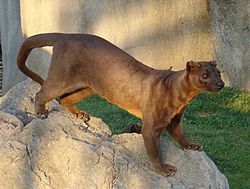
The fossa (Cryptoprocta ferox; FOSS-ə or FOO-sə; Malagasy: [ˈfusə̥]) is a slender, long-tailed, cat-like mammal that is endemic to Madagascar. It is a member of the carnivoran family Eupleridae. The fossa is the largest mammalian carnivore on Madagascar and has been compared to a small cougar, as it has convergently evolved many cat-like features. Adults have a head-body length of 70–80 cm (28–31 in) and weigh between 5.5 and 8.6 kg (12 and 19 lb), with the males larger than the females. It has semi-retractable claws (meaning it can extend but not retract its claws fully) and flexible ankles that allow it to climb up and down trees head-first, and also support jumping from tree to tree. Two larger extinct relatives of the species are known, Cryptoprocta spelea and Cryptoprocta bevatabe, with the former probably becoming extinct before 1400.
The species is widespread, although population densities are usually low. It is found solely in forested habitat, and actively hunts both by day and night. Over 50% of its diet consists of lemurs, the endemic primates found on the island; tenrecs, rodents, lizards, birds, and other animals are also documented as prey. Mating usually occurs in trees on horizontal limbs and can last for several hours. Litters range from one to six pups, which are born altricial (blind and toothless). Infants wean after 4.5 months and are independent after a year. Sexual maturity occurs around three to four years of age, and life expectancy in captivity is 20 years. The fossa is listed as a vulnerable species on the IUCN Red List. It is generally feared by the Malagasy people and is often protected by their fady taboo. The greatest threat to the fossa is habitat destruction.
Its taxonomic classification has been controversial because its physical traits resemble those of cats, yet other traits suggest a close relationship with viverrids. Its classification, along with that of the other Malagasy carnivores, influenced hypotheses about how many times mammalian carnivores have colonized Madagascar. With genetic studies demonstrating that the fossa and all other Malagasy carnivores are most closely related to each other forming a clade, recognized as the family Eupleridae, carnivorans are now thought to have colonized the island once, around 18–20 million years ago. Wikipedia →
Recent sightings of Fossa in Mantadia National Park
LIVEiNaturalistGlobal Distribution
Parks Where Found
| # | Park | Country | Daily sighting probability |
|---|---|---|---|
| 1 | Mantadia National Park | 🇲🇬 Madagascar |
More parks will be added in future updates.
Zoos & Centres Where Found
Closest Relatives at Mantadia National Park
No species of the same family or order lives in Mantadia National Park, so these are its closest relatives here: other mammals.


Before you go
What are the chances of seeing a Fossa in Mantadia National Park?
Possible
About 20% of wildlife watchers report a Fossa sighting in Mantadia National Park on a given day, based on 13 verified sightings from GBIF citizen-science data from 2019 to 2026. It is the 11th most-seen of the 12 mammals we can rate there. Over three days the chance rises to about 50%, and over a week to about 80%, if each day is a fresh chance.
When is the best time to see a Fossa in Mantadia National Park?
November
In that month about 50% of wildlife watchers report a Fossa in Mantadia National Park on a given day, against under 5% in January–July and September–October, the lowest months.
What time of day is best to see a Fossa?
Between 7 and 10 am
Across all the parks we cover, that three-hour window holds the most Fossa sightings with a recorded time, and about 7 in 10 of them come between 6 am and 6 pm: it is a daytime animal.
Where else can you see a Fossa?
Only Mantadia National Park, in our data
Mantadia National Park is the only park on Wallace's Line with enough records to rate Fossa sightings: about 20% of wildlife watchers there report one on a given day.
Where does the Fossa sighting chance come from?
GBIF citizen-science records
It is estimated from how often the Fossa is recorded against all the mammals logged in Mantadia National Park (13 verified sightings from 2019 to 2026), calibrated against known sighting rates. Figures are rounded to the nearest 10% because citizen-science data supports honest approximations, not decimals, and months with records from fewer than five people show "—". How it works.
