Black-and-chestnut Eagle

Black-and-chestnut Eagle

Spizaetus isidori

Silhouette: Sheatherius · PhyloPic

LCNTVUENEndangeredCR
Daily sighting probability ~10% · With luck
at Manu National Park

In 3 days ~40% in a week ~70%

33 Verified sightings at Manu National Park From 2019 to 2026
58 In all 3 parks
November Best month
☀️ Diurnal When it's spotted

About the Black-and-chestnut Eagle

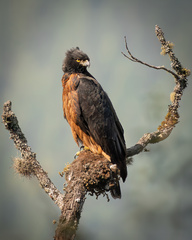
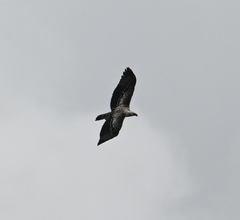
The black-and-chestnut eagle (Spizaetus isidori), also known as Isidor's eagle, is a large South American species of bird of prey in the family Accipitridae. It is often placed in the monotypic genus Oroaetus. However, recent genetic testing indicates that this species is fairly closely related to Spizaetus species and thus the species should be included in that genus. The black-and-chestnut eagle is a typical forest raptor, hunting primarily small to medium-sized mammals and birds and constructing a large nest in a tall tree. Unfortunately, the twin causes of habitat destruction and persecution have caused population declines and the black-and-chestnut eagle is considered to be an Endangered species by the IUCN.

Its scientific name was chosen in honour of French zoologist, Isidore Geoffroy Saint-Hilaire. It is found in humid montane forests, normally at elevations between 1,800 to 2,500 m (5,900 to 8,200 ft), in the Andes from northern Argentina, through Bolivia, Peru, Ecuador, Colombia, to Venezuela, with isolated populations in the Venezuelan Coastal Range, Serranía del Perijá and Sierra Nevada de Santa Marta. It is generally local and rare... Wikipedia →

Sounds

Aberrant0:12

Brazil · 2026

© Uillian · XC1138784 · CC BY-NC-SA 4.0

Alarm call0:09

Argentina · 2023

© Carlos Ferrari · XC831466 · CC BY-NC-SA 4.0

Uncertain0:14

Colombia · 2022

© Jorge Luis · XC794440 · CC BY-NC-SA 4.0

Global Distribution

Parks Where Found

# Park Country Daily sighting probability
1 Manu National Park 🇵🇪 Peru
~10%
2 Los Nevados National Natural Park 🇨🇴 Colombia
<5%
3 Podocarpus National Park 🇪🇨 Ecuador
<5%

Zoos & Centres Where Found

# Zoo / Centre Country
1 Ukumarí Biopark 🇨🇴 Colombia In captivity
2 Amaru 🇪🇨 Ecuador In captivity
3 Bioparque Los Ocarros 🇨🇴 Colombia In captivity
4 Bioparque Wakatá 🇨🇴 Colombia In captivity
5 Wiwa Quito 🇪🇨 Ecuador In captivity

Before you go

What are the chances of seeing a Black-and-chestnut Eagle in Manu National Park?

With luck

About 10% of wildlife watchers report a Black-and-chestnut Eagle sighting in Manu National Park on a given day, based on 33 verified sightings from GBIF citizen-science data from 2019 to 2026. It is the 108th most-seen of the 641 birds we can rate there. Over three days the chance rises to about 40%, and over a week to about 70%, if each day is a fresh chance.

When is the best time to see a Black-and-chestnut Eagle in Manu National Park?

March and August–November

In those months about 20% of wildlife watchers report a Black-and-chestnut Eagle in Manu National Park on a given day, against about 10% in April–July and December–February, the lowest months.

What time of day is best to see a Black-and-chestnut Eagle?

Between 10 am and 1 pm

Across all the parks we cover, that three-hour window holds the most Black-and-chestnut Eagle sightings with a recorded time, and about 9 in 10 of them come between 6 am and 6 pm: it is a daytime animal.

Is Manu National Park the best place to see a Black-and-chestnut Eagle?

Yes

Of the 3 parks where we can rate Black-and-chestnut Eagle sightings, Manu National Park has the highest daily chance: about 10%. Next come Los Nevados National Natural Park (Colombia, under 5%) and Podocarpus National Park (Ecuador, under 5%).

Where does the Black-and-chestnut Eagle sighting chance come from?

GBIF citizen-science records

It is estimated from how often the Black-and-chestnut Eagle is recorded against all the birds logged in Manu National Park (33 verified sightings from 2019 to 2026), calibrated against known sighting rates. Figures are rounded to the nearest 10% because citizen-science data supports honest approximations, not decimals, and months with records from fewer than five people show "—". How it works.

← Back to Manu National Park