Black-bellied Thorntail

Black-bellied Thorntail

Discosura langsdorffi

Silhouette: Andy Wilson · PhyloPic

LCLeast ConcernNTVUENCR
Daily sighting probability <5% · Rare
at Manu National Park

In 3 days <5%

24 Verified sightings at Manu National Park From 2019 to 2026
46 In all 2 parks
February Best month
☀️ Diurnal When it's spotted

About the Black-bellied Thorntail

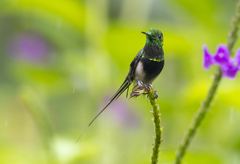
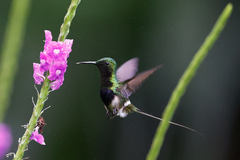
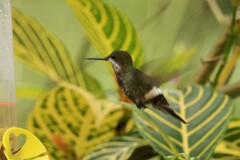
The black-bellied thorntail (Discosura langsdorffi) is a species of hummingbird in the "coquettes", tribe Lesbiini of subfamily Lesbiinae. It is found in Bolivia, Brazil, Colombia, Ecuador, Peru, and Venezuela. The black-bellied thorntail was briefly placed in genus Gouldomyia that was then merged into Popelairia. Since the late 1900s that genus has been merged into the present Discosura. Some authors have further merged Discosura into Lophornis but this treatment has not been widely accepted.

The black-bellied thorntail weighs about 3.2 g (0.11 oz). Males are 12 to 13.7 cm (4.7 to 5.4 in) long and females 7.4 to 7.6 cm (2.9 to 3.0 in). Adults of both sexes of the nominate subspecies have an iridescent emerald green crown and coppery green upperparts with a white band across the rump. The male's gorget is iridescent emerald green with a golden coppery band below it. Its flanks are bronzy green and the rest of the underparts black. The tail inner feathers of the tail are steely blue and the outer three pairs gray; all... Wikipedia →

Sounds

Call0:10

Peru · 2011

© Daniel Lane · XC83821 · CC BY-NC-ND 2.5

Global Distribution

Parks Where Found

# Park Country Daily sighting probability
1 Yasuní National Park 🇪🇨 Ecuador
<5%
2 Manu National Park 🇵🇪 Peru
<5%

Before you go

What are the chances of seeing a Black-bellied Thorntail in Manu National Park?

Rare

Under 5% of wildlife watchers report a Black-bellied Thorntail sighting in Manu National Park on a given day, based on 24 verified sightings from GBIF citizen-science data from 2019 to 2026. It is the 523rd most-seen of the 641 birds we can rate there. Over three days the chance rises to under 5%, if each day is a fresh chance.

When is the best time to see a Black-bellied Thorntail in Manu National Park?

February

In that month about 10% of wildlife watchers report a Black-bellied Thorntail in Manu National Park on a given day, against under 5% in March to January, the lowest months. That is one of Manu National Park's wettest months, with about 290 mm of rain against 60 mm in August.

What time of day is best to see a Black-bellied Thorntail?

Between 7 and 10 am

Across all the parks we cover, that three-hour window holds the most Black-bellied Thorntail sightings with a recorded time, and about 9 in 10 of them come between 6 am and 6 pm: it is a daytime animal.

Is Manu National Park the best place to see a Black-bellied Thorntail?

Among the best

Of the 2 parks where we can rate Black-bellied Thorntail sightings, Manu National Park ranks 2nd at under 5%, level with the leaders once rounded. The best odds are in Yasuní National Park (Ecuador, under 5%).

Where does the Black-bellied Thorntail sighting chance come from?

GBIF citizen-science records

It is estimated from how often the Black-bellied Thorntail is recorded against all the birds logged in Manu National Park (24 verified sightings from 2019 to 2026), calibrated against known sighting rates. Figures are rounded to the nearest 10% because citizen-science data supports honest approximations, not decimals, and months with records from fewer than five people show "—". How it works.

← Back to Manu National Park