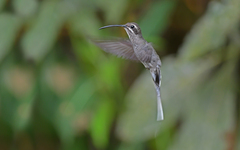
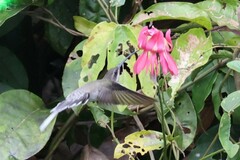
White-bearded Hermit

White-bearded Hermit

Phaethornis hispidus

Silhouette: Andy Wilson · PhyloPic

LCLeast ConcernNTVUENCR
Daily sighting probability ~30% · Possible
at Manu National Park

In 3 days ~60% in a week ~90%

1,219 Verified sightings at Manu National Park From 2019 to 2026
2,009 In all 7 parks
June Best month
☀️ Diurnal When it's spotted

About the White-bearded Hermit

The white-bearded hermit (Phaethornis hispidus) is a species of hummingbird in the family Trochilidae. It is found in Bolivia, Brazil, Colombia, Ecuador, Peru, and Venezuela. The white-bearded hermit is monotypic. The white-bearded hermit is about 13 to 14 cm (5.1 to 5.5 in) long and weighs 4 to 6 g (0.14 to 0.21 oz). This medium-sized hermit has bronzy green upperparts with gray margins on the uppertail coverts. The underparts are gray. The face has a black "mask" with a white supercilium and malar stripe; the center of the throat has a white stripe. The female has identical plumage but shorter wings and a shorter and more decurved bill than the male.

The white-bearded hermit is found in Amazonia, from the Andean foothills of western and southern Venezuela south through eastern Colombia, Ecuador, and Peru to northeastern Bolivia, and east throughout western Amazonian Brazil. In elevation it usually ranges as high as 850 m (2,800 ft) but has been recorded up to 1,200 m (3,900 ft) in Peru. It is a bird of humid landscapes. In the lowlands it mostly inhabits regularly inundated areas, such as along rivers... Wikipedia →

Sounds

Call0:56

Bolivia · 2023

© Richard E. Webster · XC860568 · CC BY-NC-SA 4.0

Song0:41

Brazil · 2017

© Fernando Igor de Godoy · XC537502 · CC BY-NC-SA 4.0

Flight call0:13

Peru · 2011

© David Geale · XC88586 · CC BY-NC-ND 2.5

Global Distribution

Parks Where Found

# Park Country Daily sighting probability
1 Manu National Park 🇵🇪 Peru
~30%
2 Tambopata National Reserve 🇵🇪 Peru
~10%
3 Amacayacu National Natural Park 🇨🇴 Colombia
~10%
4 Yasuní National Park 🇪🇨 Ecuador
~10%
5 Sierra de la Macarena National Park 🇨🇴 Colombia
<5%
6 Cuyabeno Wildlife Reserve 🇪🇨 Ecuador
<5%
7 Amboró National Park 🇧🇴 Bolivia
<5%

Before you go

What are the chances of seeing a White-bearded Hermit in Manu National Park?

Possible

About 30% of wildlife watchers report a White-bearded Hermit sighting in Manu National Park on a given day, based on 1,219 verified sightings from GBIF citizen-science data from 2019 to 2026. It is the 40th most-seen of the 641 birds we can rate there. Over three days the chance rises to about 60%, and over a week to about 90%, if each day is a fresh chance.

When is the best time to see a White-bearded Hermit in Manu National Park?

April to October

In those months about 30% of wildlife watchers report a White-bearded Hermit in Manu National Park on a given day, against about 10% in January, the lowest month.

What time of day is best to see a White-bearded Hermit?

Between 7 and 10 am

Across all the parks we cover, that three-hour window holds the most White-bearded Hermit sightings with a recorded time, and about 8 in 10 of them come between 6 am and 6 pm: it is a daytime animal.

Is Manu National Park the best place to see a White-bearded Hermit?

Yes

Of the 7 parks where we can rate White-bearded Hermit sightings, Manu National Park has the highest daily chance: about 30%. Next come Tambopata National Reserve (Peru, about 10%) and Amacayacu National Natural Park (Colombia, about 10%).

Which relatives of the White-bearded Hermit live in Manu National Park?

Same genus: Phaethornis

The closest relatives of the White-bearded Hermit that you can see in Manu National Park (genus Phaethornis, Typical Hermits) are Great-billed Hermit (about 10%), Reddish Hermit (about 10%) and White-browed Hermit (about 10%), with each one's daily chance of a sighting.

Where does the White-bearded Hermit sighting chance come from?

GBIF citizen-science records

It is estimated from how often the White-bearded Hermit is recorded against all the birds logged in Manu National Park (1,219 verified sightings from 2019 to 2026), calibrated against known sighting rates. Figures are rounded to the nearest 10% because citizen-science data supports honest approximations, not decimals, and months with records from fewer than five people show "—". How it works.

← Back to Manu National Park