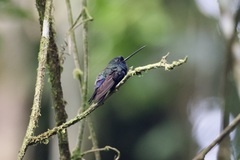
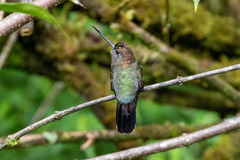
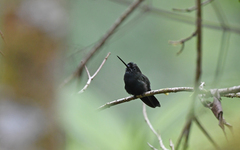
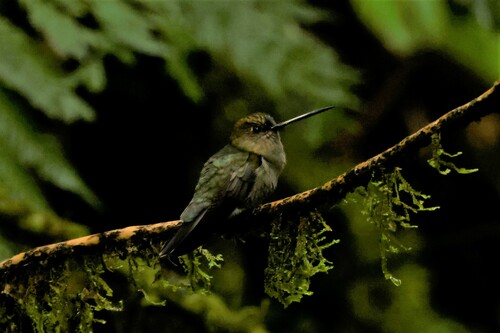
Blue-fronted Lancebill

Blue-fronted Lancebill

Doryfera johannae

Silhouette: PhyloPic

LCLeast ConcernNTVUENCR
Daily sighting probability ~10% · With luck
at Manu National Park

In 3 days ~20% in a week ~50%

333 Verified sightings at Manu National Park From 2019 to 2026
361 In all 3 parks
October Best month
☀️ Diurnal When it's spotted

About the Blue-fronted Lancebill

The blue-fronted lancebill (Doryfera johannae) is a species of hummingbird in the family Trochilidae. It is found in Brazil, Colombia, Ecuador, Guyana, Peru, and Venezuela. It shares its genus only with the very similar green-fronted lancebill (D. ludovicae).

The blue-fronted lancebill is 9.6 to 11 cm (3.8 to 4.3 in) long. Males weigh 3 to 5 g (0.11 to 0.18 oz) and females 3.3 to 6 g (0.12 to 0.21 oz). Both sexes have a long straight to slightly upcurved bill, and often hold it at an upward angle. Males of the nominate subspecies have a violet forehead ("front"), a bronze nape, and otherwise dark bronzy green upperparts. The tail is short and blue-black. The underparts are blue-black with a bluish green gloss on the throat and breast. The female differs from the male by having a greenish blue forehead and dull grayish bronzy green underparts. Both sexes of D. j. guianensis have a shorter bill than the nominate and are overall paler but similarly colored.

The nominate subspecies of blue-fronted lancebill is found... Wikipedia →

Sounds

Call0:09

Ecuador · 2024

© Manuel Sánchez-Nivicela · XC1104071 · CC BY-NC-ND 4.0

Flight call0:33

Peru · 1996

© Daniel F. Lane · XC257057 · CC BY-NC-SA 4.0

Call0:05

Colombia · 2017

© Ottavio Janni · XC357506 · CC BY-NC-SA 4.0

Global Distribution

Parks Where Found

# Park Country Daily sighting probability
1 Manu National Park 🇵🇪 Peru
~10%
2 Sierra de la Macarena National Park 🇨🇴 Colombia
<5%
3 Podocarpus National Park 🇪🇨 Ecuador
<5%

Before you go

What are the chances of seeing a Blue-fronted Lancebill in Manu National Park?

With luck

About 10% of wildlife watchers report a Blue-fronted Lancebill sighting in Manu National Park on a given day, based on 333 verified sightings from GBIF citizen-science data from 2019 to 2026. It is the 181st most-seen of the 641 birds we can rate there. Over three days the chance rises to about 20%, and over a week to about 50%, if each day is a fresh chance.

When is the best time to see a Blue-fronted Lancebill in Manu National Park?

April–July and September–November

In those months about 10% of wildlife watchers report a Blue-fronted Lancebill in Manu National Park on a given day, against under 5% in August and December–March, the lowest months.

What time of day is best to see a Blue-fronted Lancebill?

Between 8 and 11 am

Across all the parks we cover, that three-hour window holds the most Blue-fronted Lancebill sightings with a recorded time, and about 8 in 10 of them come between 6 am and 6 pm: it is a daytime animal.

Is Manu National Park the best place to see a Blue-fronted Lancebill?

Yes

Of the 3 parks where we can rate Blue-fronted Lancebill sightings, Manu National Park has the highest daily chance: about 10%. Next come Sierra de la Macarena National Park (Colombia, under 5%) and Podocarpus National Park (Ecuador, under 5%).

Where does the Blue-fronted Lancebill sighting chance come from?

GBIF citizen-science records

It is estimated from how often the Blue-fronted Lancebill is recorded against all the birds logged in Manu National Park (333 verified sightings from 2019 to 2026), calibrated against known sighting rates. Figures are rounded to the nearest 10% because citizen-science data supports honest approximations, not decimals, and months with records from fewer than five people show "—". How it works.

← Back to Manu National Park