
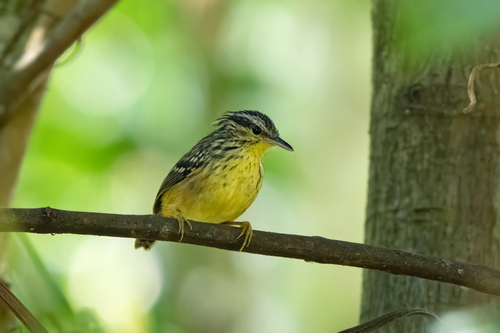
Bluish-slate Antshrike

Bluish-slate Antshrike

Thamnomanes schistogynus

Silhouette: Sheatherius · PhyloPic

LCLeast ConcernNTVUENCR
Daily sighting probability ~20% · Possible
at Manu National Park

In 3 days ~40% in a week ~70%

666 Verified sightings at Manu National Park From 2019 to 2026
1,154 In all 2 parks
September Best month
☀️ Diurnal When it's spotted

About the Bluish-slate Antshrike

The bluish-slate antshrike (Thamnomanes schistogynus) is a species of bird in subfamily Thamnophilinae of family Thamnophilidae, the "typical antbirds". It is found in Bolivia, Brazil, and Peru. Some early twentieth century authors treated the bluish-slate antshrike and the cinereous antshrike (T. caesius) as conspecific. They now are considered a superspecies.

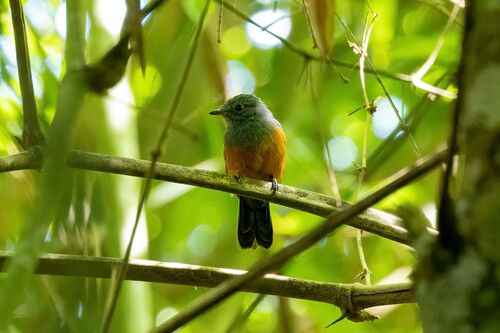
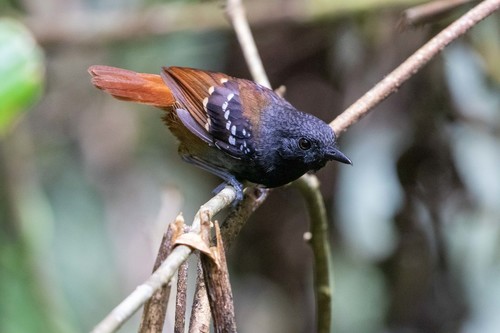
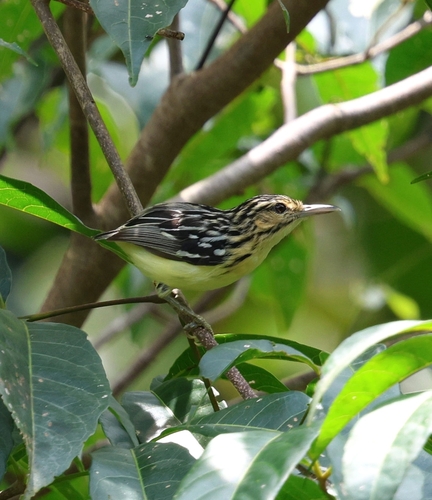
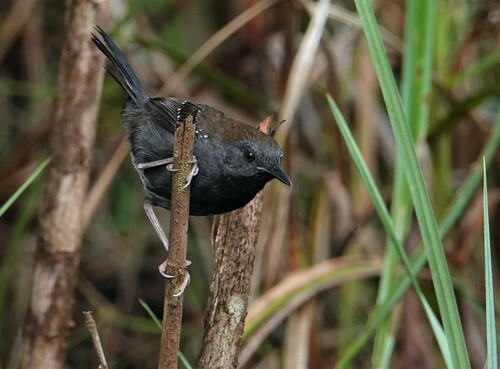
The bluish-slate antshrike is 13.5 to 14.5 cm (5.3 to 5.7 in) long and weighs 16 to 18 g (0.56 to 0.63 oz). Adult males of the nominate subspecies are almost entirely darkish gray; they have a hidden white patch between the scapulars. Adult females' upperparts and throat are a slightly browner and paler gray than the male's. Their ear coverts and throat have thin white streaks. Their belly and flanks are deep cinnamon-rufous. Subspecies T. s. intermedius is darker overall than the nominate.

The nominate subspecies of the bluish-slate antshrike has the larger range. It is found in western Brazil south of the Amazon... Wikipedia →

Sounds

Call0:16

Brazil · 2026

© JAYRSON ARAUJO DE OLIVEIRA · XC1182523 · CC BY-NC-SA 4.0

Canto0:53

Brazil · 2018

© Caio Brito · XC556624 · CC BY-NC-SA 4.0

Song1:04

Peru · 2018

© Will Sweet · XC453530 · CC BY-NC-SA 4.0

Global Distribution

Parks Where Found

# Park Country Daily sighting probability
1 Manu National Park 🇵🇪 Peru
~20%
2 Tambopata National Reserve 🇵🇪 Peru
~10%

Before you go

What are the chances of seeing a Bluish-slate Antshrike in Manu National Park?

Possible

About 20% of wildlife watchers report a Bluish-slate Antshrike sighting in Manu National Park on a given day, based on 666 verified sightings from GBIF citizen-science data from 2019 to 2026. It is the 91st most-seen of the 641 birds we can rate there. Over three days the chance rises to about 40%, and over a week to about 70%, if each day is a fresh chance.

When is the best time to see a Bluish-slate Antshrike in Manu National Park?

May, July–September and November–January

In those months about 20% of wildlife watchers report a Bluish-slate Antshrike in Manu National Park on a given day, against about 10% in February–April, June and October, the lowest months.

What time of day is best to see a Bluish-slate Antshrike?

Between 8 and 11 am

Across all the parks we cover, that three-hour window holds the most Bluish-slate Antshrike sightings with a recorded time, and about 9 in 10 of them come between 6 am and 6 pm: it is a daytime animal.

Is Manu National Park the best place to see a Bluish-slate Antshrike?

Yes

Of the 2 parks where we can rate Bluish-slate Antshrike sightings, Manu National Park has the highest daily chance: about 20%. Next come Tambopata National Reserve (Peru, about 10%).

Where does the Bluish-slate Antshrike sighting chance come from?

GBIF citizen-science records

It is estimated from how often the Bluish-slate Antshrike is recorded against all the birds logged in Manu National Park (666 verified sightings from 2019 to 2026), calibrated against known sighting rates. Figures are rounded to the nearest 10% because citizen-science data supports honest approximations, not decimals, and months with records from fewer than five people show "—". How it works.

← Back to Manu National Park