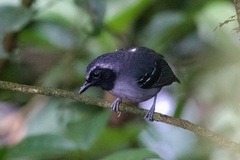

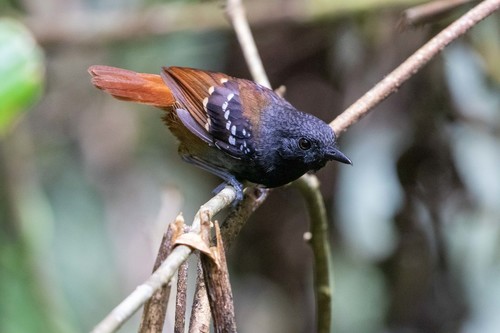
Black-faced Antbird

Black-faced Antbird

Myrmoborus myotherinus

Silhouette: Sheatherius · PhyloPic

LCLeast ConcernNTVUENCR
Daily sighting probability ~10% · With luck
at Manu National Park

In 3 days ~30% in a week ~60%

524 Verified sightings at Manu National Park From 2019 to 2026
1,656 In all 7 parks
May Best month
☀️ Diurnal When it's spotted

About the Black-faced Antbird

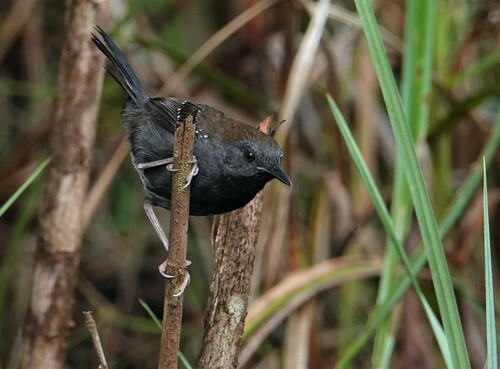
The black-faced antbird (Myrmoborus myotherinus) is a species of bird in subfamily Thamnophilinae of family Thamnophilidae, the "typical antbirds". It is found in Bolivia, Brazil, Colombia, Ecuador, Peru, and Venezuela. The black-faced antbird was described and illustrated by the German naturalist Johann Baptist von Spix in 1825 and given the binomial name Thamnophilus myotherinus. The specific epithet is from the Ancient Greek muiothēras meaning "flyhunter".

The black-faced antbird has these seven subspecies: Authors have suggested that some of the subspecies might better be treated as full species. The black-faced antbird is 12 to 13.5 cm (4.7 to 5.3 in) long and weighs 16 to 22 g (0.56 to 0.78 oz). Adult males of the nominate subspecies M. m. myotherinus have a dark bluish gray crown, nape, and upperparts... Wikipedia →

Sounds

Flight call0:23

Colombia · 2022

© Frank Lambert · XC1141182 · CC BY-NC-ND 4.0

Call0:25

Peru · 2024

© Richard E. Webster · XC961516 · CC BY-NC-SA 4.0

Song0:36

Brazil · 2022

© Ina Tirri · XC789264 · CC BY-NC-SA 4.0

Global Distribution

Parks Where Found

# Park Country Daily sighting probability
1 Sierra de la Macarena National Park 🇨🇴 Colombia
~20%
2 Tambopata National Reserve 🇵🇪 Peru
~10%
3 Manu National Park 🇵🇪 Peru
~10%
4 Amacayacu National Natural Park 🇨🇴 Colombia
~10%
5 Yasuní National Park 🇪🇨 Ecuador
~10%
6 Anavilhanas National Park 🇧🇷 Brazil
~10%
7 Cuyabeno Wildlife Reserve 🇪🇨 Ecuador
<5%

Before you go

What are the chances of seeing a Black-faced Antbird in Manu National Park?

With luck

About 10% of wildlife watchers report a Black-faced Antbird sighting in Manu National Park on a given day, based on 524 verified sightings from GBIF citizen-science data from 2019 to 2026. It is the 128th most-seen of the 641 birds we can rate there. Over three days the chance rises to about 30%, and over a week to about 60%, if each day is a fresh chance.

When is the best time to see a Black-faced Antbird in Manu National Park?

January, May and November

In those months about 20% of wildlife watchers report a Black-faced Antbird in Manu National Park on a given day, against about 10% in February–April, June–October and December, the lowest months.

What time of day is best to see a Black-faced Antbird?

Between 6 and 9 am

Across all the parks we cover, that three-hour window holds the most Black-faced Antbird sightings with a recorded time, and about 8 in 10 of them come between 6 am and 6 pm: it is a daytime animal.

Is Manu National Park the best place to see a Black-faced Antbird?

3rd of 7

Of the 7 parks where we can rate Black-faced Antbird sightings, Manu National Park ranks 3rd at about 10%. The best odds are in Sierra de la Macarena National Park (Colombia, about 20%) and Tambopata National Reserve (Peru, about 10%).

Where does the Black-faced Antbird sighting chance come from?

GBIF citizen-science records

It is estimated from how often the Black-faced Antbird is recorded against all the birds logged in Manu National Park (524 verified sightings from 2019 to 2026), calibrated against known sighting rates. Figures are rounded to the nearest 10% because citizen-science data supports honest approximations, not decimals, and months with records from fewer than five people show "—". How it works.

← Back to Manu National Park