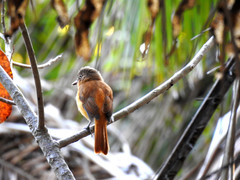
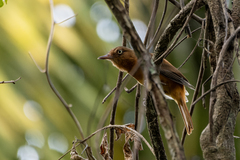
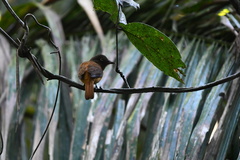
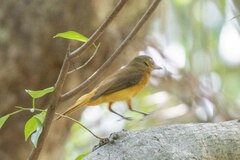

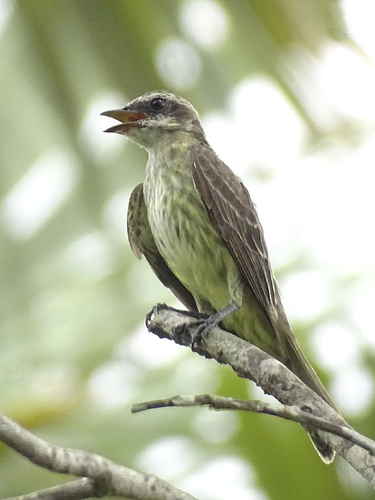
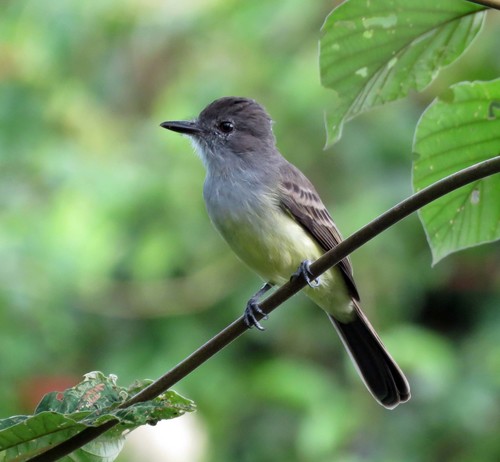
Dull-capped Attila

Dull-capped Attila

Attila bolivianus

Silhouette: Emily Willoughby · PhyloPic

LCLeast ConcernNTVUENCR
Daily sighting probability ~10% · With luck
at Manu National Park

In 3 days ~20% in a week ~30%

239 Verified sightings at Manu National Park From 2019 to 2026
563 In all 4 parks
September Best month
☀️ Diurnal When it's spotted

About the Dull-capped Attila

The white-eyed attila or dull-capped attila (Attila bolivianus) is a species of bird in the passerine family Tyrannidae, the tyrant flycatchers. It is found in Bolivia, Brazil, Colombia, and Peru. The white-eyed attila was first described by French ornithologist Frédéric de Lafresnaye in 1848. From early in the twentieth century until the 1970s many authors classified genus Attila in family Cotingidae; after that it was recognized as belonging to family Tyrannidae.

Its specific and suspecific epithets bolivianus derive from the country Bolivia. The subspecific epithet "nattereri" honors the Austrian naturalist Johann Natterer. The white-eyed attila is 19 to 22 cm (7.5 to 8.7 in) long and weighs 40 to 45 g (1.4 to 1.6 oz). The sexes have the same plumage. Adults of the nominate subspecies have a grayish rufous-brown head. Their upperparts are mostly rufous-brown with a bright cinnamon-rufous rump and tail. Their wings are mostly rufous-brown with blackish greater coverts and primaries. Their chin is faintly grayish... Wikipedia →

Sounds

Song0:20

Brazil · 2024

© Ricardo José Mitidieri · XC953330 · CC BY-NC-SA 4.0

Call0:19

Brazil · 2024

© JAYRSON ARAUJO DE OLIVEIRA · XC884424 · CC BY-NC-SA 4.0

Recording0:13

Bolivia · 2020

© Ignacio Escobar · XC615168 · CC BY-NC-SA 4.0

Global Distribution

Parks Where Found

# Park Country Daily sighting probability
1 Tambopata National Reserve 🇵🇪 Peru
~10%
2 Manu National Park 🇵🇪 Peru
~10%
3 Amacayacu National Natural Park 🇨🇴 Colombia
~10%
4 Parque Estadual Encontro das Águas 🇧🇷 Brazil
<5%

Before you go

What are the chances of seeing a Dull-capped Attila in Manu National Park?

With luck

About 10% of wildlife watchers report a Dull-capped Attila sighting in Manu National Park on a given day, based on 239 verified sightings from GBIF citizen-science data from 2019 to 2026. It is the 258th most-seen of the 641 birds we can rate there. Over three days the chance rises to about 20%, and over a week to about 30%, if each day is a fresh chance.

When is the best time to see a Dull-capped Attila in Manu National Park?

May and September–November

In those months about 10% of wildlife watchers report a Dull-capped Attila in Manu National Park on a given day, against under 5% in June–August and December–April, the lowest months.

What time of day is best to see a Dull-capped Attila?

Between 7 and 10 am

Across all the parks we cover, that three-hour window holds the most Dull-capped Attila sightings with a recorded time, and about 8 in 10 of them come between 6 am and 6 pm: it is a daytime animal.

Is Manu National Park the best place to see a Dull-capped Attila?

Among the best

Of the 4 parks where we can rate Dull-capped Attila sightings, Manu National Park ranks 2nd at about 10%, level with the leaders once rounded. The best odds are in Tambopata National Reserve (Peru, about 10%).

Where does the Dull-capped Attila sighting chance come from?

GBIF citizen-science records

It is estimated from how often the Dull-capped Attila is recorded against all the birds logged in Manu National Park (239 verified sightings from 2019 to 2026), calibrated against known sighting rates. Figures are rounded to the nearest 10% because citizen-science data supports honest approximations, not decimals, and months with records from fewer than five people show "—". How it works.

← Back to Manu National Park