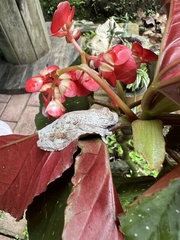
Marbled Tree Frog

Marbled Tree Frog

Dendropsophus marmoratus

Silhouette: Dmitry Bogdanov (vectorized by T. Michael Keesey) · PhyloPic

LCLeast ConcernNTVUENCR
Daily sighting probability ~10% · With luck
at Manu National Park

In 3 days ~20% in a week ~40%

6 Verified sightings at Manu National Park From 2019 to 2026
17 In all 2 parks
January Best month
🌙 Nocturnal When it's spotted

About the Marbled Tree Frog

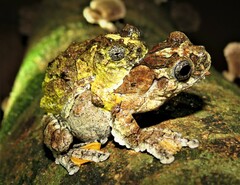
Dendropsophus marmoratus (the marmorea frog or South American bird poop frog) is a species of frog in the family Hylidae. It is found in the Amazon rainforest and montane forests in the eastern piedmont in Bolivia, Brazil, Colombia, Ecuador (Morona Santiago, Napo, Orellana, Pastaza, and Sucumbíos provinces), French Guiana, Guyana, Peru, Suriname, and Venezuela.

Its natural habitats are subtropical or tropical moist lowland forests, intermittent freshwater marshes, and heavily degraded former forest. The species is threatened by habitat loss. Dendropsophus marmoratus is a medium-sized frog. The snout–vent length in males averages 35.8 mm with a range of 29.8–41.5 mm, and in females the average is 47.7 mm with a range of 46.5–49.7 mm.

According to Duellman, the snout is round in dorsal and profile view. Eardrums are present. The outer finger of the hand has a membrane to the base of the disc; the other manual fingers have membranes along about 2/3 of their length. The toes also have membranes at the base of the discs. Males in reproduction lack cornified nuptial excrescences. Scalloped skin folds are present on the outer edges of the feet, forearms and hands. The... Wikipedia →

Sounds

Recording1:19

Suriname

© M.S. Hoogmoed · XC882750 · CC BY 4.0

Recording0:05

Ecuador · 2025

© Alex Bentley · iNaturalist · CC BY-NC 4.0

Global Distribution

Parks Where Found

# Park Country Daily sighting probability
1 Yasuní National Park 🇪🇨 Ecuador
~10%
2 Manu National Park 🇵🇪 Peru
~10%

Zoos & Centres Where Found

# Zoo / Centre Country
1 Toledo Zoo 🇺🇸 United States In captivity
2 Florida Aquarium 🇺🇸 United States In captivity
3 Snake Discovery: A Reptile Experience 🇺🇸 United States In captivity

Before you go

What are the chances of seeing a Marbled Tree Frog in Manu National Park?

With luck

About 10% of wildlife watchers report a Marbled Tree Frog sighting in Manu National Park on a given day, based on 6 verified sightings from GBIF citizen-science data from 2019 to 2026. It is the 61st most-seen of the 67 amphibians we can rate there. Over three days the chance rises to about 20%, and over a week to about 40%, if each day is a fresh chance.

When is the best time to see a Marbled Tree Frog in Manu National Park?

January

In that month about 20% of wildlife watchers report a Marbled Tree Frog in Manu National Park on a given day, against under 5% in February, April, June–October and December, the lowest months.

What time of day is best to see a Marbled Tree Frog?

Between 7 and 10 pm

Across all the parks we cover, that three-hour window holds the most Marbled Tree Frog sightings with a recorded time, and about 7 in 10 of them come between 6 pm and 6 am: it is mostly seen at night.

Is Manu National Park the best place to see a Marbled Tree Frog?

Among the best

Of the 2 parks where we can rate Marbled Tree Frog sightings, Manu National Park ranks 2nd at about 10%, level with the leaders once rounded. The best odds are in Yasuní National Park (Ecuador, about 10%).

Which relatives of the Marbled Tree Frog live in Manu National Park?

Same genus: Dendropsophus

The closest relatives of the Marbled Tree Frog that you can see in Manu National Park (genus Dendropsophus, Yellow Tree Frogs) are Inotawa Tree Frog (about 20%), Red-skirted Tree Frog (about 20%) and Mottled Clown Treefrog (about 10%), with each one's daily chance of a sighting.

Where does the Marbled Tree Frog sighting chance come from?

GBIF citizen-science records

It is estimated from how often the Marbled Tree Frog is recorded against all the amphibians logged in Manu National Park (6 verified sightings from 2019 to 2026), calibrated against known sighting rates. Figures are rounded to the nearest 10% because citizen-science data supports honest approximations, not decimals, and months with records from fewer than five people show "—". How it works.

← Back to Manu National Park