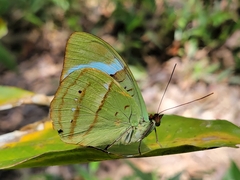
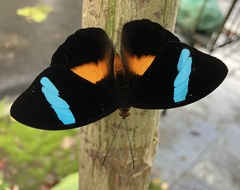
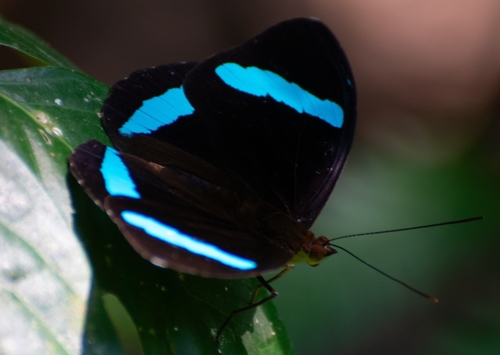
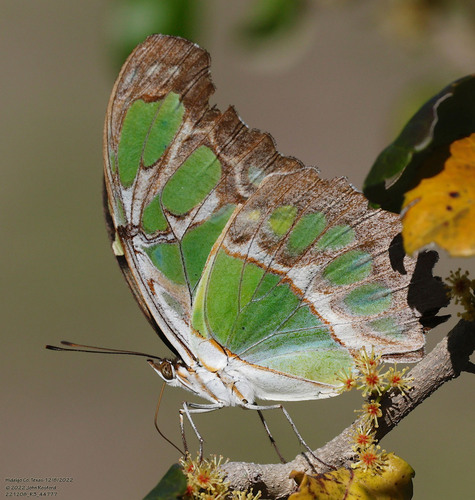
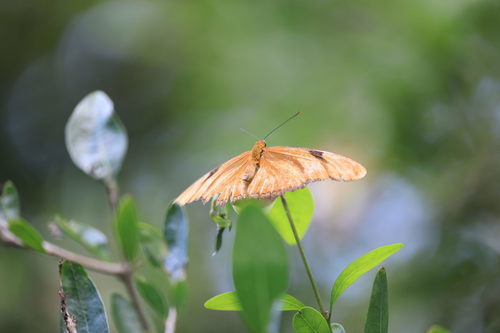
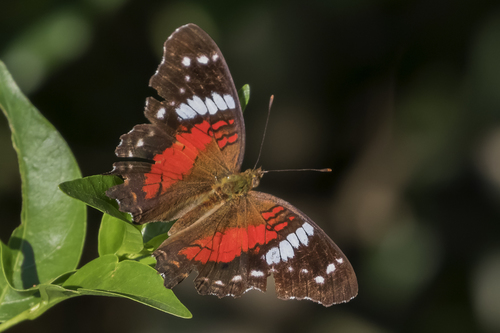
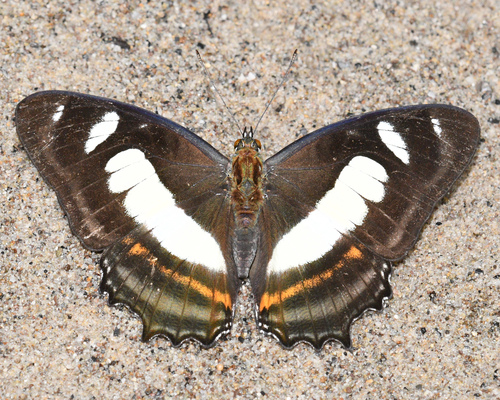
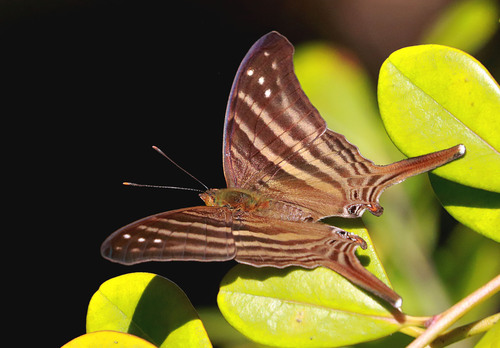
Obrinus Olivewing

Obrinus Olivewing

Nessaea obrinus

Daily sighting probability ~20% · Possible
at Manu National Park

In 3 days ~50% in a week ~80%

45 Verified sightings at Manu National Park From 2019 to 2026
53 In all 2 parks
September Best month
☀️ Diurnal When it's spotted

About the Obrinus Olivewing

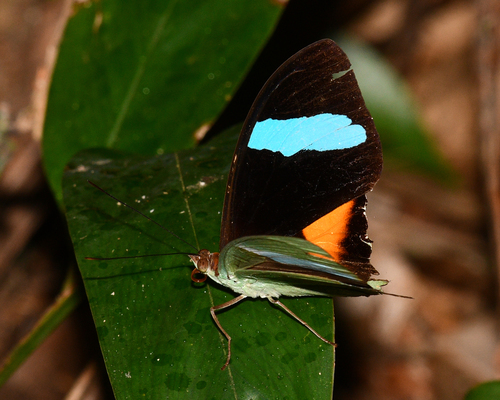
Nessaea obrinus, the obrina olivewing, is a species of butterfly of the family Nymphalidae. It is found from Colombia and the Guianas to the mouth of the Amazon and south to central Bolivia and Mato Grosso in Brazil, extending to northern Argentina.

The length of the wings is 25–40 mm for males and 26–41 mm for females. Adults of subspecies obrinus are on wing in January and from July to November. Adults of subspecies faventia are on wing year round, but mainly from June to October and adults of subspecies lesoudieri are on wing year round, with no observed peak of abundance.

Obrina Olivewing butterflies are very unusual because they are one of the few animals with actual blue pigment. Most other species get their blue coloration from a process called coherent scattering, in which scattered light waves interfere to create a blue color. All the other species of Nessaea get their blue coloration from the pigment pterobilin. Pterobilin also provides blue for Graphium agamemnon, G. antiphates, G. doson, and G. sarpedon. Other butterflies in Graphium and Papilio (specifically P. phorcas and P. weiskei) use the blue pigments phorcabilin and sarpedobilin.

��2�... Wikipedia →
Global Distribution

Parks Where Found

# Park Country Daily sighting probability
1 Manu National Park 🇵🇪 Peru
~20%
2 Tambopata National Reserve 🇵🇪 Peru
~10%

Before you go

What are the chances of seeing an Obrinus Olivewing in Manu National Park?

Possible

About 20% of wildlife watchers report an Obrinus Olivewing sighting in Manu National Park on a given day, based on 45 verified sightings from GBIF citizen-science data from 2019 to 2026. It is the 13th most-seen of the 366 insects we can rate there. Over three days the chance rises to about 50%, and over a week to about 80%, if each day is a fresh chance.

When is the best time to see an Obrinus Olivewing in Manu National Park?

September–October and December

In those months about 30% of wildlife watchers report an Obrinus Olivewing in Manu National Park on a given day, against under 5% in April and June, the lowest months.

What time of day is best to see an Obrinus Olivewing?

Between 9 am and noon

Across all the parks we cover, that three-hour window holds the most Obrinus Olivewing sightings with a recorded time, and about 8 in 10 of them come between 6 am and 6 pm: it is a daytime animal.

Is Manu National Park the best place to see an Obrinus Olivewing?

Yes

Of the 2 parks where we can rate Obrinus Olivewing sightings, Manu National Park has the highest daily chance: about 20%. Next come Tambopata National Reserve (Peru, about 10%).

Where does the Obrinus Olivewing sighting chance come from?

GBIF citizen-science records

It is estimated from how often the Obrinus Olivewing is recorded against all the insects logged in Manu National Park (45 verified sightings from 2019 to 2026), calibrated against known sighting rates. Figures are rounded to the nearest 10% because citizen-science data supports honest approximations, not decimals, and months with records from fewer than five people show "—". How it works.

← Back to Manu National Park